
LLMs in Healthcare:
Use Cases, Top Models, and Safe Deployment in Clinical Workflows
Introduction: LLMs in Healthcare
Large Language Models (LLMs in healthcare) are AI systems trained on massive text corpora to understand, summarize and generate human-like language. In healthcare, LLMs are increasingly used as assistive copilots-helping clinicians, administrators and research teams work more efficiently with complex clinical text.
Healthcare data is highly unstructured and time-consuming to process: progress notes, discharge summaries, radiology reports, referral letters, prior authorizations and patient education materials. This is precisely where LLMs in healthcare deliver value.
However, LLMs can produce confident but incorrect outputs (hallucinations). Therefore, safe healthcare deployment requires governance, human review, audit trails and strong data security.
At AI India Innovations, we design healthcare AI systems where LLMs support clinicians-not replace them.

How LLMs in healthcare Are Used?
Documentation Automation
- Drafting SOAP notes, discharge summaries, referral letters and operative notes
- Structuring free-text into templates (problems, medications, allergies)
- Reducing administrative burden when integrated with EHR workflows
EHR Summarization & Chart Review
- Condensing long patient histories into structured timelines
- Highlighting missing context such as pending labs or overdue screenings
Assistive Clinical Decision Support
- Retrieving guideline snippets with citations
- Generating differential diagnosis suggestions and care pathway checklists
(Always assistive-not autonomous)
Patient Communication & Education
- Generating patient-friendly explanations in local languages
- Conversational triage assistants with escalation and safety guardrails
Medical Coding & Billing Support
- Suggesting ICD and CPT codes
- Flagging missing documentation for billing completeness
- Automating prior authorization drafts
Research & Pharmacovigilance
- Literature summarization and evidence extraction among LLMs in healthcare
- Monitoring adverse event reports and clustering similar cases
Operations & Quality Improvement
- Summarizing incident reports among LLMs in healthcare
- Drafting root-cause analyses
- Assisting with SOPs, policies and training material
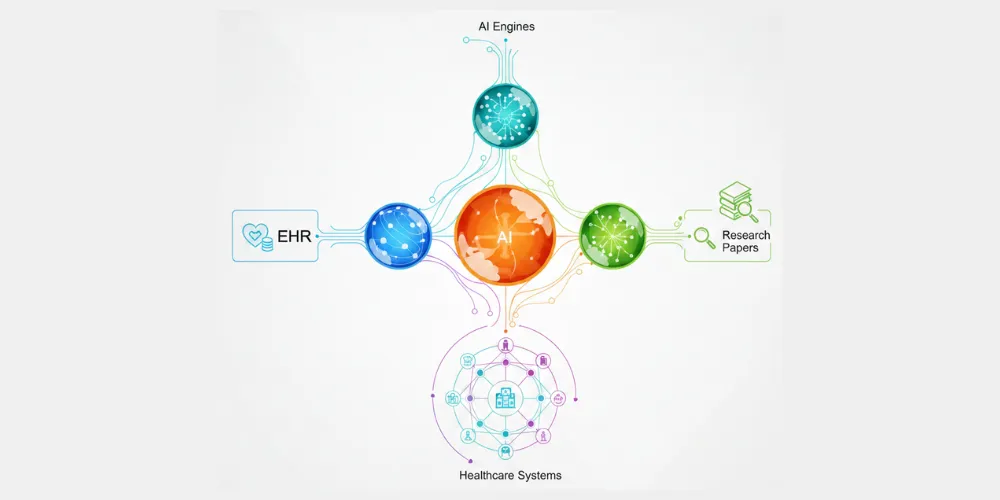
Top LLM Models Used in Healthcare (Overview)
LLMs in healthcare availability and licensing evolve rapidly-this is a conceptual and architectural guide, not a vendor endorsement.
Strengths
- High-quality reasoning and summarization among LLMs in healthcare
- Enterprise-grade workflow automation
Cautions
- Not medical-specific by default
- Requires guardrails and human validation
Strengths
- Healthcare-oriented variants (MedLM)
- Strong integration with Google Cloud healthcare stack
Cautions
- Enterprise-focused access among LLMs in healthcare
- Governance still required
Strengths
- Long-context handling
- Useful for compliance and policy documents
Cautions
- Not medically trained by default
Strengths
- Open-weights
- On-prem and private cloud deployment
Cautions
- Requires fine-tuning and MLOps maturity
Strengths
- Efficient, multilingual LLMs in healthcare
- Smaller compute footprint
Cautions
- Needs healthcare-specific evaluation
6. Technology Innovation Institute – Falcon
Strengths
- Local deployment for data control
Cautions
- Model quality varies by version
7. Google Research – Med-PaLM 2
Strengths
- Medical Q&A and reasoning benchmarks
Cautions
- Limited public access
8. Microsoft Research – BioGPT
Strengths
- Biomedical literature analysis
Cautions
- Less suitable for patient-facing use
9. ClinicalBERT (Clinical NLP Family)
Strengths
- Structured extraction from clinical notes
Cautions
- Not a conversational model
10. Medical ASR + LLM (Ambient Documentation)
Strengths
- Speech-to-notes automation with reduced clinician typing burden
Cautions
- ASR errors propagate downstream
- Requires strict privacy controls
Comparative Overview of LLMs in healthcare Applications
| Model/ Family | Medical-Specific | Open Weights | Best Fit (Typical Use Cases) | |
|---|---|---|---|---|
1 |
GPT-4 / GPT-4o |
No (General) |
No |
Documentation, Summarization, AI assistants |
2 |
Gemini / MedLM |
Partial / Yes (MedLM) |
No |
EHR Workflows, Clinical Text Tasks |
3 |
Claude |
No (General) |
No |
Long Documents, Compliance, Policies |
4 |
Llama 3 |
No (General) |
Yes |
Custom Fine-Tuned Healthcare Co-Pilots |
5 |
Mistral |
No (General) |
Some |
Efficient Multilingual Assistants |
6 |
Falcon |
No (General) |
Yes |
On-Premise / Private Deployment Needs |
7 |
Med-PaLM 2 |
Yes |
No |
Medical Q&A, Research Reference |
8 |
BioGPT |
Yes (Biomedical) |
Yes |
Biomedical Literature & Research Tasks |
9 |
ClinicalBERT |
Yes (Clinical Notes) |
Yes |
EHR NLP Extraction, Classification |
10 |
Medical ASR + LLM |
Yes (Workflow) |
Varies |
Speech-To-Notes, Ambient Documentation |
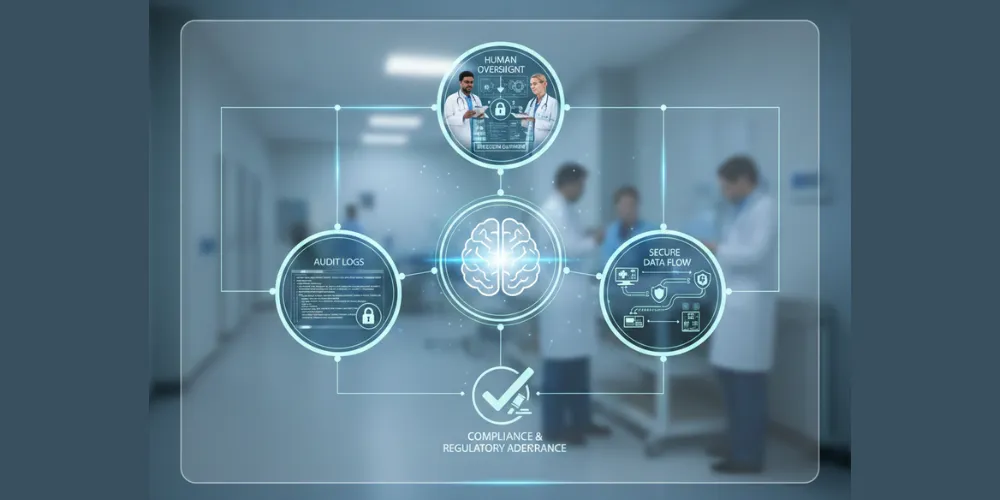
Safety, Governance & Compliance
- Safe LLMs in healthcare deployment requires:
- Human-in-the-loop review
- Confidence thresholds and refusal logic
- Audit logs and explainability
- Secure data handling (HIPAA / local compliance)
- Clinical validation and evaluation
- LLMs should assist decision-making-not make clinical decisions.
Conclusion: LLMs in healthcare
LLMs in healthcare are transforming documentation, research, operations and patient communication. When deployed responsibly, they act as powerful copilots that reduce administrative burden while preserving clinical authority.
At AI India Innovations, we build healthcare-grade AI systems grounded in safety, governance and real-world clinical workflows-not hype. You can read about our works in our Blogs section on our page. Happy Reading!
