
IBM Granite and OpenAI Whisper: ASR Model Comparison
Introduction
Think about the last time you spoke to your phone and saw your words appear as text within a second. It feels like magic. Behind it is an ASR (Automatic Speech Recognition) model working in real time.
ASR now powers voice notes, bank call transcription, and searchable meeting records. In each case one question matters: how accurately can a machine turn speech into text?
Two popular open-source options are OpenAI Whisper Large-v3 and IBM Granite Speech 4.1 2B. Both turn audio into text, but they are built very differently.
1. From Voice to Text: How Does a Machine Do It?
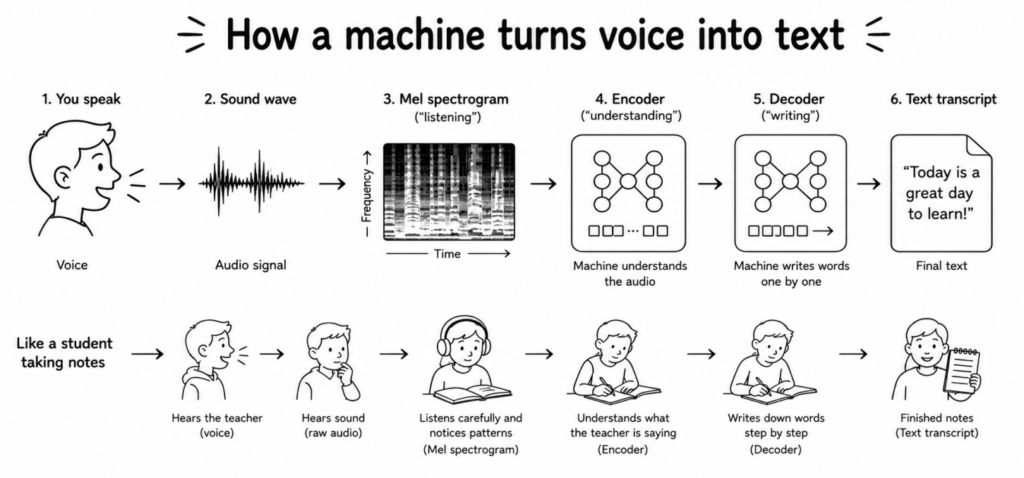
A computer does not hear "Please book the meeting for 3 PM tomorrow." It receives a long line of numbers. Imagine a student taking notes: they listen, understand, then write it down. An ASR model does the same three jobs:
- Listening: Sound becomes a log-Mel spectrogram, a colourful map of which pitches are loud or soft at each moment.
- Understanding (encoder): A neural network finds patterns such as sounds, syllables, and rhythm.
- Writing (decoder): A second network writes text one token (a word or word piece) at a time, based on the audio and the words already written.
2. OpenAI Whisper Large-v3: Architecture Explained
Whisper is a classic encoder-decoder Transformer with about 1.55 billion parameters and support for 99 languages. It can transcribe, translate into English, and detect the spoken language.
How audio flows through Whisper Large-v3
Key components in simple words
- 30-second window: Audio is processed in fixed 30-second chunks; long-form quality depends on your inference library.
- 128-bin Mel spectrogram: Up from 80 in earlier versions, giving the encoder a finer view of the sound.
-Encoder and decoder: The encoder converts audio into representations; the decoder writes tokens one by one, guided by special tokens for language, task, and timestamps.
How Whisper was trained
Whisper uses weak supervision on web-scale data: about 1 million hours of weakly labelled and 4 million hours of pseudo-labelled audio. OpenAI reports 10% to 20% fewer errors than Large-v2. The benefit is robustness to accents and noise; the trade-off is that web transcripts are imperfect, which can cause hallucinated text.
3. IBM Granite Speech 4.1 2B: Architecture Explained
Dify for Visual RAG and AI Agent Apps
Granite Speech 4.1 2B is a speech-aware language model. Speech models can also become components within broader Agentic AI solutions, where voice input is processed and passed into intelligent workflows or actions.Instead of a classic encoder-decoder, IBM connects a speech encoder to a text LLM through a small bridge. It was released on 29 April 2026 under the Apache 2.0 licence.
The three main components
- Speech encoder: 16 Conformer blocks trained with CTC, using block attention over 4-second audio blocks.
- Speech projector (Q-Former): A 2-layer query transformer that compresses audio to a 10 Hz embedding rate for the LLM.
- Language model: A granite-4.0-1b-base checkpoint with 128k context, fine-tuned on speech using LoRA adapters.
How audio flows through Granite Speech 4.1 2B
What makes Granite different
- Prompt-driven: Ask in plain text for raw text, punctuated text, or translation.
- Keyword biasing: Pass names, acronyms, and technical terms in the prompt, such as Keywords: kw1, kw2.
- Safe fallback: If the prompt is unfamiliar or malformed, the model simply transcribes.
4. Side-by-Side Comparison
| Parameter | IBM Granite Speech 4.1 2B | OpenAI Whisper Large-v3 |
|---|---|---|
| Architecture | Conformer CTC encoder + Q-Former + Granite LLM | Encoder-decoder Transformer |
| Parameters | About 2B | About 1.55B |
| Encoder | 16 Conformer blocks, dual CTC heads | Transformer encoder on Mel spectrogram |
| Decoder | Granite LLM (autoregressive text generation) | Transformer decoder |
| Input features | 80 log-Mel, stacked to 160 dim | 128-bin log-Mel, 30-second window |
| Output | Text; punctuation, keyword biasing, translation via prompt | Text with optional timestamps; transcribe or translate to English |
| Languages | English, French, German, Spanish, Portuguese, Japanese | 99 languages |
| Training data | About 174,000 hours (public and synthetic) | About 1M hours weakly labelled + 4M hours pseudo-labelled |
| English accuracy (Open ASR Leaderboard) | Mean WER 5.33 (April 2026) | Mean WER about 7.4 (leaderboard snapshot, March 2026) |
| Throughput (RTFx) | 231 reported on the leaderboard | About 69 on the leaderboard (Nov 2025) |
| Streaming | Not documented as a streaming model | Not designed for streaming; 30-second windows (streaming wrappers exist) |
| Hardware | Roughly 4 GB for weights in bf16; GPU recommended | About 10 GB VRAM in fp16 per OpenAI; smaller with quantisation |
| Deployment options | Transformers, vLLM, llama.cpp (GGUF), MLX for Apple Silicon | Transformers, faster-whisper, whisper.cpp, many managed APIs |
5. Accuracy, Latency and Streaming
On the English-focused Open ASR Leaderboard, Granite reports a lower error rate and higher throughput. But this is mostly English benchmark data. It does not guarantee better results in a noisy office or on Indian-accented speech. Whisper's strength is breadth: many languages and code-mixed speech.
Both models are mainly offline transcribers, and neither is documented as streaming-first. Live captions need extra engineering such as audio chunking, voice activity detection, and careful buffering. In production applications, the resulting transcription can also be connected to downstream business processes using n8n workflow automation.
6. Fine-Tuning and Customisation
Generic ASR models often stumble on technical terms, product names, and regional accents. Both models can be fine-tuned: Whisper is widely adapted with Hugging Face tools, and IBM provides a fine-tuning notebook for Granite, with Apache 2.0 making commercial use straightforward.
Practical advice: start with prompting or keyword biasing, move to LoRA for domain and accent adaptation, and consider full fine-tuning only if the results justify the cost.
You will need verified audio-transcript pairs from real recording conditions, diverse speakers and accents, consistent rules for terms and numbers, and a held-out test set.
7. Other Whisper and Granite Models
- Whisper Large-v3-Turbo: About 809M parameters with 4 decoder layers; faster and lighter, with a small accuracy trade-off.
- Granite Speech 4.1 2B-Plus: Adds speaker-attributed transcripts and word-level timestamps for calls and meetings.
- Granite Speech 4.1 2B-NAR: A faster non-autoregressive design for large batch jobs, without translation or Japanese.
Conclusion
Whisper Large-v3 and Granite Speech 4.1 2B solve the same problem in different ways. Whisper gives you wide language coverage, a mature ecosystem, and a trusted base for fine-tuning. Granite offers a compact speech-aware LLM, strong English results, keyword biasing, and an open licence. Public benchmarks cannot replace testing on your own audio. Check domain terms, Indian accents, and noise, add voice activity detection, human review, and strong privacy controls, and either model can become a reliable part of your product.
Frequently Asked Questions
IBM Granite Speech 4.1 2B uses a speech encoder connected to a language model, while Whisper Large-v3 uses an encoder-decoder Transformer architecture. Granite is designed around a speech-aware LLM approach with features such as keyword-list biasing, while Whisper provides broad multilingual speech recognition and translation capabilities.
Granite Speech 4.1 2B is designed for English, French, German, Spanish, Portuguese, and Japanese speech-to-text and speech translation involving English. IBM's model documentation lists these languages for the model's intended speech applications.
Whisper Large-v3 supports 99 languages for speech recognition. It can also perform speech translation into English. This gives Whisper substantially broader language coverage than Granite Speech 4.1 2B.
Benchmark results can show differences in throughput, but inference speed depends on the hardware, runtime, quantization, batch size, and implementation. IBM reports Granite Speech 4.1 2B results on the Open ASR Leaderboard, including a mean WER of 5.33 in its April 2026 evaluation. These benchmark results should be treated as reference measurements rather than guarantees for every deployment.