AI-Powered PPE Detection:
Turning CCTV Cameras into a Real-Time Workplace Safety System
Introduction
A missing helmet, an unfastened vest or a pair of absent gloves rarely causes harm on its own. The danger is that nobody notices. On a large factory floor, no supervisor can watch every worker, in every zone, across every shift. Safety checks end up being periodic, manual and reactive: violations are often discovered only after an incident or during the next audit.
Cameras are already installed in most industrial sites. The opportunity is to make them do more than record. In this blog we walk through how we built an AI-powered PPE detection system that turns ordinary CCTV feeds into a continuous safety layer: detecting protective equipment in real time, raising alerts the moment a violation happens, tracking compliance and worker efficiency and presenting everything on a live dashboard.
The goal is simple: move safety from "checked occasionally" to "monitored continuously", without adding a single person to the shop.
Why Manual Safety Monitoring Falls Short
Traditional PPE enforcement depends on people: supervisors walking the floor, safety officers running spot checks and periodic audits. These methods work, but they have structural limits.
- Coverage gaps: A supervisor can only be in one place at a time. Large plants, multiple shifts and remote zones go partly unobserved.
- Inconsistency: Checks vary by person, time of day and workload. Fatigue and distraction affect even diligent inspectors.
- Delayed response: Violations are logged after the fact. By the time a report is reviewed, the risky moment has passed.
- No usable data: Paper checklists and verbal warnings do not produce trends. It is hard to say which zone, shift or PPE item is the weak spot.
- Audit pressure: Proving compliance to clients and regulators needs a reliable, timestamped record, which manual processes rarely produce.
AI-based monitoring addresses each of these. A model never gets tired, applies the same rules to every frame, reacts in seconds and records everything it sees.
The Solution at a Glance
Our system connects four stages into one automated chain: cameras capture the work area, an AI vision model analyses each frame, violations trigger automatic alerts and results flow into a dashboard for reporting and decision-making.
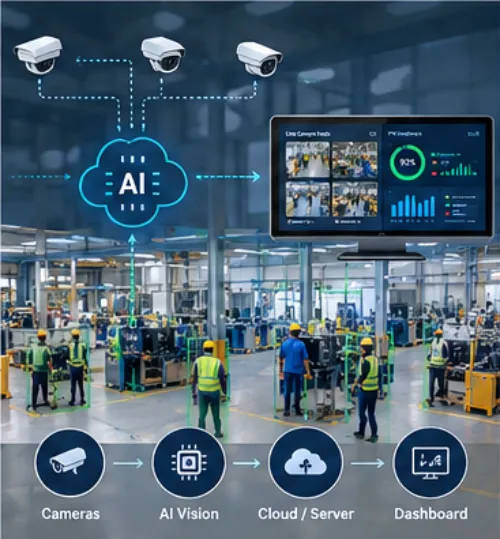
The same cameras that were installed for general surveillance now feed the AI model. No special wearables or tags are needed on workers. Everything is inferred from the video.
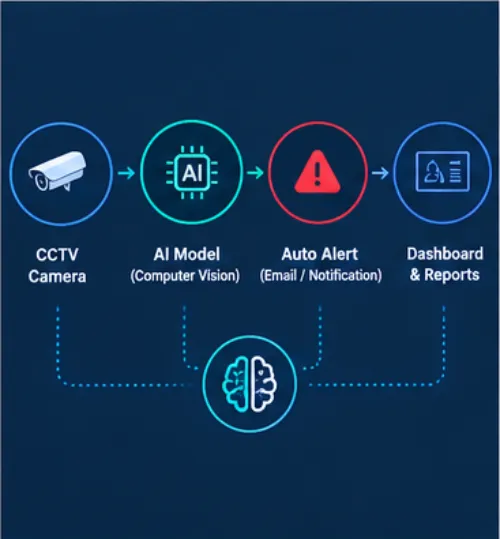
- CCTV camera. Live video streams are captured from cameras covering entry points, production lines, storage areas and other zones where PPE is mandatory.
- AI model (computer vision). Frames are analysed by an object detection model that finds people and checks whether each required PPE item is present and worn correctly.
- Auto alert. When a violation is confirmed, the system immediately sends a notification by email or messaging, with the camera name, time and a snapshot.
- Dashboard and reports. Every detection and alert is logged, so safety teams can see live status, history and trends in one place.
Reducing false alarms
Raw detections are not enough. A person walking past a camera for a single frame or partly hidden behind a machine, should not trigger an alarm. We add a rules layer on top of the model: a violation must persist across several consecutive frames or for a defined number of seconds, before an alert fires. Zone-specific rules also matter, because a helmet may be mandatory on the production floor but not in the office corridor.
PPE Detection: What the AI Sees
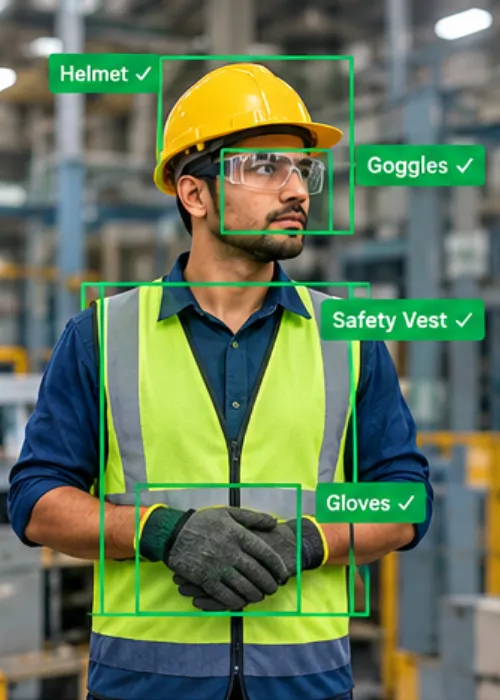
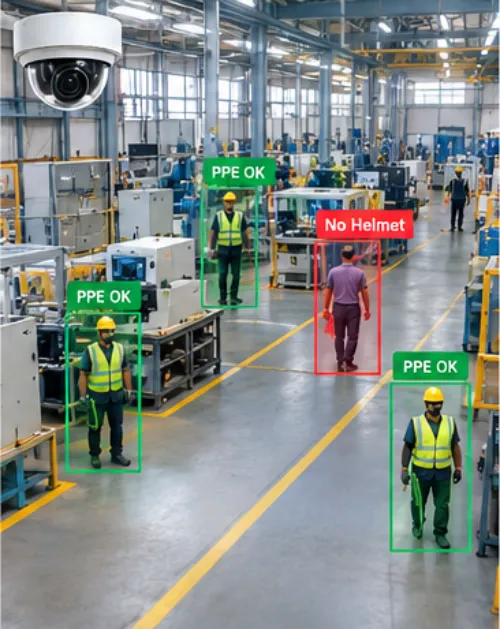
The detection model is trained to recognise both the worker and the individual PPE items. For each person it checks a set of required classes and marks them as compliant or non-compliant.
| PPE Item | What It Protects Against? | Sample compliance* |
|---|---|---|
Helmet |
Head injuries from falling objects and impact |
96% |
Safety Vest |
Low visibility around vehicles and moving machinery |
94% |
Safety Shoes |
Crush, puncture and slip injuries to the feet |
93% |
Gloves |
Cuts, abrasion, heat and chemical contact |
90% |
Goggles |
Dust, sparks and splashes reaching the eyes |
88% |
Real-Time Safety Monitoring on the Shop Floor
Detection is most valuable when it works across a whole scene, not just on one person standing close to the lens. In a typical camera view, several workers appear at different distances, some walking, some operating machines, some partly occluded by equipment.
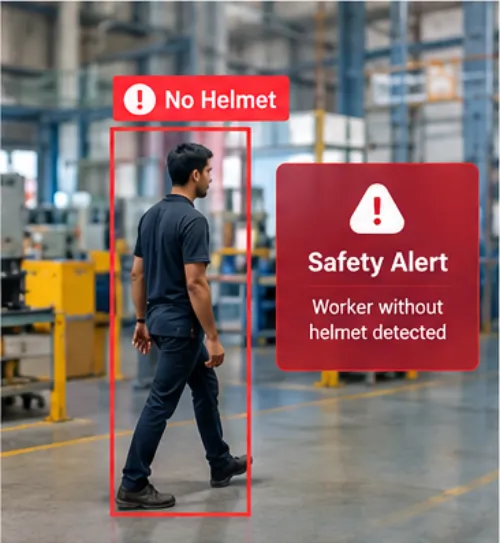
Each person is tracked and labelled. Green boxes mean every required item is detected; a red box with a label such as "No Helmet" means a violation. Because the labels are drawn directly on the live feed, a safety officer glancing at a monitor understands the situation in a second.
Challenges we plan for
- Occlusion: Workers behind machinery or other people. Tracking across frames helps maintain identity even when part of the body is hidden.
- Distance and size: Small figures far from the camera are harder to classify. Camera placement and resolution matter as much as the model.
- Lighting: Glare, shadows and low-light zones. Training on varied lighting conditions and tuning confidence thresholds reduces misses.
- Look-alikes: A yellow cap versus a yellow helmet or a bright shirt versus a vest. Good negative examples in the dataset teach the model the difference.
From Detection to Action: Automated Safety Alerts
Seeing a violation is only half the job. Safety improves when someone acts on it quickly. That is why alerting is built directly into the pipeline.
When a violation passes the rules layer, the system automatically:
- Creates an alert with the violation type, camera, zone and timestamp.
- Attach a snapshot so the reviewer can verify instantly.
- Sends the notification by email or message to the supervisor or safety officer responsible for that zone.
- Logs the event so it appears in compliance reports and trend charts.
This closes the loop. Instead of a violation being noticed hours later, the right person is informed within seconds and can intervene while the worker is still in the area.
Automation does not replace the safety officer. It removes the watching, so that people can spend their time on prevention.
Compliance Monitoring: Continuous and Audit-Ready
Every detection becomes a data point. Over time, those data points turn into a clear picture of how well the site follows its PPE policy, replacing sporadic audits with a continuous, measurable record.
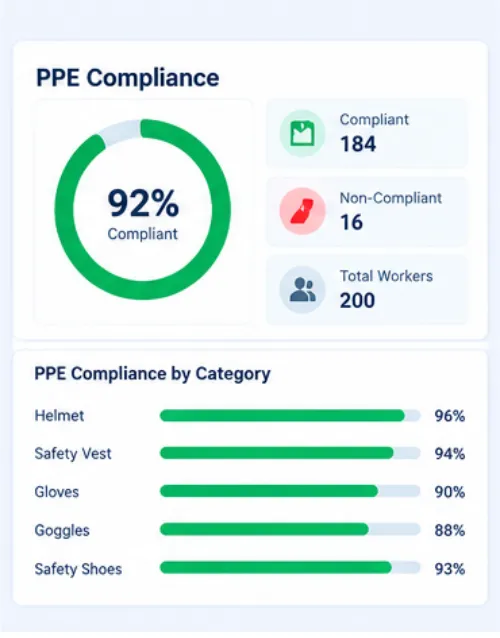
In the sample dashboard above, 184 of 200 workers are compliant, giving an overall compliance rate of 92%. The category-wise bars add the detail that a single number hides: helmets and vests are strong, while goggles trail at 88%. That points the safety team to the exact area that needs attention, perhaps a targeted reminder, better availability of goggles or a closer look at the zones where eye protection is required.
What compliance data lets you do
- Compare zones, shifts and teams to find where problems cluster.
- Track whether training campaigns and policy changes actually improve behaviour.
- Produce timestamped evidence for client audits and regulatory inspections.
- Set targets, such as raising goggle compliance above a chosen threshold and measure progress.
Efficiency Monitoring: Beyond Safety
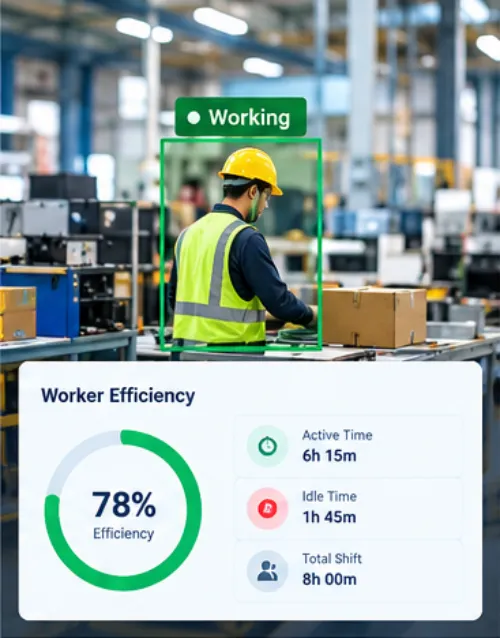
The same video that verifies PPE can also describe how work is flowing. By recognising whether a worker is active at a workstation or idle, the system adds an efficiency view alongside the safety view.
In the example shown, a worker is active for 6 hours 15 minutes of an 8-hour shift, with 1 hour 45 minutes idle, which works out to 78% efficiency. At an aggregate level, this kind of data helps managers spot bottlenecks, such as waiting for material, machine downtime or uneven task allocation and improve layout and scheduling.
Using efficiency data responsibly
Efficiency analytics should be framed as a process-improvement tool, not as surveillance of individuals. Idle time often reflects a system problem (a delayed delivery, a broken machine) rather than a worker problem. We recommend focusing on zone-level and team-level trends, being transparent with employees about what is measured and complying with local privacy and labour regulations.
Real-Time Dashboard Insights
All of the information above comes together on a single dashboard, so decision-makers do not have to piece together reports from different sources.
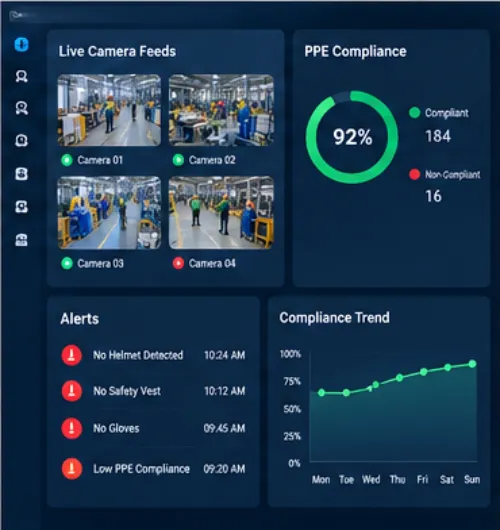
Live camera feeds. Thumbnails of key cameras give an instant visual check of the floor.
PPE compliance panel. The headline compliance percentage with compliant and non-compliant counts, updated as new detections arrive.
Alerts list. A running log of violations such as "No Helmet Detected", "No Safety Vest" and "No Gloves", each with a time, so the most recent issues are always visible.
Compliance trend. A line chart across the week shows whether compliance is rising or slipping, which is the clearest signal of whether safety initiatives are working.
Each widget answers a question a safety manager actually asks: What is happening right now? Where are the violations? Are we getting better? From one screen, the answers are available in seconds.
Deployment, Impact and What Comes Next
Where the AI runs?
The AI vision stage can run on a server or in the cloud, as in the architecture shown earlier or directly at the edge on a compact GPU device such as an NVIDIA Jetson placed near the cameras. Edge processing reduces latency, lowers bandwidth use and keeps raw video on site, which is often important for data privacy. The right choice depends on the number of cameras, network quality and security requirements.
The Impact
- Safer workplaces: Violations are caught and corrected in the moment, not after an incident.
- Lower manual effort: Safety teams spend less time watching and more time acting.
- Audit-ready records: Every event is logged with time, location and evidence.
- Data-driven decisions: Trends by zone, shift and PPE type replace guesswork.
- Operational insight: Efficiency data highlights bottlenecks that also affect productivity.
What is next?
PPE detection is a strong foundation. The same camera network and AI platform can be extended to detect fire and smoke, equipment faults, restricted-zone entry and unsafe behaviour and to feed predictive analytics that flag risk before an incident occurs. Because the pipeline is modular, new detection models can be added without rebuilding the system.
Conclusion
Workplace safety does not have to depend on someone happening to look in the right direction. By combining cameras that are already in place with computer vision, automated alerts and a live dashboard, we at AI India Innovations can monitor PPE compliance and efficiency continuously, respond in seconds and learn from the data.
Frequently Asked Questions
AI-powered PPE detection is a computer vision technology that uses CCTV cameras and AI to automatically identify whether workers are wearing required personal protective equipment such as helmets, safety vests, gloves, masks, and safety goggles.
AI PPE detection uses computer vision models to analyze live CCTV footage, recognize workers and their protective equipment, and detect PPE compliance in real time. When missing or incorrect PPE is identified, the system can trigger an alert for the safety team.
Depending on the AI model and training, PPE detection systems can identify safety helmets, reflective vests, gloves, face masks, goggles, safety shoes and other protective equipment. The system can be customized based on the specific safety requirements of a workplace.
Yes. AI-powered PPE detection provides continuous, automated monitoring and can help safety teams identify PPE violations faster. This can reduce dependence on manual inspections, improve compliance and support a more proactive workplace safety strategy.
Yes, AI-powered PPE detection can often be integrated with existing CCTV infrastructure, depending on camera quality, positioning and system compatibility. This allows businesses to add AI-based workplace safety monitoring without necessarily replacing their entire surveillance setup.