
Handwritten Hospital Form Digitization: Converting English and Marathi Paper Forms into Digital Records
Introduction
Handwritten hospital form digitization is helping redefine how hospitals can manage patient registration paperwork by converting handwritten English and Marathi forms into structured digital records. At busy registration counters, staff often spend valuable time reading patient details from paper forms and manually entering them into hospital systems. AI India Innovations is developing an AI-powered OCR solution to simplify this process by reading photographed forms, identifying key information, checking questionable entries and preparing records for staff review.
The objective is straightforward: reduce repetitive data entry while making patient information easier to organize, verify and retrieve. Rather than asking hospitals to abandon their existing paper forms immediately, the solution is designed to help bridge the gap between familiar paperwork and digital record management.
Why hospitals need a smarter way to process handwritten forms
Paper registration forms remain a practical part of hospital workflows, particularly where patients complete forms at registration desks, outpatient departments, admission counters and healthcare camps. However, the work does not end when a patient submits a form. Someone must read the handwriting, interpret tick marks, enter details into a computer and check that the information has been recorded correctly.
This becomes more challenging when forms contain a mixture of English and Marathi text. Patient names, addresses, dates of birth, contact numbers and other personal details may be handwritten differently by each individual.
Common challenges include:
- Repetitive manual entry: Staff must type information already available on paper.
- Difficult handwriting: Some characters and digits can look very similar, making accurate transcription harder.
- Photographed forms: Images captured on mobile phones may be tilted or unevenly lit.
- Complex form layouts: Individual boxes, address lines, tick marks and overwritten selections require careful interpretation.
- Scattered paper records: Locating an older registration form can take time when documents are stored physically.
A single incorrect digit in a phone number or an incorrectly recorded date can create avoidable follow-up work. Hospitals therefore need more than basic text extraction; they need a process that combines recognition, validation and human verification.
Introducing AI India Innovations' handwritten hospital form digitization solution
AI India Innovations is developing an AI-based hospital form digitization system that reads handwritten registration forms in English and Marathi and converts the captured information into organized digital records.
The workflow begins with a photograph of a completed form. The system prepares the image for processing, recognizes handwritten details field by field in their original language, checks for potential inconsistencies and presents uncertain entries for review by hospital staff.
One important distinction is that the solution is designed to recognize the language in which the information was written, rather than translate it into another language. This helps preserve the original patient details while making them available in a consistent digital structure.
The goal is to make digitization more practical for everyday hospital operations, including situations where paper forms are still part of the registration process.
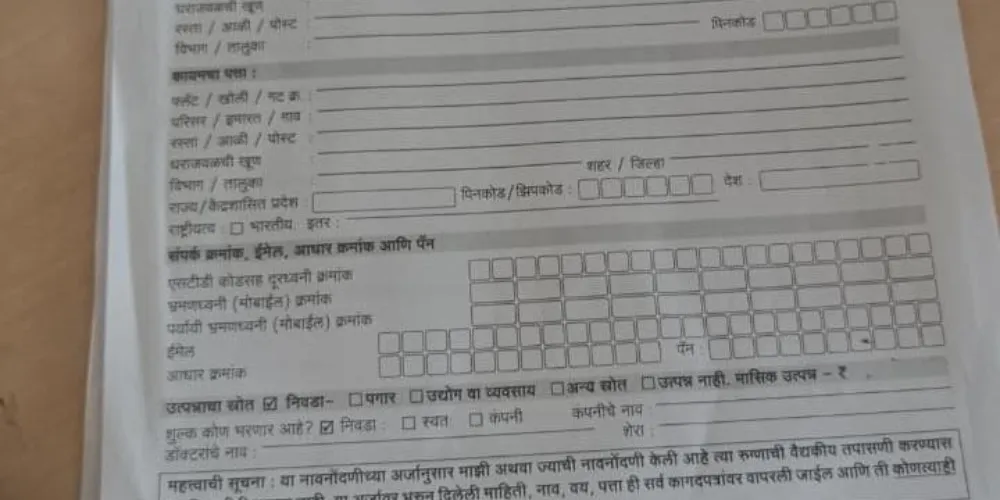
The registration form, with its boxes, tick marks and address lines. Patients fill these in by hand.
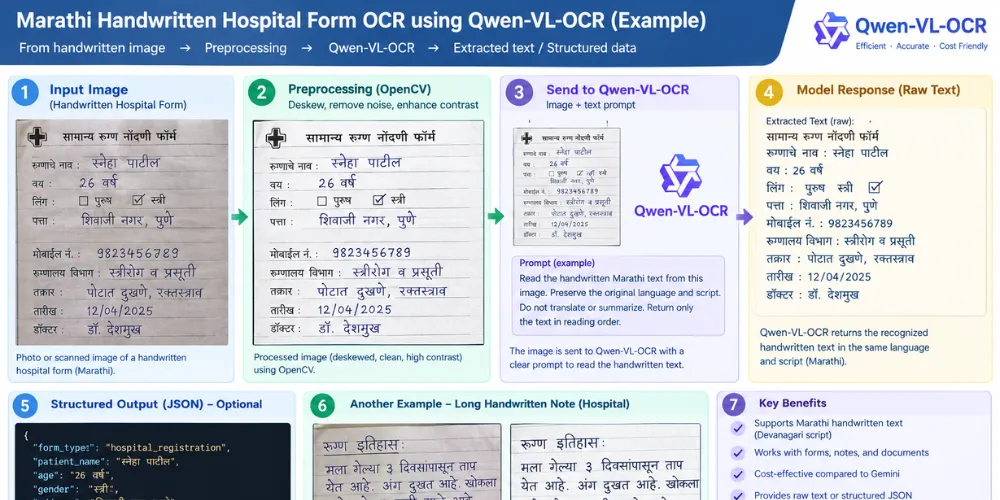
Sample workflow: from a photo of the handwritten form to readable text and a clean digital record.
Key features of the AI-powered hospital OCR system
1. Handwriting recognition in English and Marathi
The system is designed to read handwritten patient information in both languages, including forms where English and Marathi appear together. It processes fields in their original language without translating the entries.
2. Processing photos taken on mobile phones
Hospitals do not always have scanned copies of completed forms. The workflow accepts photographs and prepares images by straightening tilted pages and improving brightness before handwriting recognition.
3. Field-wise extraction of patient information
Patient details are captured according to the form's structure, including names, date of birth or age, addresses, contact details, identity proof, title, gender, billing responsibility, consent declarations and signatures.
4. Automatic validation of questionable entries
The system checks for obvious issues, such as a phone number containing too few digits and flags entries that need attention. These checks help identify potential mistakes before the record is finalized.
5. Human review for uncertain handwriting
When the system cannot confidently read a field, it marks the value as unreadable instead of guessing. Staff can review the flagged information and confirm or correct it before saving the record.
6. Structured and searchable digital records
Each processed form is organized into a consistent record layout, making important details easier to find and retrieve than information stored only on paper.
How the hospital form digitization process works
The system follows a practical workflow that moves from a paper form to a verified digital record.
01] Capture the form
Staff or the patient takes a photograph of the completed registration form.
02] Prepare the image
The system straightens the page and adjusts brightness to make handwriting easier to process.
03] Recognize handwritten fields
AI-based OCR reads the English or Marathi information in each field without translating it.
04] Validate the extracted details
Basic checks flag suspicious or incomplete values, such as a phone number with too few digits.
05] Review uncertain fields
Hospital staff verify flagged or unreadable information rather than relying on guess.
06] Save the digital record
The confirmed information is organized into a consistent record for later retrieval.
Benefits for hospitals and healthcare administration
Less repetitive data entry
Manual transcription requires staff to read every field and type it into a computer. Automating the initial extraction can reduce the amount of repetitive typing required, allowing staff to focus on reviewing information and supporting patients. The actual time saved will need to be measured during pilot testing.
Better handling of English and Marathi paperwork
A bilingual workflow is relevant to hospitals that receive forms completed in either language or a combination of both. Recognizing information in its original language can make digitization more suitable for local registration practices.
Earlier identification of potential errors
Basic validation checks can flag missing or suspicious values before records are finalized. Human verification remains important because handwriting recognition and automatic checks cannot guarantee that every extracted detail is correct.
Easier retrieval of patient information
A consistent digital record structure makes it easier to search for information than relying exclusively on physical files. This can support administrative tasks and reduce the effort involved in locating previously recorded details.
A practical route from paper to digital workflows
Hospitals can explore digitization without assuming that every existing paper form must immediately be replaced. The system is intended to work with photographs of familiar forms, helping bridge paper-based collection and digital record management.
More controlled access to sensitive information
Hospital forms contain personal information that needs careful handling. The planned access restrictions and masking of sensitive details can support privacy-conscious workflows when implemented and configured appropriately.
Where can handwritten hospital form OCR be used?
Although patient registration is the primary use case described for the solution, the same approach can be relevant to other paper-based healthcare workflows.
Patient registration desks
Digitize new forms and reduce the need to manually enter information already written on paper.
Outpatient departments and admissions
Capture details from completed at OPD counters or wards for subsequent review and record.
Health camps and community programmes
Digitize forms collected in the field, including batches of paperwork processed after camp.
Insurance and claim administration
Extract handwritten claim details into records that teams can review, verify and search.
Legacy paper record digitization
Convert older registration forms into structured records that can be searched conveniently.
For each use case, the final field mapping and review rules should be adapted to the relevant forms. Additional document types may require their own validation and processing configuration.
Conclusion: Making hospital paperwork easier to manage
Handwritten paperwork remains a part of everyday hospital operations, but manually transferring every patient detail into a digital system does not have to be the only approach. With AI-powered OCR, hospitals can work towards converting English and Marathi registration forms into structured digital records while using automated validation and staff review to handle uncertain information responsibly.
AI India Innovations, a Pune-based AI solutions company, develops customized AI solutions around real operational challenges. Our OCR capabilities are at the heart of this hospital form digitization initiative, bringing handwriting recognition, image processing and structured data extraction together in one workflow. For hospitals looking to modernize registration and document management, AI India Innovations can work with their teams to explore a solution aligned with their forms, processes and digitization requirements.
Frequently Asked Questions
Handwritten hospital form digitization is the process of converting information written on paper-based hospital forms into structured digital records. AI-based OCR can recognize handwritten details, extract individual fields, validate questionable entries and prepare records for human review and storage.
Yes, AI-based OCR systems can be designed to recognize handwritten English and Marathi text, including bilingual hospital registration forms. The solution developed by AI India Innovations is designed to process information in its original language without translating it, with uncertain fields flagged for staff verification.
AI-based hospital OCR processes a photograph of a completed form, improves image quality, recognizes handwritten fields and checks for potential errors such as incomplete phone numbers. Hospital staff can review unclear entries before the extracted information is saved as a structured digital record.
OCR-based hospital form digitization can reduce repetitive manual data entry, help identify incomplete or questionable information organize patient details consistently and make digitized records easier to search. Human verification remains essential for important patient information and actual efficiency gains depend on implementation and testing.
Yes. An OCR solution can be designed to process photographs taken with a mobile phone, rather than requiring every form to be scanned first. Image preparation, handwriting recognition, validation and human review can then help convert photographed English and Marathi hospital forms into structured, searchable records.