Doctor-to-Patient Clinical Summary System:
Turning Conversations Into Clinical Notes
Introduction
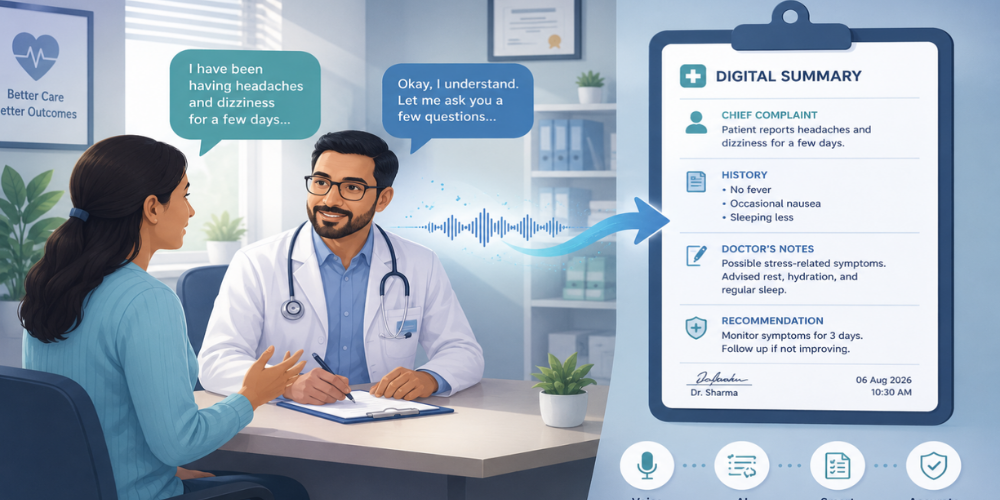
Doctor-to-Patient Clinical Summary System helps hospitals and clinics turn everyday consultations into clear, structured clinical notes without requiring doctors to manually write everything after the visit. In a busy outpatient department, doctors spend much of their time speaking with patients, understanding symptoms, discussing medical history and explaining the next steps. Once the consultation ends, however, the documentation still needs to be completed - taking additional time and creating the possibility of important details being missed.
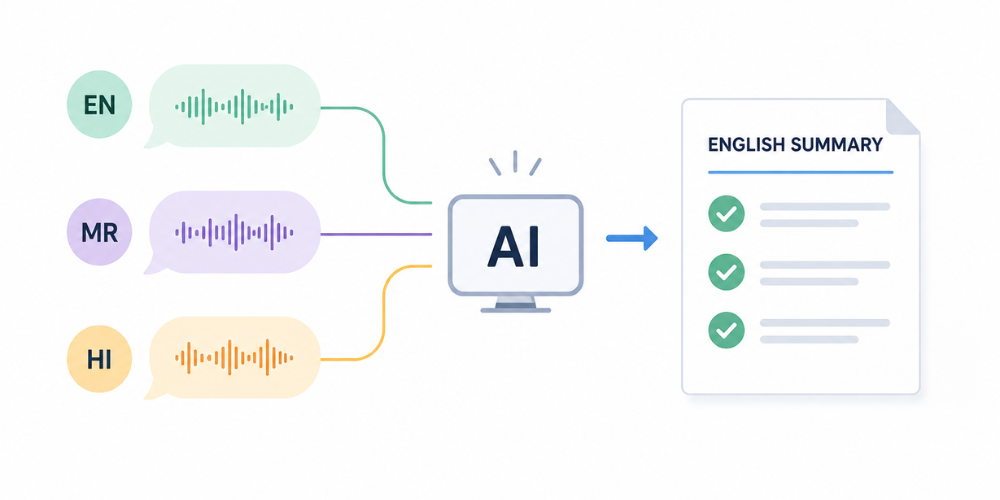
The challenge becomes even greater when consultations happen naturally across multiple languages. In many Indian hospitals, doctors and patients may move between English, Marathi and Hindi during the same conversation. There may also be nurses, relatives or other staff contributing to the discussion. AI can help turn this natural conversation into a structured clinical summary while keeping the doctor in control of the final record.
At AI India Innovations, we developed an AI Clinical Conversation Summary Assistant that listens to the consultation, identifies different speakers, extracts medically relevant information and generates a structured English summary for the doctor to review. The system can also be customized around the documentation format and workflow of individual hospital departments.
The Problem We Wanted to Solve
Outpatient consultations create a lot of valuable information, but capturing it accurately and consistently is difficult in practice.
– Doctors spend extra time after every consultation writing up notes manually.
– Conversations happen in English, Marathi, Hindi or a natural mix of these languages.
– A consultation often includes more than just the doctor and patient - nurses, relatives or other staff may also speak.
– Patient information is sensitive, so it must always stay fully private and protected within the hospital.
– Different departments record patient visits differently, so a single, one-size-fits-all note format does not work for everyone.
We set out to build a solution that could listen to a natural consultation, understand who is speaking and turn it into a clean, structured, English summary - tailored to each department's needs, without adding any extra work for the doctor.
Our Solution
Our application works quietly in the background during a consultation. The doctor simply starts it at the beginning of the visit and stops it at the end - there is nothing else to manage.
The application listens to the full conversation, understands what was said and identifies who was speaking - the doctor, the patient or anyone else present. It then reads through the conversation, picks out the medically important details and leaves out small talk or anything unrelated to the visit.
Finally, it organizes everything into a clear, structured summary - written in English regardless of the language spoken during the visit - and formatted to match the exact style each hospital department already uses.
Business Benefits and Impact
This solution delivers real, day-to-day value for hospitals, doctors and patients alike.
– Saves Doctor Time: Removes the need to manually write up notes after every consultation, freeing up more time in the day.
– Reduces Missed Details: Captures the full conversation, so important information is far less likely to be forgotten or left out.
– Works Across Languages: Supports natural conversations in English, Marathi and Hindi, without requiring doctors or patients to change how they speak.
– Keeps Records Consistent: Produces clean, standardized summaries that are easy to read, file and refer back to later.
– Protects Patient Privacy: Keeps all patient information secure and fully within the hospital's own control at all times.
Where It Can Be Used
While this solution was designed around outpatient consultations, it is well suited to a variety of healthcare settings.
– Outpatient Departments: Captures every consultation automatically, reducing paperwork for doctors seeing many patients each day.
– Multi-Specialty Hospitals: Adapts to different note formats needed across departments such as general medicine, pediatrics or orthopedics.
– Multilingual Communities: Especially valuable in regions where patients and doctors naturally converse in more than one language.
– Clinics and Small Practices: Gives smaller practices access to organized, professional clinical documentation without extra administrative staff.
– Teaching Hospitals: Provides clear, structured conversation records that can also support training and case review.
Conclusion
A Doctor-to-Patient Clinical Summary System can remove one of the most repetitive parts of a doctor's day without interfering with the consultation itself. By capturing the conversation, identifying speakers, picking out medically relevant information and converting it into a structured clinical summary, the system allows doctors to spend less time on documentation and more time focused on their patients. It is particularly useful in multilingual healthcare environments where consultations naturally move between English, Marathi and Hindi.
At AI India Innovations, we build customized healthcare AI and Speech AI solutions around the actual workflows of hospitals and clinics. Our Clinical Conversation Summary Assistant can be tailored to different departments, documentation formats, languages and deployment requirements while keeping patient information within the hospital's own environment. For healthcare organizations looking to reduce documentation workload while maintaining consistent and structured clinical records, customized AI-powered clinical summarization can be a practical step toward more efficient patient care.