AI-Powered Medical Prescription Assistant:
Turning Doctor Speech Into Digital Prescriptions
Introduction
AI-Powered Drug Entry System helps doctors create structured digital prescriptions simply by speaking them aloud. In hospitals and clinics, prescription entry can take valuable time during and after every consultation. Doctors may need to write prescriptions by hand, type medicine names into a hospital system or correct unclear entries before the prescription is finalized. This adds administrative work to an already busy clinical workflow.
The problem becomes more difficult when medicine names, dosages, frequencies and clinical terms have to be captured accurately. General-purpose voice-to-text tools are not designed specifically for medical language, which can result in incorrect drug names or misunderstood instructions.
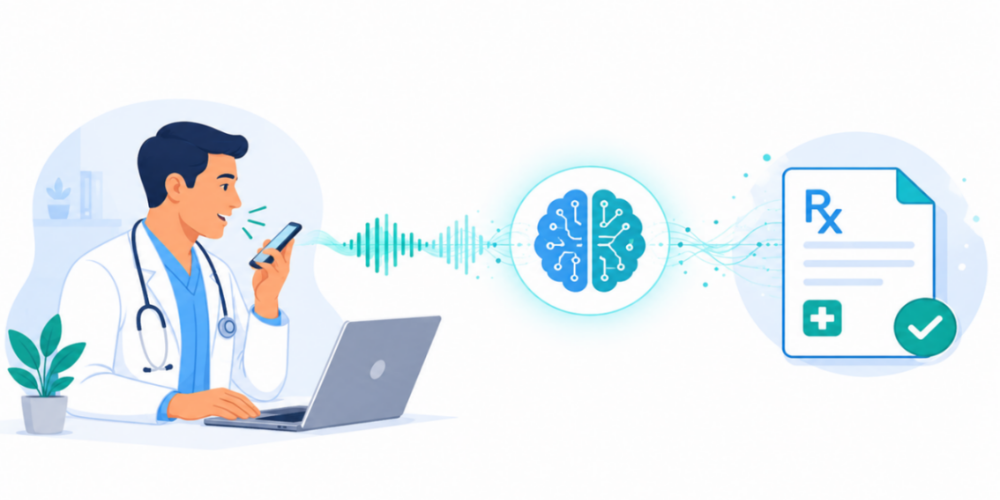
At AI India Innovations, we developed an AI-Powered Medical Prescription Assistant that is built specifically around this workflow. It listens to a doctor's natural speech, understands medical terminology and prescription instructions, verifies medicines against a trusted list and converts the spoken prescription into a clean, structured format that can be reviewed and integrated with existing hospital systems.
The Problem We Wanted to Solve
Hospitals and clinics handle an enormous number of prescriptions every day. This typically happens in one of two ways: doctors write prescriptions by hand or they type them into a computer between patient visits. Both approaches create challenges.
– Handwritten prescriptions can be hard to read and are prone to errors, especially with medicine names, dosages and frequencies.
– Typing prescriptions takes time away from patients and adds to a doctor's daily workload.
– Everyday voice-to-text tools are not built for medical language, so they often misunderstand drug names, dosages and clinical terms.
– Hospitals need organized, standardized prescription records to support recordkeeping, billing and reporting - not loose, free-form notes.
We set out to build a solution that could listen to everyday medical conversation and turn it into a clean organized, ready-to-use prescription - instantly and without slowing doctors down.
Our Solution
Our application listens to a doctor speaking naturally - the same way they would talk to a patient or colleague - and instantly turns that speech into a structured prescription. It understands medical terms, drug names, dosages and instructions, checks them against a trusted medicine list and produces a clean prescription that can flow directly into the hospital's records.
Because it is built for real hospital use rather than as a simple demo, it is designed to work reliably, stay secure and continue functioning smoothly even during heavy use across many doctors at once.
The application has been trained on thousands of real prescription phrases spoken by different voices, allowing it to recognize medical terminology and prescription patterns far more accurately than everyday voice-to-text tools.
Business Benefits and Impact
Beyond convenience, the application delivers real, measurable value to hospitals, clinics and the doctors who use it every day.
– Saves Time: A prescription that once took a minute or more to type can now be captured in the time it takes to say it out loud.
– Reduces Doctor Workload: Frees doctors from repetitive paperwork so they can spend more time focused on patients.
– Improves Accuracy and Clarity: Removes the guesswork of handwriting and reduces the chance of miscommunication over medicine names and dosages.
– Creates Cleaner Records: Produces consistent, well-organized prescription data that is easier to store, search and use for reporting and billing.
– Supports Better Patient Care: Gives doctors more direct attention time with patients instead of time spent on data entry.
– Scales With Your Organization: Works reliably whether it is supporting a single clinic or an entire hospital network.
Where It Can Be Used
While the application was designed with hospital prescriptions in mind, it is flexible enough to support a wide range of healthcare settings.
– Hospitals: Doctors can dictate prescriptions directly during patient rounds or outpatient visits, reducing time spent on paperwork.
– Clinics: Smaller practices can adopt organized digital prescriptions without needing dedicated administrative staff for data entry.
– Telemedicine: During remote consultations, a structured prescription can be created in real time and shared electronically with the patient or pharmacy.
– Electronic Health Records: Organized prescription data flows directly into patient records, making history easier to search and review.
– Prescription Modernization: Hospitals updating their prescription process can use this application as the layer that connects natural doctor speech to their existing systems.
– Clinical Documentation: The same technology can be extended to support broader note-taking and documentation needs across a healthcare organization.
Conclusion
An AI-Powered Drug Entry System can take a simple but time-consuming part of a doctor's workflow and make it significantly more efficient. Instead of manually writing or typing every prescription, doctors can speak naturally while AI captures the medicine names, dosages, frequencies and instructions and turns them into an organized digital prescription. This can reduce repetitive data entry, improve clarity and give doctors more time to focus on their patients.
At AI India Innovations, we build customized healthcare AI and Speech AI solutions designed around the real workflows of hospitals and clinics. Our AI-Powered Medical Prescription Assistant is built to understand medical terminology, verify medicines, generate structured prescriptions and integrate with existing healthcare systems while maintaining secure access. For organizations looking to modernize prescription entry without forcing doctors to change the way they work, customized AI-powered drug entry can be a practical step toward faster and more efficient clinical operations.