Automatic Detection & Tracking of Surgical Instruments Using AI
Introduction
Automatic Surgical Instrument Detection is helping bring a new layer of intelligence to operating rooms by using Computer Vision and Deep Learning to identify, count and track surgical tools in real time. Instead of relying entirely on manual counting and visual checks, AI-based systems can continuously monitor surgical instruments and provide an additional digital layer of verification throughout a procedure. The same computer vision capabilities can be extended to healthcare workflows such as medical document processing and OCR, including AI India Innovation’s own OCR technology for extracting information from scanned documents.
Why Surgical Instrument Tracking Matters
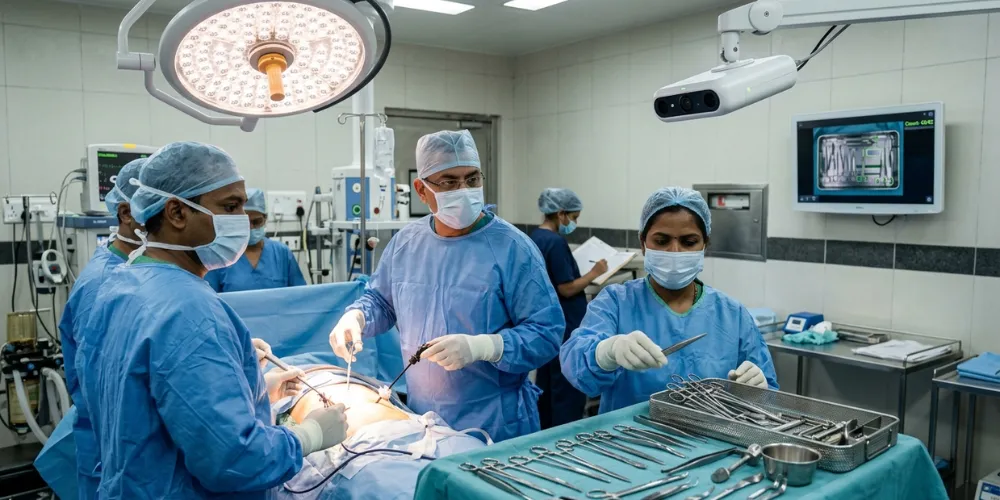
Surgical procedures involve numerous instruments that move between the sterile tray, surgical field and operating-room staff. As procedures become longer or more complex, maintaining an accurate count can become increasingly difficult.
The problem is not necessarily that surgical teams lack established safety procedures. Manual surgical counts, checklists, communication protocols and verification processes remain important. The challenge is that humans can become fatigued, distracted or interrupted, particularly during lengthy procedures.
The consequences of an unintentionally retained surgical item can be serious. The Joint Commission currently identifies unintended retention of a medical or surgical item after surgery or another invasive procedure as a serious reportable event and its 2026 guidance includes retained surgical instruments among the items covered.
This creates an opportunity for technology to work alongside existing clinical protocols rather than replace them.
Preventing Surgical Errors with AI-Based Instrument Tracking
A surgical instrument tracking system uses cameras, computer vision algorithms and Deep Learning models to monitor instruments within a defined area of interest.
The system can be designed to recognize different types of surgical tools and determine whether an instrument is present, removed, returned or missing from the monitored tray.
This is particularly useful when several instruments look similar or when multiple tools are being handled rapidly.
Common Challenges in Surgical Instrument Management
Infrequent but serious incidents
Retained surgical items are relatively uncommon, but when they occur, the consequences can be significant. The Joint Commission notes that unintended retention can result in anything from no detectable harm to serious harm or death.
Risk of infection and complications
An item unintentionally retained inside the patient can lead to complications and may require additional intervention. The risk depends on the type of item, its location and how long it remains undetected.
Fatigue and distractions
Long procedures can involve fatigue, interruptions, communication challenges and rapidly changing circumstances. These factors can make manual tracking more demanding.
Complex instrument workflows
Modern procedures can involve a large number of specialized instruments. Maintaining an accurate count manually throughout the procedure requires continuous attention from the surgical team.
AI-based monitoring does not eliminate the need for established surgical protocols. Instead, it can provide an additional, continuously running layer of monitoring.
How Automatic Surgical Instrument Detection Works
The core technology behind the system is Computer Vision combined with Deep Learning.
Cameras installed at suitable positions in the operating environment capture video of the defined monitoring area. The AI model analyzes the video frames and identifies instruments based on their visual characteristics.
A typical workflow can include:
Step-01: Camera Capture
High-resolution cameras continuously capture the designated surgical instrument tray or monitoring area.
Step-02: Instrument Detection & Classification
A trained Deep Learning object-detection model identifies surgical instruments appearing within the camera's field of view.
The system classifies detected objects into predefined instrument categories. For example, types of forceps, scissors, retractors, clamps or other tools depending on the training dataset.
Step-03: Tracking
Once detected, instruments can be tracked across successive video frames. This helps the system understand changes in the monitored area rather than treating every frame as an entirely new observation.
Step-04: Count and Status Verification
The detected instruments can be compared against an expected inventory or count. If an instrument disappears from the monitored area or the final count does not match the expected status, the system can flag the discrepancy.
Step-05: Dashboard and Alerts
Detection results can be displayed through a software dashboard, while alerts can potentially be connected to other applications or devices depending on the hospital's infrastructure and integration requirements.
A typical AI-based surgical instrument tracking system combines several components, from camera-based image capture and Deep Learning detection to automated counting, alerts and dashboard-based monitoring.
| Component | What It Does | Role in the Workflow |
|---|---|---|
Camera System |
Continuous video of instrument tray or monitoring area. |
Provides the visual input for AI analysis. |
Computer Vision |
Processes video frames & identifies instruments within defined AOI. |
Enables automated instrument detection. |
Deep Learning |
Classifies different surgical instruments based on their visual features. |
Distinguishes between instrument categories. |
Instrument Tracking |
Tracks detected instruments across consecutive video frames. |
Helps monitor instruments as removed or returned. |
Auto Counting |
Maintains the detected count and compares it with expected set. |
Helps identify potential count discrepancies. |
Dashboard |
Displays detected instruments, status info and results. |
Gives surgical or authorized staff real-time visibility. |
Alert System |
Generates an alert when a discrepancy is detected. |
Enables timely verification by responsible personnel. |
Time Monitoring |
Associates relevant events and video with timestamps. |
Supports traceability, review and workflow analysis. |
These components can be configured according to the hospital's surgical environment, instrument inventory and workflow requirements, allowing the system to function as an additional monitoring layer alongside existing surgical safety procedures.
What Our Surgical Instrument Detection Demo Shows
Our demonstration video illustrates how Computer Vision can identify multiple surgical instruments placed on an operating-room tray.
As the instruments are positioned within the camera's field of view, the AI system detects and visually marks them in real time. Different instruments are identified individually, demonstrating how an AI model can distinguish between multiple surgical tools within the same scene.
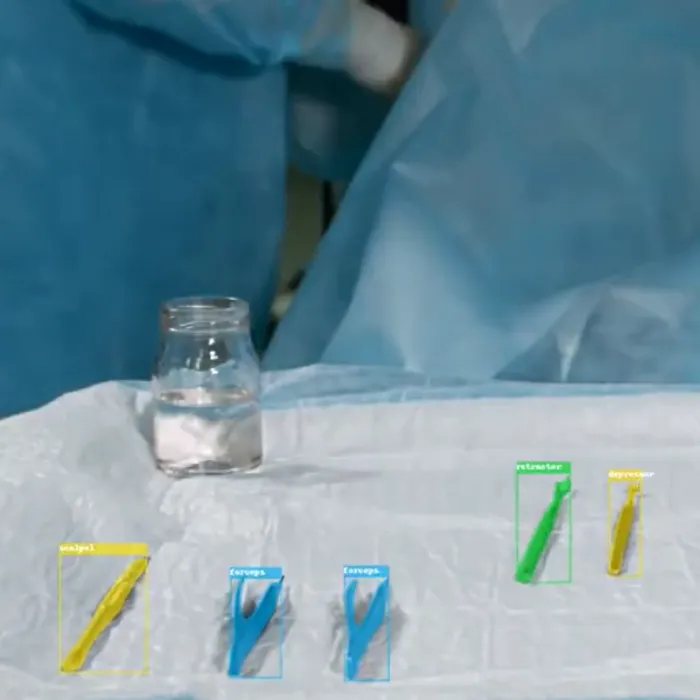
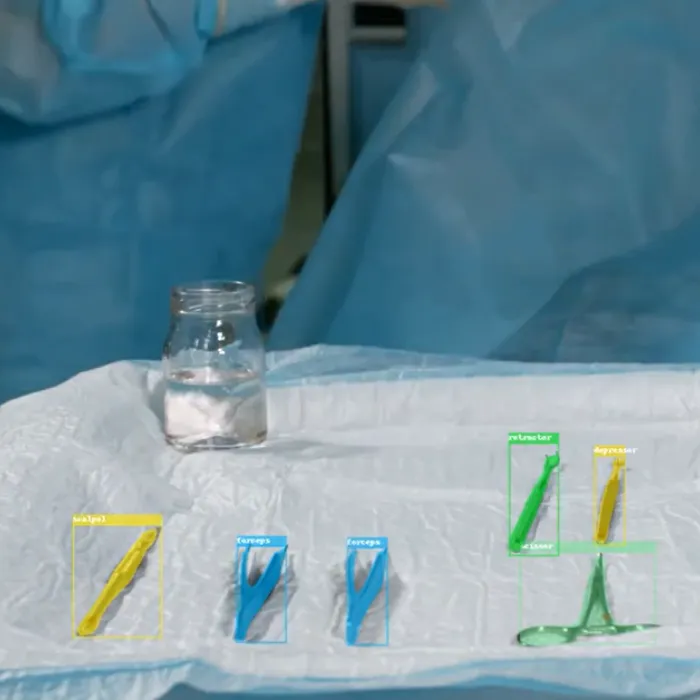
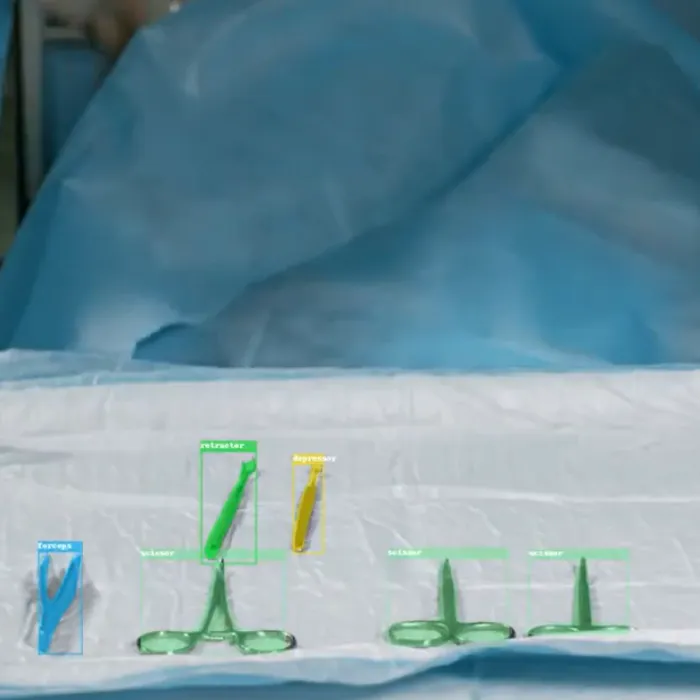
This type of detection forms the foundation for a larger surgical instrument tracking workflow.
In a production deployment, the system can be further customized for a hospital's instrument inventory, camera configuration, operating-room environment and required workflow. The Deep Learning model can also be trained or fine-tuned to recognize instrument categories specific to a particular surgical specialty.
Real-Time Monitoring of Surgical Instrument Trays
One practical application is continuous monitoring of the surgical instrument tray.
The tray can be treated as an Area of Interest (AOI) within the camera feed. The Computer Vision system continuously analyzes this region and maintains information about detected instruments.
For example, a workflow could establish an expected set of instruments before a procedure. During the operation, the system can monitor changes in the tray and update the digital status as instruments are removed or returned.
At the end of the procedure, the system can assist with the final verification by comparing detected instruments with the expected count.
This can create a digital audit trail in which video events and instrument-status information are associated with timestamps.
Alerts and Healthcare System Integration
Detection alone is only one part of the solution. The information generated by the AI system can be connected to a dashboard or alerting mechanism.
If a discrepancy is identified, an alert can be generated for authorized personnel. Depending on the hospital's technology architecture, notifications may be integrated with third-party software, monitoring systems or compatible medical-device communication infrastructure.
Any integration with clinical systems should be designed around the hospital's applicable security, interoperability, validation and regulatory requirements. Standards such as the ISO/IEEE 11073 family can be considered where applicable to medical-device communication and interoperability.
The exact integration architecture should therefore be determined according to the healthcare facility, devices involved and intended clinical workflow.
Benefits of AI-Based Surgical Instrument Tracking
Improved Instrument Count Accuracy
Automated visual detection provides an additional method for verifying instrument counts and identifying discrepancies.
Real-Time Visibility
Instead of checking the tray only at specific points, the system can continuously monitor the designated area and provide real-time information through a dashboard.
Reduced Dependence on Manual Monitoring
The goal is not to remove healthcare professionals from the process. Rather, AI can reduce repetitive visual monitoring and provide an additional digital checkpoint.
Timestamped Video Records
Relevant video can be stored with timestamps, creating a traceable record that can support internal review, quality improvement and workflow analysis, subject to the hospital's data-retention and privacy policies.
Lower Operational and Financial Risk
Preventing avoidable errors can help reduce the potential costs associated with additional procedures, investigations, operational disruption and liability.
Adaptable to Different Surgical Environments
Computer Vision models can be customized according to the instruments, camera angles, tray layouts, lighting conditions and workflows used by a particular healthcare facility.
Computer Vision Beyond Surgical Instrument Detection
The same Computer Vision infrastructure can support other healthcare automation use cases.
For example, AI can be used for various healthcare purposes. AI India Innovations also develops its own OCR capabilities that can be integrated into workflows where hospitals need to extract structured information from scanned medical or administrative documents.
This combination of Computer Vision, Deep Learning, OCR and workflow automation can help healthcare organizations build more connected digital processes rather than deploying isolated AI models.
Building Safer Surgical Workflows with AI
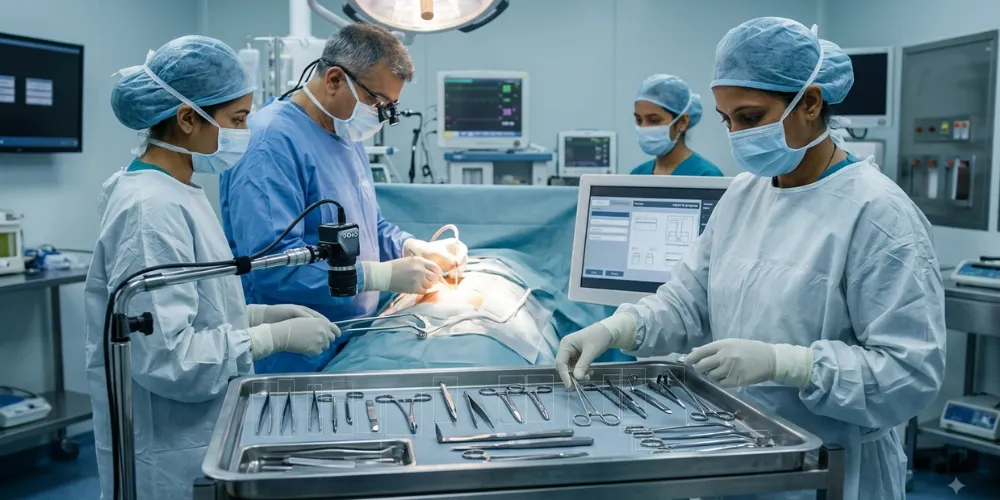
The value of surgical instrument detection is not simply in identifying an instrument on a screen. The bigger opportunity is to connect detection, tracking, counting, alerts, visualization and historical records into one workflow.
A hospital could use the system to establish an expected instrument set, monitor instruments during a procedure, flag discrepancies and support final verification.
Importantly, such technology should be viewed as a clinical decision-support and safety-assistance layer, not as a replacement for surgical teams, established counting procedures or clinical judgment.
The Joint Commission emphasizes that preventing surgical errors requires multiple complementary safety strategies and effective communication among members of the procedure team. AI-based instrument tracking can fit into that broader safety framework by adding continuous computer-based monitoring.
Conclusion
Automatic surgical instrument detection and tracking represents a practical application of AI in healthcare where Computer Vision can address a very specific operational challenge: maintaining better visibility of surgical instruments before, during and after a procedure. By combining real-time detection, Deep Learning-based classification, instrument tracking, automated counting, dashboards, alerts and timestamped monitoring, hospitals can add another layer of safety to existing surgical workflows.
AI India Innovations develops customized AI solutions for healthcare organizations, including Computer Vision systems for surgical instrument detection and tracking, as well as in-house OCR technology for intelligent document and data extraction. Our solutions can be adapted to the instruments, workflows, infrastructure and integration requirements of individual healthcare environments.