Evolution of YOLO:
A Complete Guide from YOLOv8 to YOLO26
Introduction
YOLO evolution has been one of the most significant developments in real-time computer vision. What started as a fast approach to object detection has gradually evolved toward more efficient architectures, attention-based feature processing, end-to-end inference and edge-first deployment.
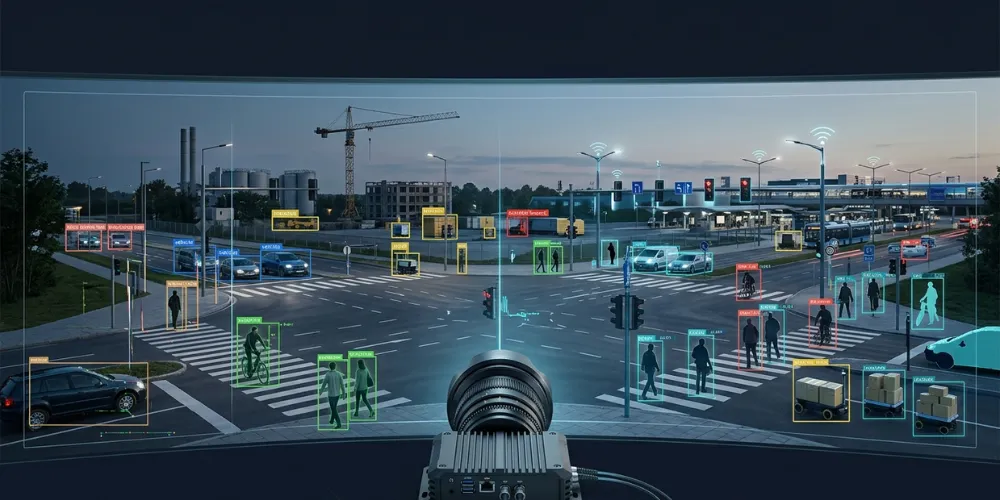
From YOLOv8's anchor-free detection and developer-friendly framework to YOLO26's focus on low-latency edge inference, each generation has addressed a different limitation of the models that came before it. This evolution is also closely connected to the growing demand for practical computer vision systems such as surveillance, smart cities, industrial inspection, traffic monitoring and automated visual analysis.
At AI India Innovations, we work on computer vision applications where accurate visual understanding needs to translate into a usable business solution. This includes custom OCR technology for extracting and processing information from images and documents, alongside other AI-based vision solutions.
So, what exactly changed between these YOLO generations? Let's break it down.
1. YOLOv8 (2023)
Introduction
Released by Ultralytics in early 2023, YOLOv8 established a strong baseline for real-time object detection, image classification and instance segmentation. It built on the advancements of earlier YOLO versions while introducing a more developer-friendly API and an anchor-free detection approach.
Why Was YOLOv8 Introduced?
One of the key goals was to move beyond the limitations of anchor-based detection while maintaining high inference speed. Earlier approaches relied heavily on anchor boxes, which could require dataset-specific tuning and create challenges with objects having extreme aspect ratios.
Architecture Overview
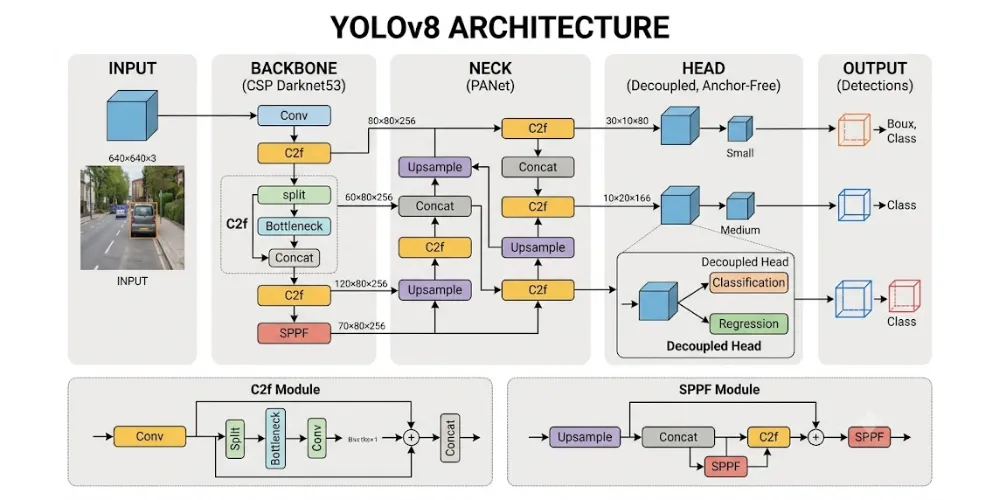
– Backbone: YOLOv8 uses a modified Darknet-based structure and replaces the earlier C3 module with the C2f (Cross Stage Partial Bottleneck with 2 convolutions) module. This improves gradient flow and feature representation without adding significant computational overhead.
– Neck: A Path Aggregation Network (PANet) is used to combine multi-scale features, allowing semantic information to reach different detection scales.
– Detection Head: YOLOv8 uses a decoupled, anchor-free detection head.
Main Innovations
– C2f Module: Combines high-level features with contextual information, improving gradient flow compared to the older C3 block.
– Anchor-Free Detection: Shifts from predicting anchor box offsets to center-based prediction, speeding up NMS (Non-Maximum Suppression) and improving generalization.
– Decoupled Head: Separates the localization and classification tasks, leading to faster convergence and higher accuracy.
Supported Tasks
YOLOv8 supports:
✓ Object Detection
✓ Instance Segmentation
✓ Image Classification
✓ Pose Estimation
✓ OBB Detection
It is available in Nano, Small, Medium, Large and Extra Large variants.
Key Limitation
Despite its speed and flexibility, YOLOv8 still relies on Non-Maximum Suppression (NMS) during inference. In dense scenes, this additional post-processing can introduce latency.
Sample Python Code
from ultralytics import YOLO

model = YOLO('yolov8n.pt')

results = model('image.jpg')
2. YOLOv10 (2024)
Introduction
YOLOv10 shifted the focus from simply improving detection accuracy to reducing the latency caused by post-processing. Developed by researchers at Tsinghua University, it introduced an end-to-end approach designed to eliminate NMS.
Why Was YOLOv10 Introduced?
Although previous YOLO models were already fast, NMS could create unpredictable latency, particularly on edge devices. YOLOv10 addressed this bottleneck by moving toward NMS-free object detection.
Architecture Overview
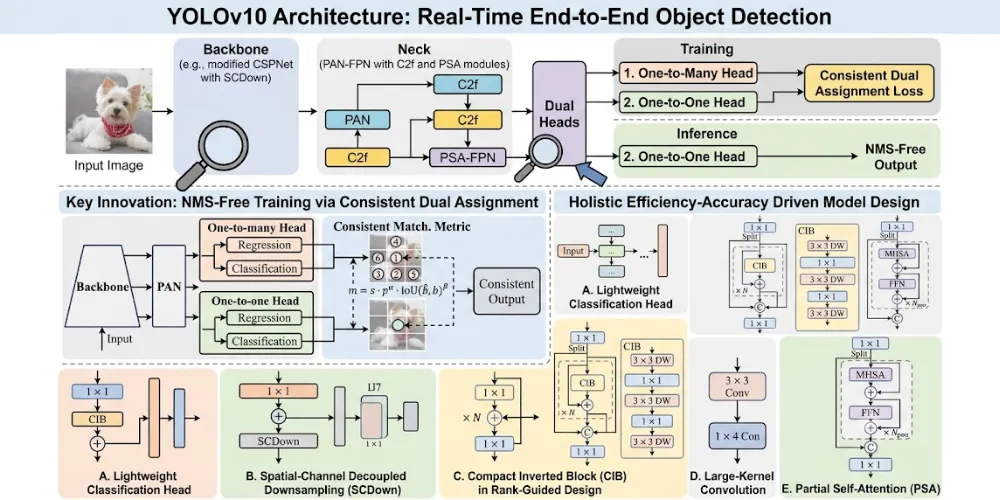
YOLOv10 introduced components such as SCDown, C2fCIB, Partial Self-Attention (PSA) and a dual-head detection architecture.
The dual-head design uses both one-to-many and one-to-one label assignments during training. During inference, the one-to-many head can be discarded, allowing the model to generate predictions without conventional NMS.
Main Innovations
– Consistent Dual Assignment: Provides rich supervision during training while enabling NMS-free inference.
– Rank-Guided Block Design: Removes redundant network components.
– Partial Self-Attention: Captures global context without applying attention to the entire feature map.
Performance
According to the source material, YOLOv10-B reduced latency by 46% compared with YOLOv9-C while maintaining similar mAP. Its main advantages include NMS-free inference, consistent speeds and fewer parameters.
Supported Tasks
Primarily optimized for Object Detection.
3. YOLO11 (2024)
Introduction
YOLO11 returned to Ultralytics' standard naming convention while focusing on efficiency and feature extraction. The model was designed to achieve improved accuracy with fewer parameters compared with YOLOv8.
Architecture Overview
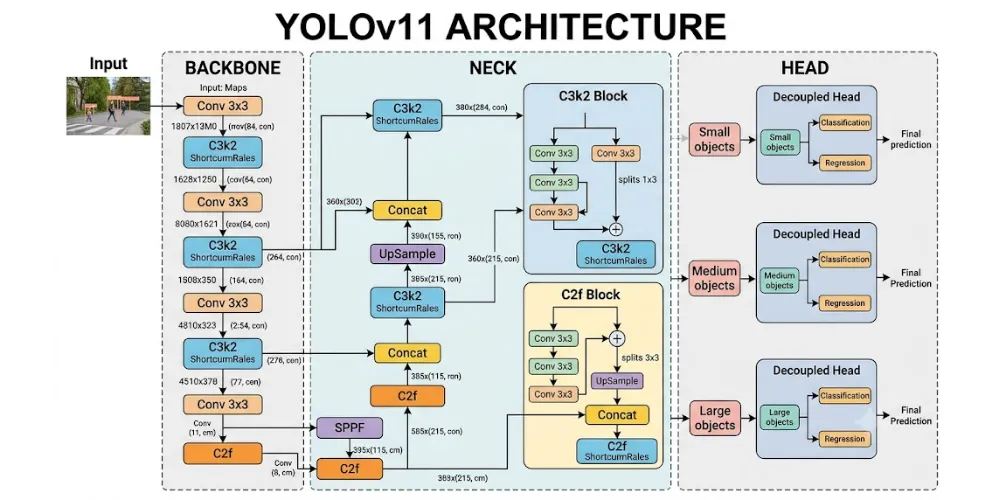
The backbone replaces the C2f blocks with C3k2 blocks, which improve feature extraction while optimizing parameter usage.
The neck integrates C2PSA (Cross Stage Partial with Spatial Attention) with SPPF, giving the model a stronger ability to focus on important spatial regions.
Main Innovations
– C3k2 Block: An optimized evolution of the C3 structure designed to improve feature representation while controlling parameter usage.
– C2PSA: Adds spatial attention to help the model focus on important regions, which can be particularly useful when objects are partially hidden or surrounded by complex backgrounds.
Performance
The source reports that YOLO11m achieves higher COCO mAP with 22% fewer parameters than YOLOv8m. It also maintains support for detection, segmentation, classification, pose estimation and OBB detection.
Its main limitation is that, unlike YOLOv10, it still uses NMS during inference.
4. YOLOv12 (2025)
Introduction
YOLOv12 represents a shift toward an attention-centric architecture. Instead of relying primarily on conventional CNN-based feature extraction, it combines attention mechanisms with the speed requirements of real-time detection.
Why Was YOLOv12 Introduced?
The objective was to bring the global-context understanding associated with Transformer-style architectures into real-time object detection without the heavy computational cost normally associated with them.
Architecture Overview
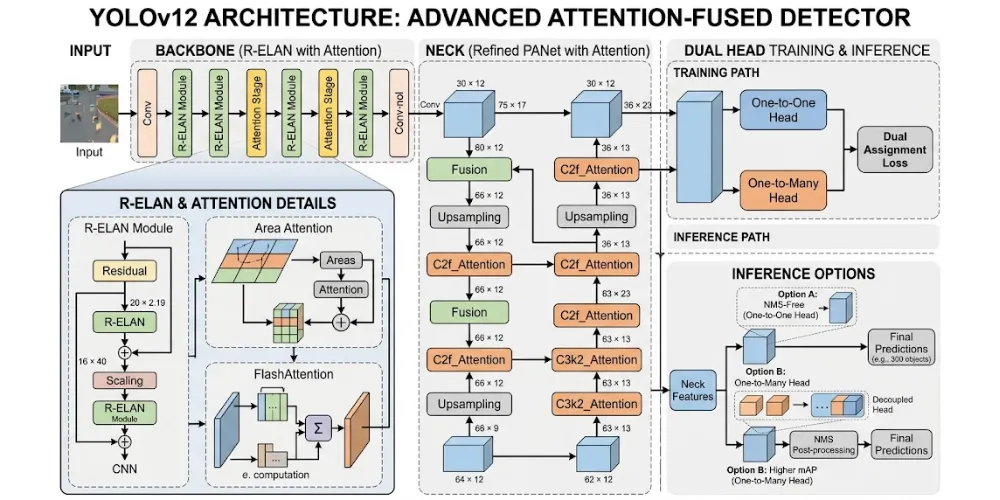
YOLOv12 uses R-ELAN (Residual Efficient Layer Aggregation Networks) and incorporates Area Attention into its feature processing.
The detection pipeline also uses 7×7 separable convolutions, while FlashAttention helps reduce memory-access overhead during attention computation.
Main Innovations
– Area Attention: Breaks feature maps into regions to reduce the complexity of standard self-attention.
– FlashAttention: Improves the efficiency of attention calculations.
– R-ELAN: Helps stabilize and optimize training in attention-heavy architectures.
– No Positional Encoding: Uses 7×7 separable convolutions as a positional information mechanism.
Performance
The source reports 55.2% mAP on COCO for YOLOv12x. Its key strength is improved global-context understanding, particularly in cluttered scenes. However, it benefits from modern GPU hardware capable of efficiently supporting FlashAttention.
Supported Tasks
Object Detection, Instance Segmentation, Image Classification, Pose Estimation, OBB.
The only limitation it has is that it requires modern GPUs (Ampere architecture or newer) to fully leverage FlashAttention.
5. YOLO26 (2026)
Introduction
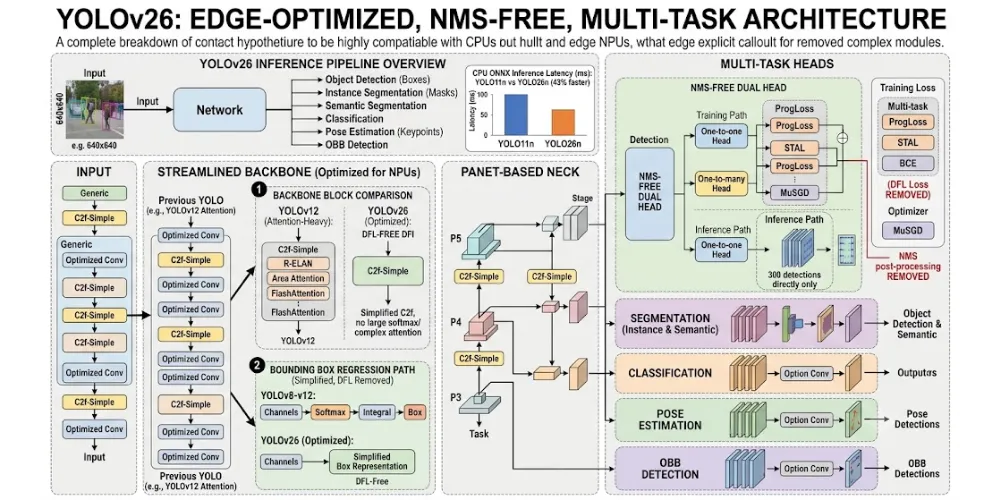
YOLO26 takes the YOLO evolution further toward deployment-first computer vision. According to the source material, it was released by Ultralytics in January 2026 and combines an NMS-free approach with optimizations aimed at efficient edge inference.
Why Was YOLO26 Introduced?
The focus is straightforward: make object detection easier to deploy on CPUs and NPUs while keeping inference deterministic and low-latency.
This means reducing or removing components that can become bottlenecks on lower-power hardware.
Architecture Overview
The backbone and neck are streamlined for hardware compatibility. The detection head uses a native dual-head architecture, with a one-to-one head enabling end-to-end predictions without NMS.
Main Innovations
End-to-End NMS-Free Detection: The model generates detections directly without relying on traditional NMS post-processing.
DFL Removal: Distribution Focal Loss is removed to simplify bounding-box regression and improve compatibility with CPUs and edge NPUs.
ProgLoss & STAL: Progressive Loss places more emphasis on the inference head during training, while Small-Target-Aware Label Assignment focuses on improving small-object detection.
MuSGD Optimizer: A hybrid optimization approach combining concepts from Muon and SGD is used to improve convergence.
Performance
The source reports 57.5 mAP for YOLO26x and up to 43% faster CPU ONNX inference for YOLO26n compared with YOLO11n. The key advantage is its focus on deterministic, efficient inference for edge environments.
Supported Tasks
YOLO26 supports:
✔ Object Detection
✔ Instance Segmentation
✔ Semantic Segmentation
✔ Classification
✔ Pose Estimation
✔ OBB Detection
Sample Python Code
from ultralytics import YOLO

model = YOLO('yolo26n.pt')

# Predicts directly without NMS overhead

results = model('edge_camera.jpg')
YOLOv8 vs YOLOv10 vs YOLO11 vs YOLOv12 vs YOLO26
The progression becomes easier to understand when the major differences are viewed together.
| Feature | YOLOv8 | YOLOv10 | YOLO11 | YOLOv12 | YOLO26 |
|---|---|---|---|---|---|
Release |
2023 |
2024 |
2024 |
2025 |
2026 |
Detection |
Anchor-Free |
Anchor-Free |
Anchor-Free |
Anchor-Free |
Anchor-Free |
NMS |
Yes |
No |
Yes |
Yes |
No |
Core Focus |
Multi-task & easy API |
End-to-end detection |
Efficiency |
Attention & global context |
Edge-first deployment |
Key Innovation |
C2f + Decoupled |
NMS-free detection |
C3k2 |
Area Attention + Flash |
Head + ProgLoss |
Efficiency |
High |
Higher |
High |
Higher Accuracy |
Maximum |
Application |
General CV |
Real-Time |
Production |
High Accuracy Vision |
Robotics, Smart Cities |
The comparison in the source highlights a clear pattern: YOLO models are not simply becoming “faster versions” of one another. Each generation is targeting a different bottleneck - from architecture and feature extraction to post-processing, attention and finally deployment efficiency.
The Bigger Picture: Where Is YOLO Heading?
Looking at the progression from YOLOv8 to YOLO26, three major trends stand out.
1. Less Post-Processing
YOLOv8 still uses NMS, while YOLOv10 and YOLO26 move toward end-to-end, NMS-free inference. This is important for real-time applications where even small amounts of additional processing can affect response time.
2. Smarter Feature Understanding
YOLO11 and YOLOv12 place greater emphasis on attention and richer feature extraction. The objective is not just to detect objects quickly but to understand their visual context more effectively.
3. Deployment Matters as Much as Accuracy
The latest direction is increasingly focused on where AI actually runs. Edge devices, cameras, industrial systems, robotics and smart-city infrastructure often operate with limited computing resources.
That makes deterministic latency, CPU/NPU compatibility, memory efficiency and reliable inference just as important as benchmark accuracy.
For businesses, this distinction matters. The “best” YOLO model is not automatically the newest one. The right choice depends on the application, hardware, dataset, latency requirements, object size, accuracy expectations and deployment environment.
Real-World Applications of YOLO
The evolution of YOLO has made real-time computer vision practical across a wide range of industries.
Some common applications include:
– Traffic & Transportation: Number plate, vehicle detection, traffic and parking systems.
– Smart Cities: People counting, vehicle monitoring and public-space analytics.
– Manufacturing: Defect detection, quality inspection and production-line monitoring.
– Security & Surveillance: Intrusion detection, object tracking and activity monitoring.
– Retail: Customer counting, shelf monitoring and visual analytics.
– Healthcare: Medical image analysis and visual assistance systems.
– Robotics: Real-time object recognition and environmental perception.
– Edge AI: Computer vision directly on cameras, industrial devices and low-power hardware.
YOLO can therefore be much more than a model running inside a notebook. With the right engineering, it can become part of a complete production-grade computer vision system.
How AI India Innovations Can Help
Choosing a YOLO model is only one part of building a practical computer vision solution. The bigger challenge is connecting the model to real-world cameras, data, business rules, dashboards, APIs and existing workflows.
At AI India Innovations, we develop customized AI and computer vision solutions around specific business requirements rather than treating a model as a one-size-fits-all product. Our work can include object detection, number plate recognition, people counting, industrial vision, OCR and other visual intelligence applications.
Our custom OCR capabilities can also complement computer vision systems when the requirement goes beyond detecting an object and involves actually reading and extracting information from it - such as vehicle plates, documents, labels, forms or other text captured through images.
Whether the requirement is a YOLO-based detection system, an OCR-enabled workflow or a complete edge AI application, the objective is the same: turn computer vision technology into something that works reliably in a real business environment.
Talk to AI India Innovations if you are looking to build a customized YOLO, computer vision, OCR or edge AI for your business.
Conclusion
The evolution from YOLOv8 to YOLO26 shows how quickly real-time computer vision is moving. The focus has expanded from simply achieving high detection accuracy to solving practical problems such as post-processing latency, global visual context, hardware efficiency, small-object detection and edge deployment.
For businesses, however, adopting the latest YOLO version is not the whole answer. A successful computer vision system needs the right model, custom training, deployment architecture, data pipeline, integrations and testing strategy.
AI India Innovations can help build these customized solutions, including YOLO-based vision systems and OCR capabilities that allow machines not only to identify objects but also read and extract useful information from visual data.
The future of computer vision is moving closer to real-time, intelligent and edge-ready AI. The companies that turn these capabilities into practical workflows will be the ones that get the real value from the technology.