
AI in Pharmaceutical Manufacturing:
GenAI, AI Agents & Automation Use Cases
Introduction
The pharmaceutical manufacturing industry is entering a new era of intelligent automation. Manufacturing batch records, SOPs, laboratory reports, Certificates of Analysis, deviation reports, CAPA records, validation documents, equipment manuals and regulatory filings all contain valuable knowledge.
This creates a clear opportunity:
“Use AI to transform pharmaceutical data, documents and manufacturing workflows into intelligent, connected and automated business processes.”
This guide walks through 19 practical AI use cases for pharmaceutical manufacturing, the architecture behind each one and the governance principles that make AI adoption safe in a regulated industry.
Why AI Is Important for Pharmaceutical Manufacturing
Pharmaceutical manufacturing runs on strict processes, exhaustive documentation and layered quality controls. On any given day, a mid-sized manufacturer is managing dozens of interlocking document types and data streams, including:
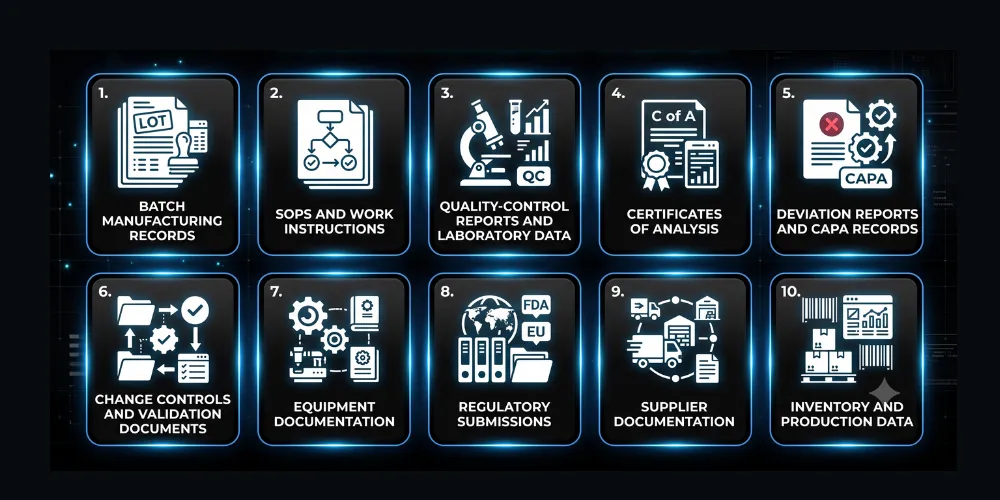
AI can help by making these processes progressively better along a simple continuum:
Searchable → Understandable → Connected → AutomatedThe goal is not to remove human expertise from pharmaceutical manufacturing - regulated industries cannot and should not work that way.

The path from manual process to production AI is incremental, not a single leap.
1. AI Pharmaceutical Knowledge Assistant
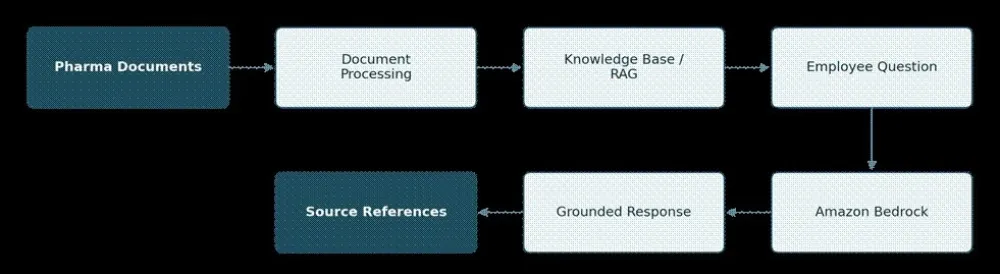
A pharmaceutical company can easily accumulate thousands of documents scattered across departments - SOPs, batch records, equipment manuals, quality procedures, validation documents, regulatory guidelines, product specifications and laboratory procedures. Finding the right document, fast, is a persistent operational drag.
Employees could ask
“What is the approved procedure for cleaning this equipment?”
“Which SOP covers this manufacturing step?”
2. AI SOP Assistant
Standard Operating Procedures are foundational to pharmaceutical manufacturing and large organizations may maintain hundreds or thousands of them across sites and product lines.
Example
“What are the required steps before starting this production process?”
For regulated environments, the system is designed to reference controlled & approved documents rather than generate procedures - the assistant retrieves, it does not invent.
3. AI Batch Manufacturing Record Assistant
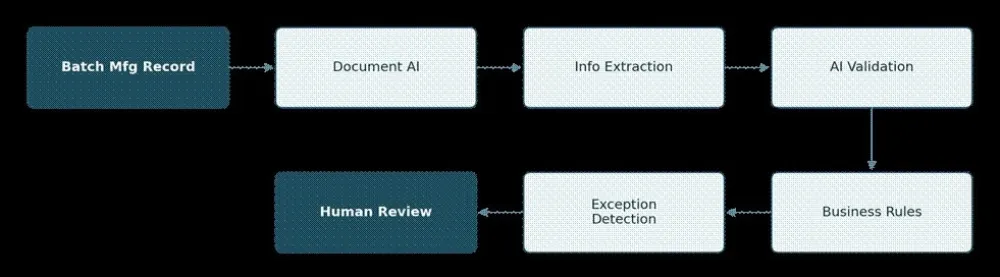
Batch Manufacturing Records (BMRs) contain a dense mix of structured and unstructured information collected at every stage of production. Reviewing them manually, line by line, is one of the most time-consuming tasks in a pharmaceutical quality function.
Example workflow
4. AI Quality Control Assistant
Quality teams work with large volumes of laboratory and manufacturing data every day. An AI Quality Assistant can help with test-report analysis, Certificate of Analysis processing, specification comparison, quality-document search, trend summarization, exception identification and investigation support.
Example
“Show batches where this quality parameter approaches the specification limit.”
5. AI Quality Assurance Assistant
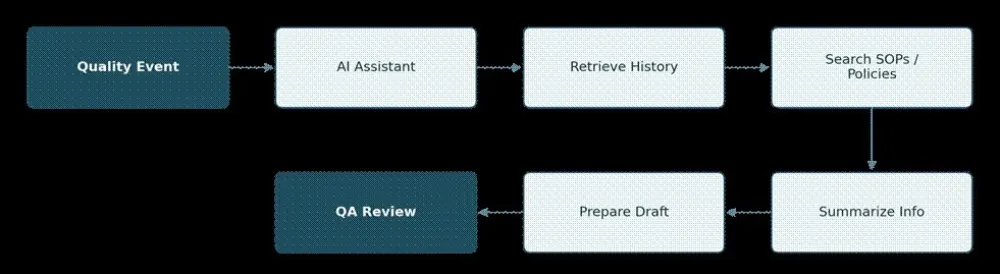
Quality Assurance teams manage an especially broad documentation footprint. Potential applications include SOP search, deviation-document analysis, CAPA document assistance, change-control analysis, audit preparation, training-record search and quality-document classification.
AI-powered QA workflow
6. AI Deviation Management
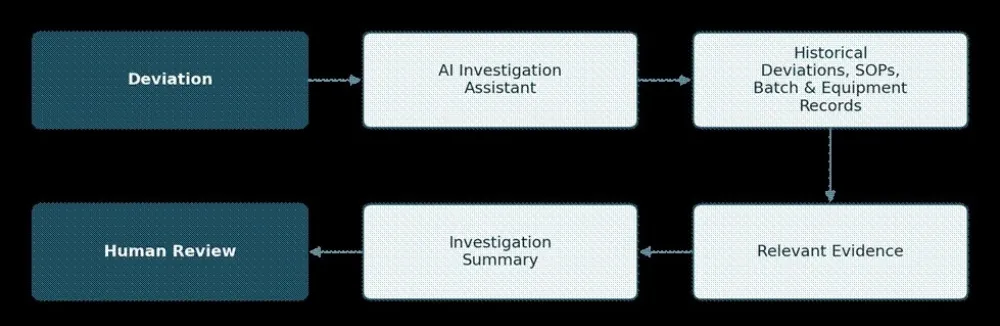
Manufacturing deviations often require pulling together information from multiple, disconnected sources before an investigation can even begin. AI can help teams organize that information quickly by extracting deviation details, searching historical deviations, finding related SOPs, identifying similar events, summarizing previous investigations, organizing supporting documentation and drafting investigation summaries for review.
Example
7. AI CAPA Assistant
Corrective and Preventive Action (CAPA) processes demand extensive documentation and long-running follow-up. AI can assist with CAPA document analysis, historical CAPA search, similar-event identification, action tracking, evidence organization, CAPA status summaries and management reporting.
The system provides structured information to quality teams while keeping approval and final decisions with authorized personnel - AI supports the CAPA process without replacing the judgment it requires.
8. AI Certificate of Analysis Processing
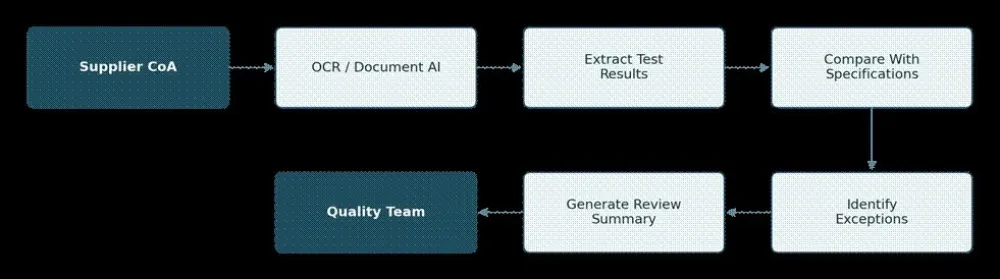
Certificates of Analysis (CoAs) are central to pharmaceutical supply chains and a manufacturer may receive a very large number of supplier CoAs every month. An AI system can read, extract, compare, validate and flag exceptions automatically:
Read → Extract → Compare → Validate → Flag Exceptions
Example
9. AI Supplier Quality Agent
Pharmaceutical manufacturers work with many suppliers, each generating its own stream of documents, certificates, quality records, audit information and delivery data. An AI Supplier Quality Agent can analyze all of this and provide a single, consolidated supplier view.
Example
“Summarize the quality history of Supplier X over the last 12 months.”
10. AI Regulatory Affairs Assistant
Pharmaceutical companies deal with large volumes of regulatory information that changes over time. An AI Regulatory Assistant can help teams search regulatory documents, summarize guidelines, compare requirements, find relevant sections, organize regulatory information, assist with document preparation and track regulatory changes.
Example
“What changed between the previous and current version of this regulatory document?”
11. AI Audit Preparation Assistant
Pharmaceutical organizations frequently prepare for internal and external audits, a process that typically means pulling documents from many different systems under time pressure.
Example
“Find all CAPA records associated with this manufacturing line and summarize their current status.”
12. AI Manufacturing Co-pilot
A pharmaceutical manufacturing copilot provides an intelligent interface over production and operational information, so a production manager can simply ask a question instead of pulling reports from several systems.
Example
“What were the major production issues during the last three batches?”
13. AI Predictive Maintenance Assistant
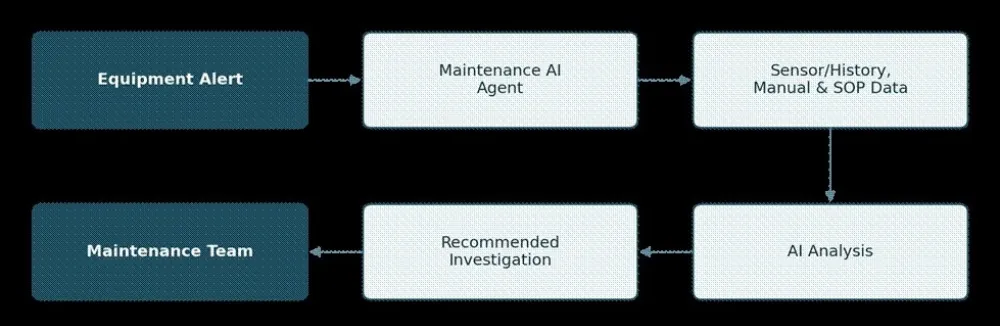
Pharmaceutical manufacturing depends heavily on specialized equipment - mixing equipment, granulators, tablet presses, coating machines, filling machines, packaging equipment, HVAC systems, water systems and cleanroom equipment. AI can combine equipment data with maintenance documentation to help technicians act faster.
Example
14. AI Visual Inspection for Pharmaceutical Manufacturing
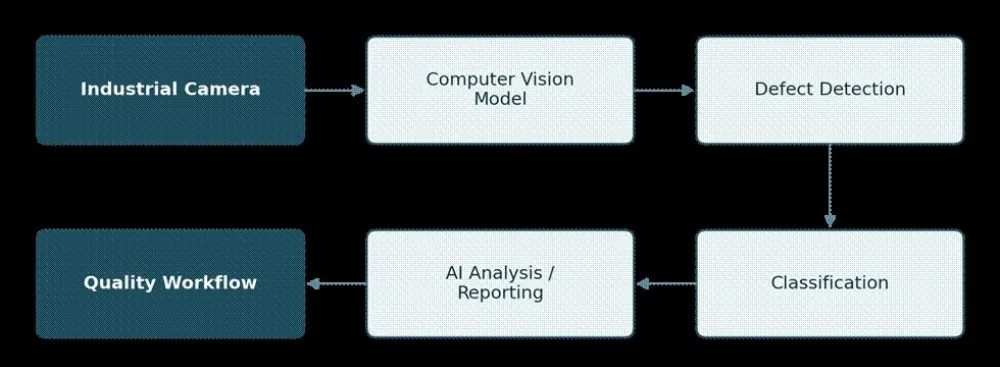
Generative AI is only one part of pharmaceutical AI. Computer vision is equally important for manufacturing inspection workflows, with applications spanning tablet inspection, capsule inspection, packaging inspection, label verification, bottle inspection, vial inspection, seal inspection, defect detection, fill-level inspection and packaging-line monitoring.
Example
15. AI Packaging Inspection
Pharmaceutical packaging requires a very high level of accuracy, since a labeling or seal error can have real patient-safety consequences. Computer vision systems can assist with label presence, label position, barcode detection, expiry-date verification, batch-number verification, packaging defects, cap or seal inspection and missing components.
A vision system can detect anomalies in real time and trigger an operational workflow:

16. AI Inventory & Supply Chain Agent
Pharmaceutical manufacturers manage complex inventories spanning raw materials, APIs, excipients, packaging materials and finished products, alongside supplier lead times, purchase orders and inventory levels. An AI Supply Chain Agent can analyze all of this to support:
Example
“Which critical raw materials could create a production risk over the next 30 days?”
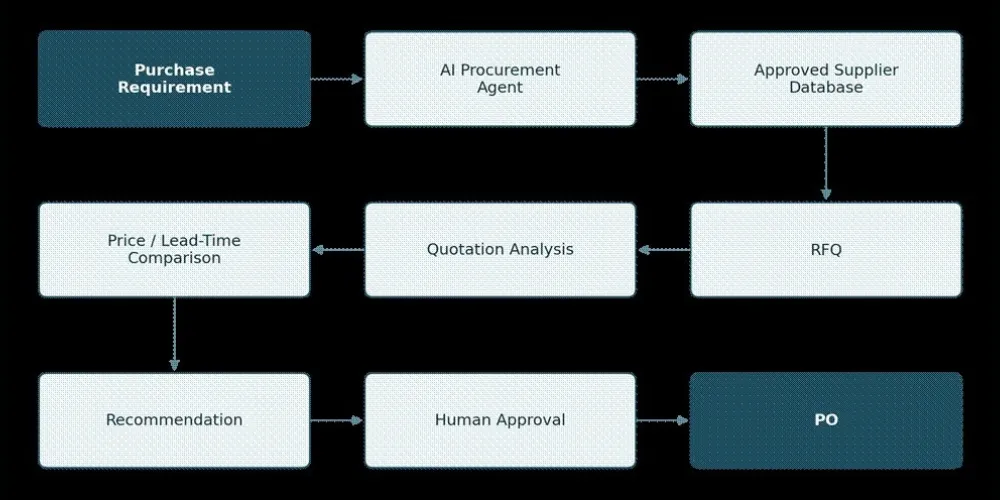
17. AI Procurement Agent for Pharma
Procurement is a major operational function in pharmaceutical manufacturing, involving supplier discovery, RFQs, quote comparison, vendor documentation, price analysis, purchase requests, purchase-order preparation and supplier communication.
Workflow
18. AI Medical & Pharmaceutical Research Assistant
Pharmaceutical R&D teams need to analyze large amounts of scientific and competitive information. An AI Research Assistant can help with scientific literature search, research-paper summarization, patent research, compound information retrieval, clinical-trial information, competitive intelligence and research report preparation.
AI can help researchers find and organize information faster while leaving scientific conclusions and critical decisions to qualified experts - the assistant accelerates the literature review, it doesn't replace the scientist.
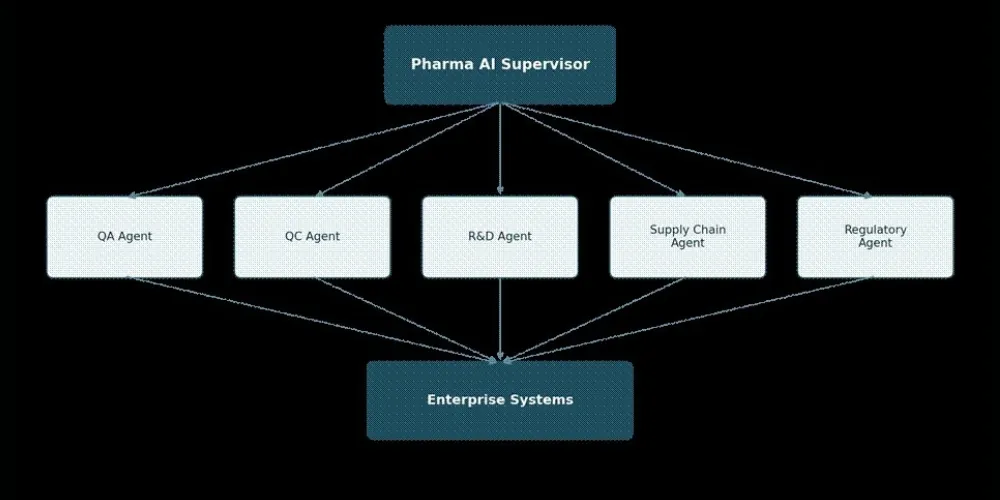
19. AI Multi-Agent Pharma Platform
For large pharmaceutical organizations, different business functions can be supported by specialized AI agents working under a coordinating supervisor layer, including QA, QC, Manufacturing, Maintenance, Procurement, Regulatory, Supply Chain, R&D Research and Document agents.
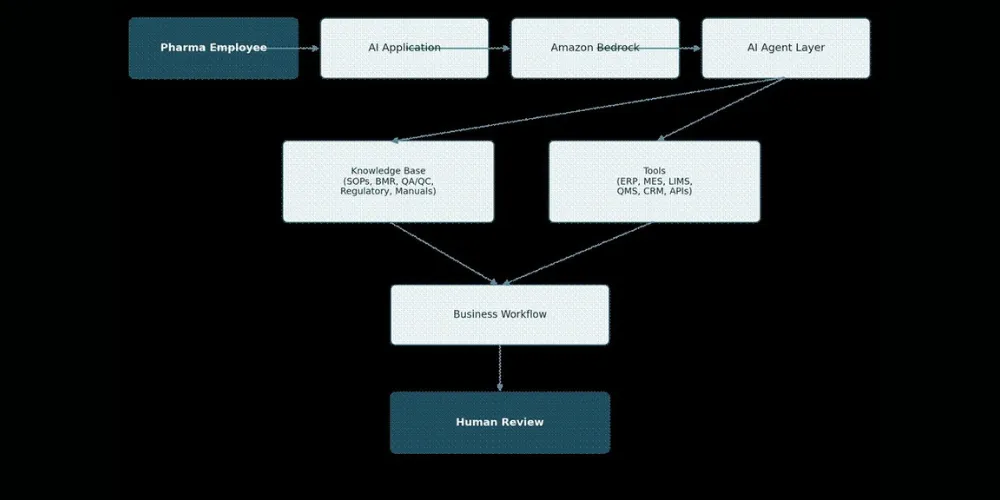
Amazon Bedrock for Pharmaceutical AI
Amazon Bedrock can provide the generative AI layer for many of the applications described above. A typical architecture connects the employee, through an AI application and Bedrock's AI agent layer, out to both a knowledge base and a set of enterprise tools:
RAG for Pharmaceutical Companies
RAG is particularly valuable in pharmaceutical environments because organizations sit on such large document repositories. A pharmaceutical RAG application can search SOPs, quality manuals, regulatory documents, equipment manuals, product specifications, batch documentation, training material and supplier documents.

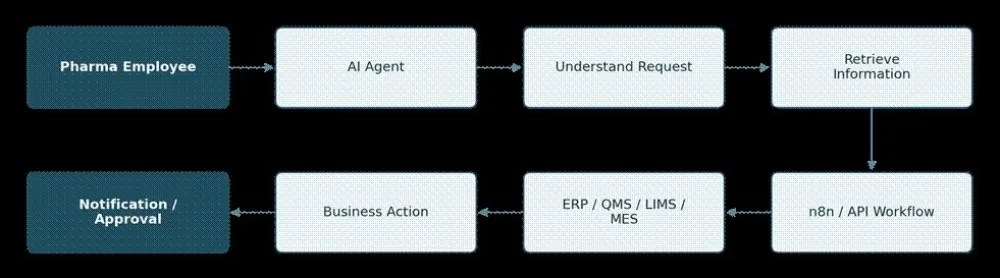
AI Agents + n8n for Pharmaceutical Automation
AI becomes more valuable when it can trigger actions, not just answer questions. A possible architecture lets an AI agent understand a request, retrieve information and hand off execution to an n8n or API workflow that talks directly to ERP, QMS, LIMS and MES systems.
Human-in-the-Loop Is Critical in Pharma
Pharmaceutical manufacturing is a highly regulated environment and AI should never make uncontrolled decisions about product release, batch rejection, patient treatment, regulatory submissions, critical quality decisions or safety-critical manufacturing decisions.

AI Governance for Pharmaceutical Manufacturing
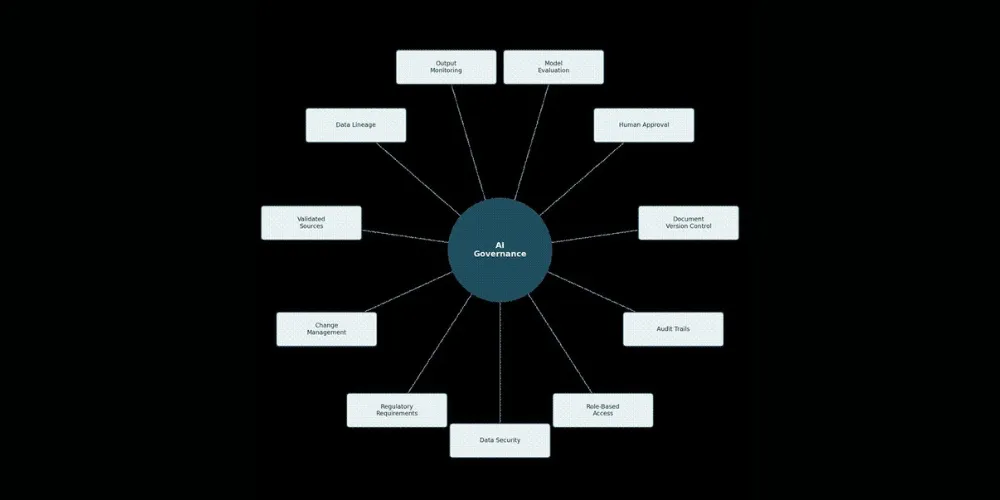
Enterprise pharmaceutical AI should be designed with governance in mind from day one, not added afterward. Key considerations include data security, role-based access, audit trails, document version control, human approval, model evaluation, output monitoring, data lineage, access to validated sources, change management and regulatory requirements.
Why Choose AI India Innovations?
Pharmaceutical AI requires more than an LLM. It requires understanding manufacturing, quality, documents, AI and automation together with the enterprise systems they run on.
Manufacturing + Quality + Documents + AI + Automation + Enterprise SystemsAI India Innovations brings together capabilities across generative AI, AI agents, RAG, document intelligence, computer vision, workflow automation, enterprise integration and AI application development - allowing us to design solutions around real pharmaceutical workflows rather than generic AI demos.
Our objective is to move organizations along a clear, incremental path:
Manual Process → AI-Assisted Process → Intelligent Automation → Production AIOur Pharmaceutical AI Development Process
1. Manufacturing & Business Discovery
Understand the organization's current processes, pain points and priorities.
2. AI Opportunity Assessment
Identify high-value AI opportunities across manufacturing, quality, regulatory and supply-chain functions.
3. Data & System Assessment
Review documents, ERP, MES, LIMS, QMS and other systems that any solution will need to work with.
4. AI Architecture
Design the appropriate combination of AI agents, RAG, computer vision, document intelligence and automation.
5. Proof of Concept
Build a focused solution around one measurable use case, so value is demonstrated before wider investment.
6.Validation & Governance
Define appropriate human review, security and operational controls for the regulated environment.
7. Enterprise Integration
Connect the AI solution with existing business systems rather than requiring a replacement.
8. Production Deployment
Deploy the solution into the appropriate production environment with the right monitoring in place.
9. Continuous Optimization
Monitor performance and improve the system over time as usage and requirements evolve.
The Future of Pharmaceutical Manufacturing Is Intelligent
The pharmaceutical factory of the future will not rely on traditional automation alone. It will increasingly combine industrial automation, computer vision, IoT, generative AI, AI agents, enterprise data and workflow automation into a single connected system.
A production manager may interact with a manufacturing copilot. A quality professional may use an AI investigation assistant. A technician may use an AI maintenance agent. A procurement manager may use an AI supplier agent. A regulatory team may use an AI research assistant. And the pharmaceutical organization connects all of these systems through a secure enterprise AI architecture.
Conclusion
Across the 19 use cases in this guide - from knowledge assistants and SOP search to batch-record review, deviation investigation, CoA processing, predictive maintenance, computer-vision inspection and multi-agent platforms - the common thread is the same: AI does the searching, extracting, comparing and summarizing, while qualified pharmaceutical professionals keep every judgment call, approval and release decision firmly in their hands.
That balance - meaningful automation with uncompromising human oversight - is what makes AI adoption practical and safe in a regulated manufacturing environment. Organizations like AI India Innovations that start with one well-scoped use case, prove its value and then expand deliberately tend to see the fastest and most durable returns.