How to Evaluate AI Automation
Before Moving It Into Production
Introduction
An AI demo rarely fails. The inputs are curated, the happy path is rehearsed and someone is standing by to explain away anything unexpected. A production AI system doesn't get that protection - it runs unattended, against real data and has to behave predictably even when the input is messy, an API times out or the model returns something nobody anticipated.
That gap is where most AI automation initiatives stall. The model itself is rarely the problem - what's usually missing is everything built around it: validation, business rules, human oversight where it matters, monitoring and an agreed definition of what “good” looks like. This applies to a single AI agent, a generative AI application, a data workflow or an n8n-orchestrated process alike - the architecture changes, the evaluation questions don't.
The right question before a rollout isn't “Can the AI perform the task?” It's “Can complete automation reliably produce an acceptable business result under real operating conditions?”
What Production Readiness Actually Means
Production readiness isn't determined by the AI model alone. A typical AI automation moves through several stages - business input, data retrieval, AI processing, output validation, business rules, human approval, system action and monitoring - and if any one of them can fail undetected, the automation carries risk even when the model performs well:
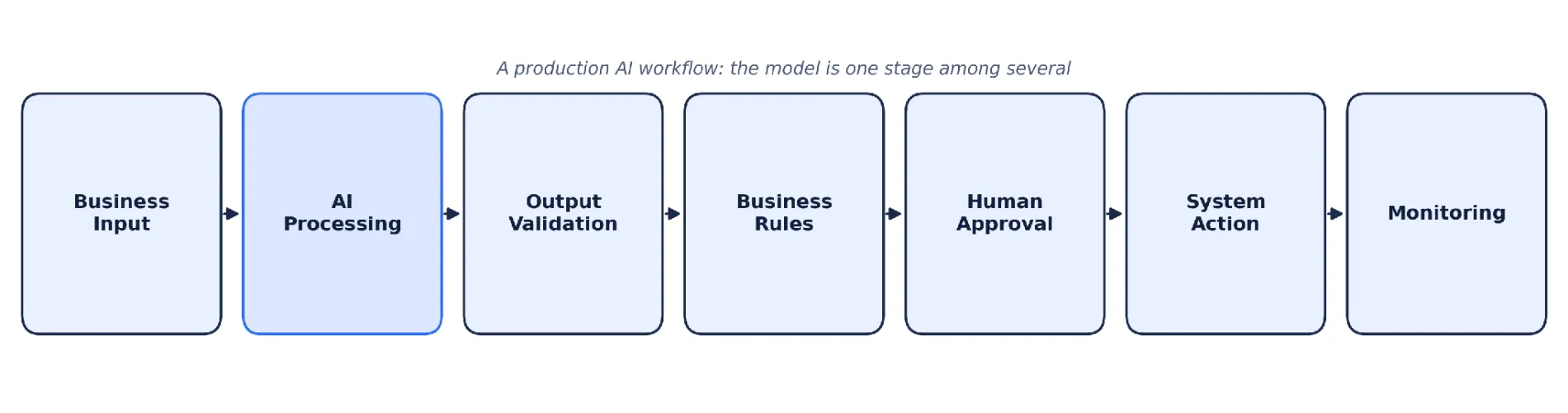
A production AI workflow: the AI model is one stage among several, not the whole system.
Define the Business Outcome and Acceptance Criteria
Before testing the AI component, define what the automation is meant to accomplish and what counts as success. A workflow classifying customer enquiries shouldn't be judged on whether its output “looks reasonable” - it needs measurable requirements: what must be extracted, which categories are valid, what confidence threshold applies, what happens when information is missing, which cases need human review and what action follows a result.
This turns an AI experiment into an operational specification. The same applies to defining an accepted output: a document-processing result might require correct classification, all required fields present, no fabricated values and confidence above a threshold; a support workflow might require correct intent detection, no unsupported claims, correct routing and a successful CRM action. Without an agreed definition of “acceptable,” it's hard to know whether automation is actually improving the process.
Evaluate the Complete Workflow, Not Just the AI Output
An AI model can produce an excellent response while the overall automation stays unreliable. An invoice-processing workflow, for example, still has to handle invalid files, missing fields, API failures, duplicate submissions and low-confidence outputs - none of which are the model's job to solve alone. A production evaluation should follow the whole path:
For businesses that create invoices before they enter an automated processing workflow, an online invoice generator can also form part of the broader process.
A production evaluation should follow the whole path:
Input → Processing → AI Output → Validation → Business Rules → Approval → Action → LoggingA lead-processing workflow illustrates the pattern: a lead enters, an AI model classifies and summarizes it, validation checks required fields, business rules set the category, high-confidence leads route automatically while uncertain ones go to a human and the approved result is written into the CRM. Each stage has a defined responsibility, which makes failures easier to trace. For businesses assembling these systems, n8n Workflow Automation is commonly used to connect applications, APIs, AI logic and business processes into a structured workflow.
Testing has to match this reality: a test set should include normal cases, incomplete or ambiguous inputs, unusual formats and past failure cases - not just clean examples, which give an unrealistically optimistic picture.
Patterns We See Across Enterprise Implementations
A handful of patterns recur once a business moves past a single AI prototype (illustrative, not case studies of specific clients):
– Invoice processing:
extracted data is checked against purchase orders before posting to accounting.
– Lead routing:
enquiries are classified, with ambiguous or high-value leads held for human review.
– Support triage:
A draft response is generated but sent only after agent approval.
– Knowledge assistants:
answers drawn from internal documentation, with low-confidence answers escalated.
Validation, Business Rules and Human Oversight
AI-generated output shouldn't automatically become a business action. A validation layer - required-field checks, schema validation, confidence thresholds, business-rule checks, duplicate detection - confirms the output meets predetermined conditions before the workflow proceeds; if validation fails, the workflow should stop or route for review rather than continue automatically. That distinction is a large part of what separates connecting an AI model to a workflow from engineering a reliable one.
Human approval is typically introduced when confidence is low, information is missing, a financial threshold is exceeded, a customer-sensitive or compliance-sensitive action is involved or the AI output conflicts with a business rule - producing a controlled human-in-the-loop architecture rather than an all-or-nothing choice. For more complex autonomous workflows, Agentic AI Development can support architectures where agents interpret requests, use tools and coordinate steps within defined controls. Autonomy should be bounded by the business process, not treated as an objective in itself.
Failure Handling and Access Control
Production systems will encounter failures - API timeouts, malformed AI output, downstream rejections. The question is whether the workflow knows how to respond: automatic retry, backoff, an alternate path, queueing, escalation or safe termination. Retries need to be controlled too, since blindly repeating an action can create duplicate records or transactions, so a workflow needs to distinguish failures safe to retry from ones that need intervention.
The same discipline applies to permissions: the AI should operate with only the access it needs - read access without delete permissions, drafting without auto-send. Permission design should cover which systems and data the AI can reach, which actions require approval, which credentials are used and how every action is logged. This matters more, not less, as businesses move toward autonomous agents.
Measuring Performance, Rejected Outputs and Cost
A common mistake is showcasing successful outputs while ignoring rejected ones. A useful evaluation records total attempts, accepted and rejected outputs and why, human review time, retries, escalations and the final business outcome. A useful production-evaluation framework separates peak capability from operating reliability by looking at how often outputs become usable results and what happens to the ones that are rejected - one exceptional output doesn't prove the system is reliable for repeated use.
Cost follows the same logic: the real cost isn't the API call, it's generation plus infrastructure, review time, correction time and rejected attempts. A useful metric is cost per accepted result: total workflow cost ÷ accepted results - which lets decision-makers compare automation against the manual process on business terms. None of this stops at deployment; ongoing monitoring of success rate, rejection rate, escalation rate, processing time and cost is what surfaces problems that a small test set didn't reveal.
Data Foundation and Choosing the Right Architecture
AI automation is only as reliable as the data flowing through it. Poor data quality can leave the AI layer producing a polished response from bad input, which is why data engineering is part of this conversation, not separate from it. AI India Innovations data engineering work covers pipelines, ETL/ELT, integration, warehousing and AI-ready data preparation - worth evaluating before assuming the AI layer is the weak point.
Not every process needs the same architecture: generative AI, retrieval-augmented generation, AI agents, document intelligence, predictive models, rule-based automation or a mix, depending on where AI adds measurable value versus where deterministic logic is more reliable. For custom generative AI applications, GenAI Development can support use cases centered on language generation, summarization or knowledge interaction.
A Practical Production-Readiness Checklist
Before moving an AI automation into production, review the following:
– Business: Is the outcome defined, with a measurable success criterion & understood ROI?
– AI: Has output quality been tested across inputs, with acceptance criteria documented?
– Workflow: Has the complete path been tested, with validation and failure paths defined?
– Human oversight: Which decisions require approval and can employees override the AI?
– Security: Are permissions limited, sensitive systems protected, actions logged?
– Operations: Are failures and costs monitored and rejected outputs measured?
– Data: Is the underlying data reliable, integrations stable and prepared for AI processing?
If several of these can't be answered yet, the automation is probably still at the pilot stage - which is a useful thing to know before a rollout, not a failure.
How AI India Innovations Approaches Production-Focused AI Automation
Production AI requires more than a model and a prompt. In our work, the architecture gets designed around the actual business process rather than treating the model as the whole system: start from the business outcome and what counts as an accepted result, evaluate the workflow as a whole, put validation and business rules ahead of any automated action, decide deliberately where human approval belongs, scope AI permissions to what the task requires and build in monitoring and a cost-per-accepted-result view from day one.
An enterprise workflow built this way typically combines data pipelines, an AI model, business rules, human approval and orchestration, with an agentic architecture introduced only where the process genuinely requires it. The question we keep coming back to with clients is the one this article opened with: what does the business need the system to accomplish and how will that be measured after deployment?
Conclusion
The difference between an impressive AI demonstration and a dependable production system is rarely one output - it's the quality of the entire operating process, considered together.
Teams researching production AI approaches can also review additional AI and machine-learning resources when evaluating technologies and use cases.
If your team already has an AI prototype running, the next step usually isn't a bigger model - it's applying this evaluation to the workflow it will operate inside. Working through the checklist above with the people who own that process is often enough to know if you're ready to move to production. If you'd rather do that with a team that builds these systems regularly, AI India Innovations works with businesses at exactly this stage.
The goal isn't to make an AI workflow work once. The goal is to make it work reliably when the business depends on it.
Frequently Asked Questions
A workflow tested against realistic inputs, with validation, error handling, security, monitoring and human-oversight mechanisms appropriate to its use case.
Test the complete workflow, not just the model - normal cases, edge cases, invalid inputs, failures, rejected outputs, retries and escalation.
No. It depends on the consequences of an incorrect action - low-risk tasks can be highly automated, sensitive ones usually warrant approval.
Processing time, labour hours saved, completion rate, error reduction, cost per accepted result, throughput and the business value generated.
Poor data quality and unstable integrations can undermine an otherwise capable model - data engineering is part of the same evaluation, not a separate one.