Doctor-to-Patient Summary : Case Study
Introduction
Doctors spend years learning how to take care of patients. A big part of their day is spent writing notes. After each consultation the details must be written down. This gets tiring and hard to keep up with on a day.
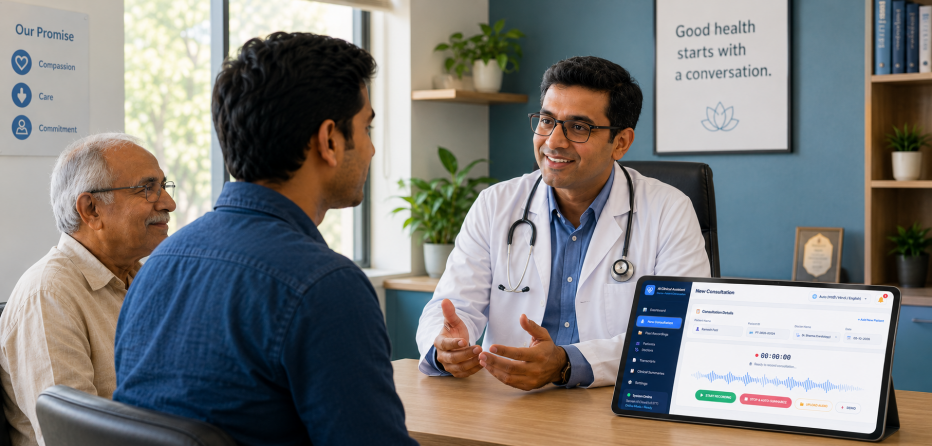
The Doctor-to-Patient Summary application listens to the conversation. Prepares a short organised summary of what was discussed. The doctor only taps Start at the beginning of the visit. Stop at the end.
It is designed for Indian clinics. It follows English, Hindi, Marathi or a mix of these. It can tell the doctor, the patient and family members apart. Only the medical points are. Casual chat is left out. The doctor consults in the way with one quiet helper, in the room.
How It Helps Doctors
Whether it is a small neighbourhood clinic or a large hospital, doctors can gain in many practical ways:
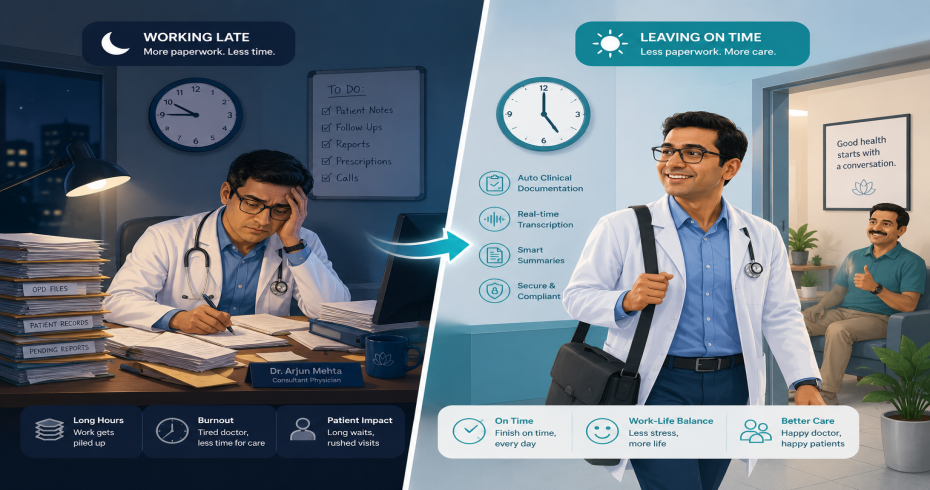
- Saves time: There is no need to write notes after each visit anymore. Small savings for each patient add up to hours in a week.
- Lighter paperwork: Doctors and support staff do typing, less correcting and less filing.
- More attention on the patient: The doctor can look at the patient. Listen, instead of writing during the visit.
- Fewer missed details: Since the full conversation is recorded, symptoms, medicines and advice are less likely to be forgotten.
- Better understanding of history: Previous summaries are stored in one place so the doctor can quickly remember what happened in visits.
- Easier follow-up visits: Before the appointment the doctor can look at what was discussed and what was advised earlier.
- Consistent notes: Every summary uses the format of the department so the records look neat and uniform.
- Less tiredness: With the notes work reduced the doctor’s day can finish on time and, with stress.
- Smoother consultations: With paperwork to deal with visits feel calmer and waiting times might also get better.
Application Workflow & Key Features
The application fits into the doctor’s daily routine in four simple steps:
Consultation: The doctor enters the patient name, ID and date on one screen. Then taps Start. Speaks with the patient just like always. A live timer appears on the screen showing that the visit is being recorded.
AI processing: The application understands speech in mixed languages. It marks each line clearly identifying who is speaking. The doctor, the patient or someone else in the room.
Structured patient summary: Key details like symptoms, medical history, medicines, diagnosis and advice are pulled out automatically. They are organized neatly in English using the same format as the department’s standard records.
Doctor and patient use: The doctor reads the summary makes changes if needed and saves it. Past visits and summaries can be opened in seconds. Every word, from the conversation can be searched quickly.
The doctor always has the final say. The summary is only a support tool, and patient records stay protected within the hospital.
Patient Experience and Quality of Care
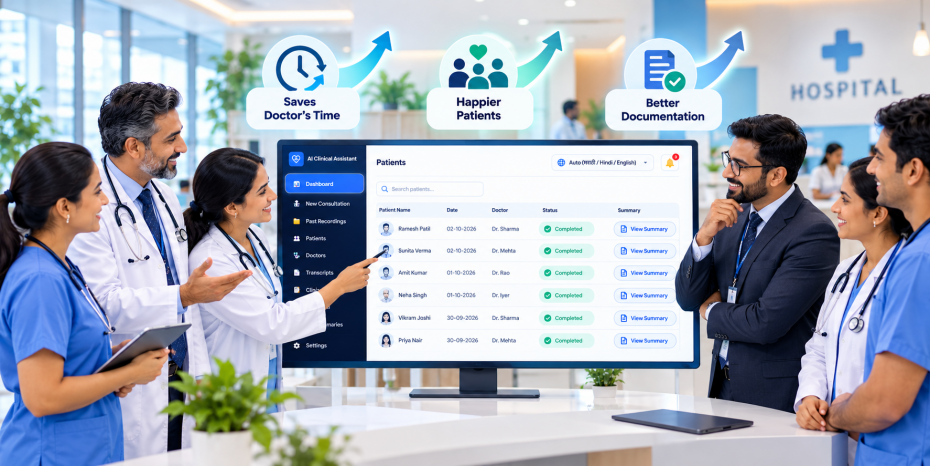
Technology in healthcare should not only help doctors. It should also make the experience better for patients. The Doctor-to-Patient Summary application helps create a more comfortable and meaningful consultation for every patient. Instead of spending time writing notes during the visit, doctors can focus on listening carefully and having a natural conversation. This helps patients feel heard and valued.
Many patients forget important information after leaving the clinic. They may not remember all the medicines, lifestyle advice, follow-up instructions or precautions discussed during the consultation. A clear summary helps reduce this confusion by providing an organised record of the visit. Patients and their family members can review the information later and better understand the treatment plan.
The application is especially useful in Indian healthcare settings where consultations often involve multiple people. Family members may join the discussion, ask questions and share medical history. The system can separate different speakers and capture only the relevant medical information. This helps ensure that important details are not missed.
For elderly patients and those managing long-term conditions, having access to previous consultation summaries can be very helpful. They can easily track their symptoms, treatment progress and doctor recommendations over time. This improves continuity of care and supports better health management.
The solution also helps build trust between doctors and patients. When patients see that their concerns are properly documented and that nothing important is overlooked, they gain greater confidence in the quality of care they receive.
Business Impact & Conclusion
For hospitals and clinics the advantage is more than saving time. Doctors get back time for patients for rest or for growing their practice. Records become more complete and consistent in every department. Patients feel they are being listened to and satisfied patients are more likely to come and tell others about the clinic.
The solution is also simple to use. Doctors do not have to change how they talk learn a way to write notes or rely on extra staff for writing things down. Clinic owners can provide an more professional service.
The Doctor-to-Patient Summary application shows how artificial intelligence can help doctors without taking their place. It deals with the paperwork so that doctors can focus on what's most important: taking care of patients. For healthcare organizations that want efficiency and a better experience, for patients it is a smart and reliable step forward.
Frequently Asked Questions
An AI-powered Doctor-to-Patient Summary is a healthcare AI solution that listens to doctor-patient conversations and automatically creates a structured summary of the consultation. It can capture important details such as symptoms, medical history, medicines, diagnosis, and doctor’s advice, helping reduce manual medical documentation.
AI uses speech recognition and natural language processing to understand the doctor-patient conversation, identify different speakers, extract relevant medical information, and convert it into a structured patient summary. The solution can also handle multilingual conversations, including English, Hindi, and Marathi.
AI patient summaries can reduce the time doctors spend on clinical documentation and paperwork. By automatically organizing consultation details, the technology allows doctors to focus more on patients, maintain consistent medical records, review previous consultations faster, and improve overall healthcare workflow efficiency.
Yes. AI-powered healthcare documentation solutions can be designed to understand multilingual conversations, including English, Hindi, Marathi, and mixed-language consultations. This makes AI patient summary technology particularly useful for Indian hospitals, clinics, and healthcare providers.
No. An AI-generated patient summary is designed to support doctors, not replace them. The AI captures and organizes relevant information from the consultation, while the doctor reviews, edits, and approves the final summary. The doctor remains responsible for clinical decisions and patient care.