
Diabetic Dost: An AI-Powered Voice Assistant for Diabetes Patient Screening
Introduction
AI-powered diabetes voice assistant technology is opening new ways for healthcare providers to collect patient information without relying entirely on lengthy forms or repetitive manual questioning. Diabetic Dost, developed by AI India Innovations, is a conversational AI solution designed to support preliminary diabetes patient screening through voice-based interactions, context-aware follow-up questions and structured patient history summaries. The approach is particularly relevant for healthcare environments where patients may find speaking easier than typing. Alongside its healthcare AI solutions, AI India Innovations also develops OCR technology to help businesses turn document-based information into usable digital data.
What Is Diabetic Dost?
Diabetic Dost is an AI-powered voice assistant designed to make the initial collection of diabetes-related patient information more conversational and organized.
Before a consultation, healthcare professionals may need details about a patient's symptoms, medical history, medications, previous glucose readings and relevant investigations. Collecting this information manually can take time and important details may be missed or recorded inconsistently.
Diabetic Dost addresses this challenge by guiding patients through a voice-led screening conversation. It uses the available conversation context to ask relevant follow-up questions and organizes the patient's responses into a structured summary for healthcare professional review.
The goal is straightforward: make preliminary patient intake easier to manage while allowing clinicians to focus on reviewing the information and making informed clinical decisions
Instead of relying entirely on manual responses from reception staff, patients can use interactive menus, ask questions in their own words, explore available services and follow a structured appointment-request process.
The Dental WhatsApp Chatbot demonstrated for Deenanath Mangeshkar Hospital (DMH) is designed around these everyday requirements. It combines curated dental information, multilingual conversations, guided appointment workflows and an option to contact reception when a question needs human attention.
The goal is not to replace dentists or reception teams. It is to make routine information easier to access and help patients understand what they can do next.
Key Features of Diabetic Dost
- Voice-Based Patient Interaction
Patients can share their symptoms, medical history and other relevant details verbally instead of relying only on typed forms. This offers an alternative for people who are more comfortable speaking than entering information manually.
- Speech-to-Text Conversion
The system uses speech recognition to convert spoken patient responses into text. This creates a written record of the information shared during the screening session, subject to the accuracy of speech recognition and the need to verify important clinical details.
- Context-Aware Follow-Up Questions
Diabetic Dost uses earlier responses to guide the next questions in the conversation. If a patient mentions having diabetes but does not specify how long they have had it, for example, the assistant can ask for that missing information rather than simply moving ahead.
- Structured Patient History Collection
Information about reported symptoms, diabetes history, medications and available readings can be organized into defined fields. A structured format makes the collected information easier for healthcare professionals to scan, review and confirm.
- Identification of Missing or Unclear Information
Medical information needs careful handling. When details are incomplete, ambiguous or conflicting, the workflow is designed to flag them for clarification instead of guessing or creating unsupported clinical facts.
- Clinician-Ready Summary for Review
At the end of the screening session, Diabetic Dost presents a concise summary of the patient-reported information. This gives the healthcare professional a starting point for the consultation, while preserving the distinction between what the patient reported and what has been clinically verified.
How Does Diabetic Dost Work?
The workflow is designed around a simple sequence:
Step 1: Patient starts a voice session.
The patient begins the screening interaction with the assistant.
Step 2: Guided questions are presented.
The assistant asks approved questions related to diabetes screening and patient history.
Step 3: Responses are converted into text.
The speech recognition component converts the patient's spoken answers into text.
Step 4: Follow-up questions use conversation context.
The assistant uses available session information to ask relevant questions when additional details are needed.
Step 5: Patient information is organized.
Reported symptoms, history, medication details and available readings are arranged into structured fields.
Step 6: A healthcare professional reviews the summary.
The collected information is presented for review and confirmation before it is used in clinical decision-making.
This workflow provides a more organized starting point for patient intake without removing the need for professional assessment.
Practical Use Cases of Diabetic Dost
Pre-Consultation Diabetes Screening
Patients can answer screening questions before meeting the doctor. The clinician can then review the organized history during the consultation instead of starting the information-gathering process from scratch.
Multilingual Patient Intake
Patients may be more comfortable explaining their concerns in Hindi, Marathi, English or a combination of languages. Diabetic Dost's multilingual potential can support more accessible intake where the required languages are supported by the deployed speech components.
Medication and Medical History Collection
The assistant can collect patient-reported medication details and medical history. Unclear information can be flagged for confirmation, helping healthcare staff identify details that need further attention.
Follow-Up Question Automation
When a response leaves an important detail unanswered, the assistant can ask a relevant follow-up question. This can help identify missing information before the clinician begins reviewing the case.
Healthcare teams can use the generated summary as a starting point for review. Transferring verified information into hospital information systems or electronic medical records may also be possible when the relevant integration is explicitly implemented, authorized and tested.
Benefits of Diabetic Dost for Healthcare Providers
Diabetic Dost is designed to address practical challenges in preliminary patient intake rather than promise unverified clinical outcomes.
- More convenient patient intake: Offers a voice-based alternative to lengthy typed forms.
- Better-organized information: Arranges patient responses into defined fields for easier review.
- Potential workflow efficiency: May reduce repetitive questioning and manual intake effort.
- Improved visibility of missing details: Context-aware follow-ups help identify information that needs to be collected.
- Support for multilingual accessibility: Can make the intake experience more approachable for patients using supported languages.
- A useful starting point for consultations: Provides a concise patient-reported summary for clinicians to review and confirm.
The actual benefits will depend on the implementation, patient population, speech recognition performance and clinical workflow. A controlled pilot can help healthcare organizations assess whether the solution improves their specific intake process.
Diabetic Dost: Output Screen
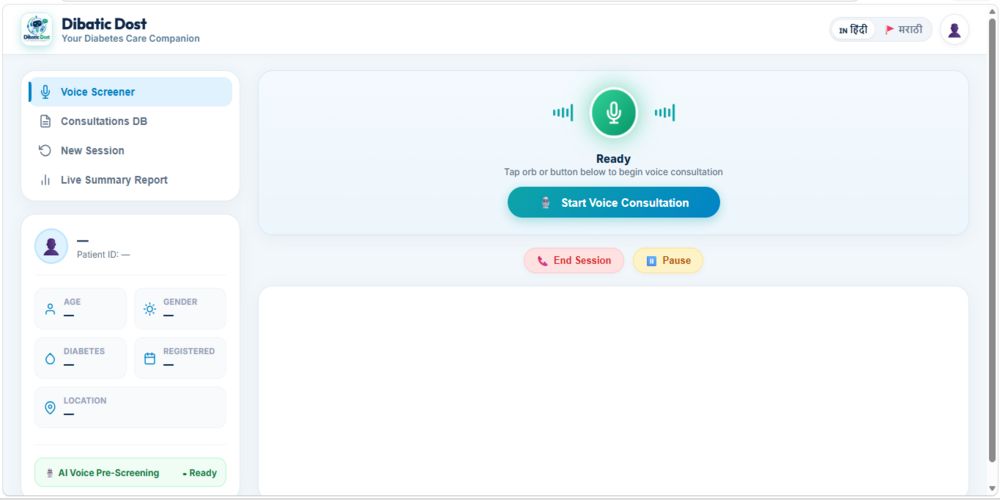
Screen 1: Diabetic Dost Voice Screener(Speech to Speech)
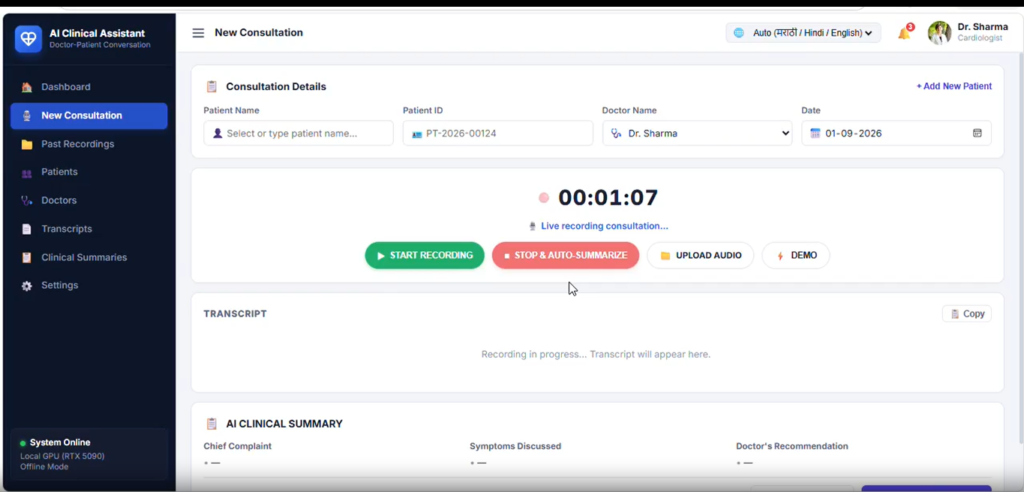
Screen 2: Diabetic Dost Voice Screener(Speech to Text) Chatbot
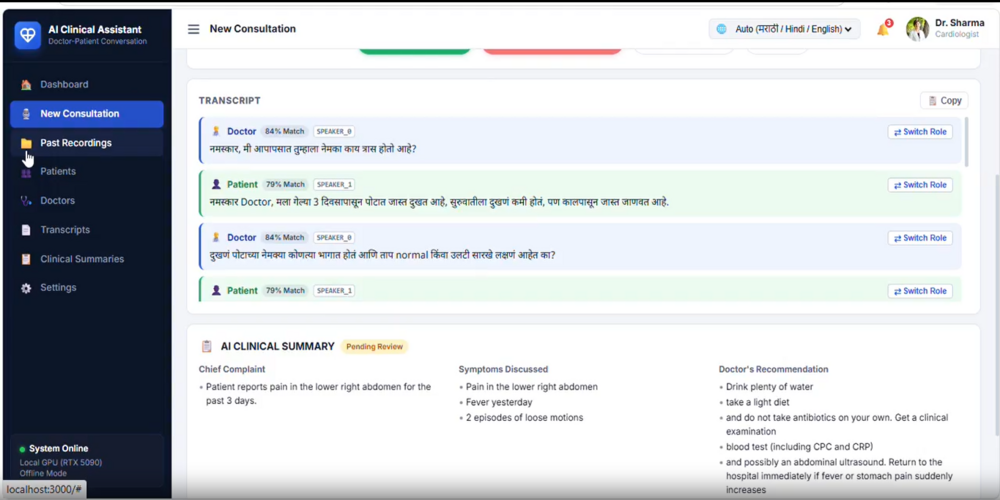
Screen 3: Diabetic Dost Consultation Tracker Screen
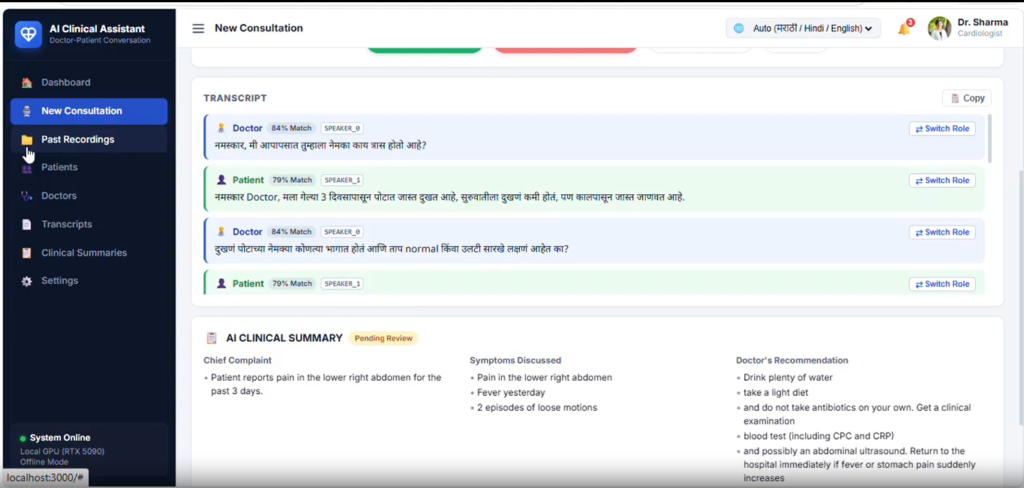
Screen 4: Diabetic Dost Consultation Transcript Screen
Responsible AI in Diabetes Patient Screening
Healthcare AI must be designed with appropriate clinical oversight. Diabetic Dost supports preliminary information collection; it does not independently diagnose diabetes or prescribe treatment.
Before deployment with real patient data, healthcare organizations should establish suitable consent procedures, access controls, data retention policies, security measures and applicable compliance requirements. Important clinical information should be checked and unclear or conflicting responses should be clarified rather than treated as confirmed facts.
Its effectiveness should be evaluated through measurable pilot indicators, including patient completion rates, time spent collecting intake information, completion of required fields, speech recognition errors involving clinical terms, summary factuality, clarification rates and clinician feedback.
These measures can help determine where the system works well and where further improvement is required.
Why Choose AI India Innovations for Healthcare AI Solutions?
Healthcare organizations need AI solutions that address real operational challenges while fitting their existing processes. AI India Innovations, based in Pune, develops customized AI solutions for healthcare and life sciences, including clinical workflow automation, medical documentation, speech AI and intelligent document processing.
Diabetic Dost reflects this approach by applying conversational AI to a specific challenge in healthcare: collecting patient information in a more accessible and structured way.
Beyond conversational AI, AI India Innovations also develops OCR technology for extracting information from documents and supporting document-driven workflows. These capabilities represent complementary areas of healthcare automation, with the right combination depending on an organization's requirements.
Conclusion
Diabetic Dost brings voice-based interaction, context-aware follow-up questions and structured patient history collection together to support preliminary diabetes screening. For clinics and hospitals, it offers an approach worth evaluating when manual intake is repetitive or patient information is difficult to organize. Its value should be established through pilot testing, with clinical decisions remaining in the hands of qualified healthcare professionals.
AI India Innovations helps healthcare and life sciences organizations explore and develop customized AI solutions around their operational needs, from conversational patient intake to medical documentation and OCR-based document processing. Organizations interested in applying AI to their healthcare workflows can work with AI India Innovations to assess relevant use cases, integration requirements and deployment considerations.
A well-designed chatbot can help bring these interactions into one accessible channel. Its effectiveness, however, depends on more than conversational AI alone. Reliable information, clearly defined workflows, appropriate escalation and integration with existing systems are equally important.
Frequently Asked Questions
An AI-powered diabetes screening voice assistant helps collect patient-reported information through spoken conversations. Diabetic Dost, developed by AI India Innovations, supports preliminary diabetes screening by guiding patients through questions, capturing responses, asking relevant follow-up questions, and organizing the information into a structured summary for healthcare professionals to review.
Diabetic Dost guides patients through a voice-based screening conversation, converts spoken responses into text, and uses the conversation context to ask follow-up questions when additional information is needed. It organizes the collected details into a structured patient history summary, helping healthcare professionals review the information before making clinical decisions.
Diabetic Dost is designed to collect patient-reported information such as symptoms, diabetes history, medication details, and available blood glucose readings. The information can be organized for review, while incomplete, unclear, or conflicting responses should be checked by a healthcare professional.
Voice-based screening can give patients an alternative to lengthy forms and help organize information before a consultation. By supporting guided questions, speech-to-text conversion, and structured patient history collection, Diabetic Dost can assist with pre-consultation intake and reduce repetitive information gathering. Actual workflow improvements depend on the implementation and clinical setting.
Yes. Diabetic Dost is designed to use conversational context to ask relevant follow-up questions when additional information is needed. This can help clarify patient responses and identify missing details during information collection. Important or conflicting information should still be verified by the healthcare professional.