
Best Open- Source Vision Language Models in 2026: Small VLMs, Comparisons and Licensing
Key takeaways at a glance
Qwen3-VL, InternVL 3.5, and Molmo 2 are the most versatile all-round open-source VLMs in 2026 — strong at OCR, document understanding, video, and reasoning.
Small is practical: models like SmolVLM2 (256M–2.2B), Qwen3-VL 2B, and MiniCPM-V 1B now handle real workloads on edge devices at low cost.
Parameter count ≠ performance: architecture, visual token compression, and training data matter as much as size.
Licensing decides deployment: Apache 2.0 and MIT models are safest for commercial use; Moondream 3 (BSL 1.1) and Llama 4 (community license with a 700M-MAU clause) need legal review.
1. Introduction
Vision Language Models (VLMs) are multimodal AI systems that understand visual and textual information together. They can analyze images, interpret documents, recognize text in scenes, read diagrams, answer visual questions, and even summarize video content.
In 2026, VLMs have moved from research demos into production: industrial automation, document intelligence, robotics, education, and real-time visual assistance all depend on them. Three forces are driving adoption — better architectures, aggressive visual token compression, and dramatically smaller parameter counts. Advanced visual understanding is no longer reserved for teams with data center budgets.
This article compares the leading open-source VLMs, with particular attention to lightweight models, their capabilities, evaluation benchmarks, and — critically — their licensing conditions.
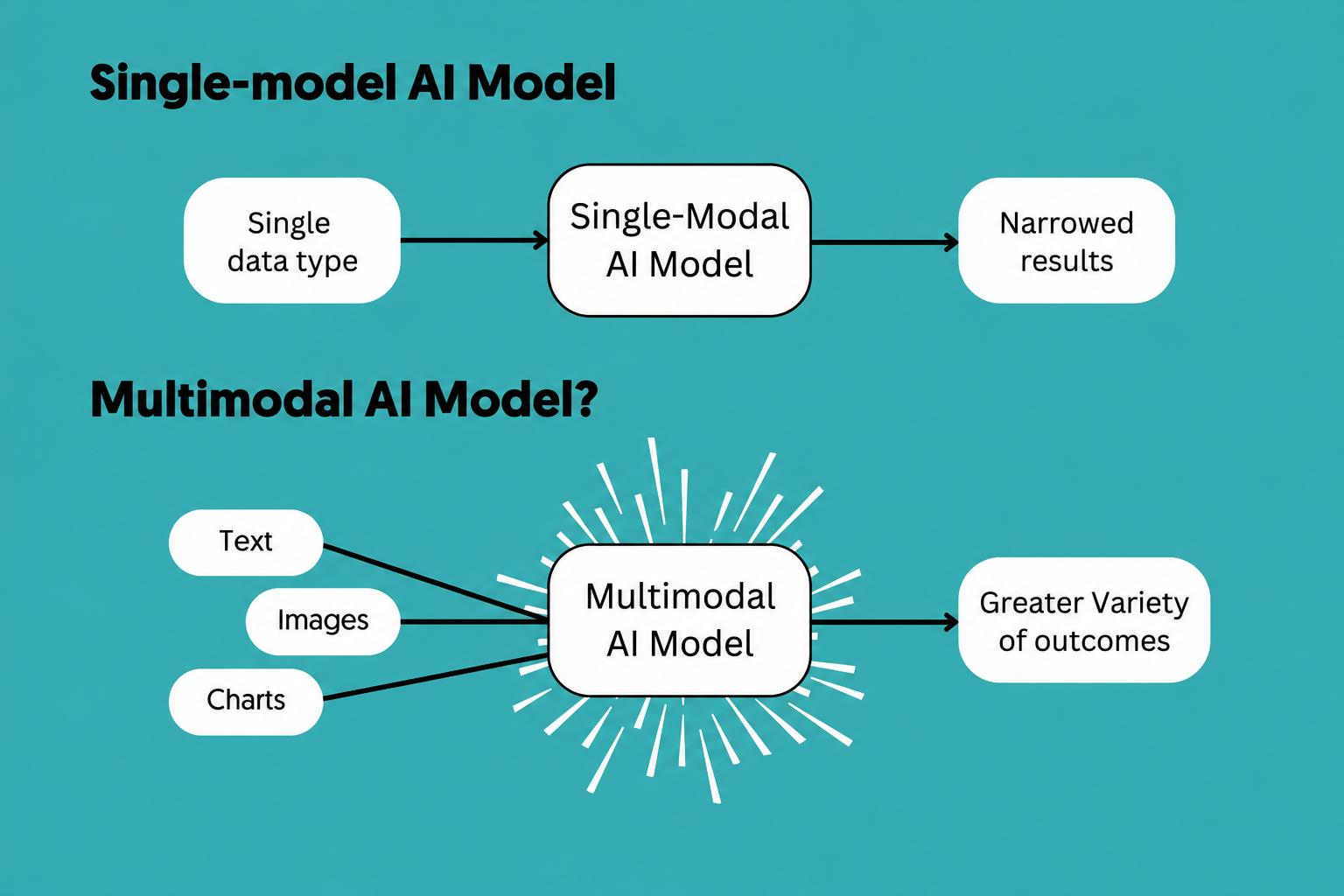
Figure 1 — Multimodal models fuse text, images, and structured input into a single system.
2. How a VLM Works: The Architecture in 60 Seconds
Nearly every modern VLM is built from the same three-part recipe:
- Vision encoder — converts images or video frames into visual features (tokens), typically using a ViTstyle backbone.
- Projection layer — maps those visual features into the language model's embedding space, so images and words live in the same vector world.
- Large language model (LLM) — consumes the combined visual and textual tokens and generates natural-language responses.
Depending on the design, a VLM may use a separate pretrained vision encoder, a fully unified multimodal architecture, or an efficient hybrid of both. During pre-training, the vision encoder and text decoder are often kept frozen while the projector learns the alignment — an inexpensive way to give a strong LLM "eyes."
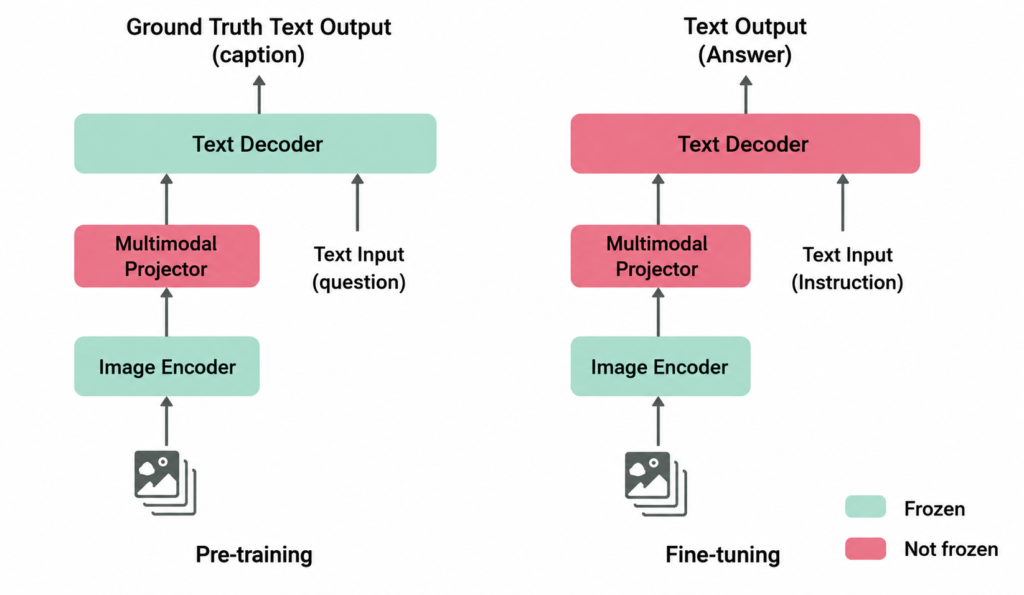
Figure 2 — Pre-training vs. fine-tuning in a typical VLM: the image encoder and text decoder start frozen.
3. The Best Open-Source VLMs of 2026
The models below represent different points on the capability/efficiency spectrum — from general-purpose reasoning to highly optimized visual processing.
| Model | Important variants | Main capabilities | Official reference |
|---|---|---|---|
| Qwen3-VL | 2B, 4B, 8B and larger | General vision, OCR, spatial understanding, video, visual reasoning | github.com/QwenLM/Qwen3-VL |
| InternVL 3.5 | 1B, 2B, 4B, 8B, 14B, 38B and MoE | High-resolution understanding, OCR, document analysis, reasoning | github.com/OpenGVLab/InternVL |
| Gemma 3 | 4B, 12B, 27B | Image understanding, multilingual tasks, VQA, reasoning | gemma.ai/models/gemma-3 |
| Molmo 2 | 4B, 8B, 7B-O | Visual grounding, pointing, counting, image & video understanding | allenai.org/molmo |
| Llama 4 | Scout, Maverick | Native multimodal understanding, image reasoning, long context | ai.meta.com — Llama downloads |
| MiniCPM-V 4.7 | 1B, 35B-A3B | Image, multi-image, document & video understanding with visual token compression | github.com/OpenBMB/MiniCPM-V |
| SmolVLM2 | 256M, 500M, 2.2B | Lightweight image understanding, video analysis, VQA | huggingface.co/blog/smolvlm2 |
| Moondream 3 | 2B active parameters | Visual grounding, object localization, captioning, segmentation | moondream.ai/models |
| Phi-4multimodal | ≈5.6B | Image, audio & text understanding, OCR, chart interpretation, reasoning | huggingface.co/microsoft/Phi-4-multimodal-instruct |
| PaliGemma 2 | 3B, 10B, 28B | Image captioning, OCR, VQA, task-specific fine-tuning | huggingface.co/google/paligemma2-10b-pt-448 |
Notable model characteristics
- Qwen3-VL — the most versatile family: visual understanding, spatial intelligence, document processing, and video in one stack. Its 2B variant is a standout for smaller deployments.
- InternVL 3.5 — the widest size range, from 1B/2B efficiency options up to 38B and MoE variants for advanced reasoning.
- Gemma 3 — pairs image understanding with strong multilingual language skills; the 4B variant is an attractive lightweight option.
- Molmo 2 — best-in-class for grounding, counting, pointing, and video; the 4B model is a capable smaller entry point.
- Llama 4 — native multimodal Mixture-of-Experts: Scout ships 109B total / 17B active parameters; Maverick 400B total / 17B active.
- MiniCPM-V 4.7 — aggressive visual token compression; spans from a 1B edge model to a 35B-A3B MoE.
- SmolVLM2 — efficiency-first design, including video understanding, at sizes down to 256M parameters.
- Moondream 3 — production-oriented grounding and localization; note its preview license has commercial-use restrictions (see Section 6).
- Phi-4-multimodal — fuses image, audio, and text inputs in a single ≈5.6B model.
- PaliGemma 2 — a flexible family built for visual understanding and fast adaptation to specialized tasks.
4. Small VLMs: The Efficiency Revolution
Small VLMs aim to deliver genuinely useful visual understanding with fewer parameters and lower computational cost. They shine wherever inference speed, memory footprint, and operating cost matter — which, in production, is almost everywhere.

Figure 3 — Representative parameter counts across the leading small VLMs
| Small VLM | Parameters | Strengths | Main Limitation |
|---|---|---|---|
| SmolVLM2 | 256M | Extremely compact; supports video | Limited complex reasoning |
| SmolVLM2 | 500M | Efficient image & video understanding | Struggles on difficult visual tasks |
| SmolVLM2 | 2.2B | Better visual reasoning & video understanding | Below larger models on complex tasks |
| Qwen3-VL | 2B | General visual understanding & OCR | Less capacity than larger variants |
| InternVL 3.5 | 1.1B total | Compact multimodal model | Reduced complex-reasoning capacity |
| Gemma 3 | 4B | Multilingual & image understanding | Outclassed by larger variants on hard tasks |
| MiniCPM-V 4.7 | 1B | Visual token compression; document understanding | More limited model capacity |
| Molmo 2 | 4B | Grounding, counting, video understanding | Below the 8B variant on demanding tasks |
| Moondream 3 | 2B active | Fast visual grounding & localization | Specialized preview with licensing restrictions |
Crucially, small models are not just compressed versions of big ones. Architecture, training data, choice of visual encoder, and token-processing strategy all materially change what a small model can do.
Why small VLMs matter
- Lower memory and compute requirements
- Reduced inference latency in suitable workloads
- Feasible on edge and embedded hardware
- Lower operating costs at scale
- Cheap experimentation and task-specific fine-tuning
The honest trade-off: small models can still stumble on dense document layouts, multi-step reasoning, complex diagrams, and long-video analysis. Match the model to the task, not the benchmark.
5. Small vs. Large VLMs
| Dimension | Small VLMs | Large VLMs |
|---|---|---|
| Parameters | Usually below 4B | Often 8B and above |
| Inference speed | Generally faster | Generally slower |
| Memory consumption | Lower | Higher |
| Visual reasoning | Basic to moderate | Usually more advanced |
| OCR & documents | Suitable for simpler tasks | Better for complex documents |
| Video understanding | Limited to moderate | Better temporal reasoning potential |
| Fine-tuning | Often more manageable | More computationally demanding |
| Best fit | Edge AI, lightweight apps | Research, complex analysis, enterprise |
Parameter count alone does not determine performance. A well-trained small model can — and regularly does — outperform a larger, poorly aligned model on specific tasks
6. Licensing: The Part Everyone Skips (and Regrets)
Licensing is one of the most important — and most overlooked — factors when selecting a VLM. A publicly downloadable model does not automatically grant unrestricted commercial rights.
Common AI model licenses
| License | Commercial Use | Modification | Redistribution |
|---|---|---|---|
| Apache 2.0 | Yes | Yes | Yes, with conditions |
| MIT | Yes | Yes | Yes, with copyright notice |
| Gemma Terms | Conditional | Yes, subject to terms | Yes, subject to redistribution requirements |
| Llama Community License | Conditional | Yes | Conditional |
| Creative Commons (CC) | Depends on variant | Depends on variant | Depends on variant |
| Custom License | Depends on agreement | Depends on agreement | Depends on agreement |
Key distinctions
- Apache 2.0 — permissive: commercial use, modification, and redistribution allowed, with copyright, license, and notice requirements.
- MIT — commercial use, modification, and redistribution permitted, with copyright and license notice preserved.
- Gemma Terms — commercial use and modification permitted, but with use restrictions and specific redistribution obligations.
- Llama Community License — commercial use allowed under conditions, including attribution; notably, organizations exceeding 700 million monthly active users must request additional permission under the Llama 4 agreement.
- Creative Commons — variant-dependent: CC BY permits commercial reuse with attribution; CC BYNC explicitly prohibits commercial use.
- Custom licenses — terms are set by the model owner and must be reviewed individually.
Model-by-model licensing comparison
| Model | License | Commercial Use | Modify | Redistribute |
|---|---|---|---|---|
| Qwen3-VL | Apache 2.0 | Yes | Yes | Yes |
| InternVL 3.5 | MIT (repository code; verify checkpoint) | Generally yes | Yes | Yes |
| Gemma 3 | Gemma Terms | Yes, subject to terms | Yes | Yes, with conditions |
| Molmo 2 | Apache 2.0 | Yes | Yes | Yes |
| Llama 4 | Llama Community License | Conditional | Yes | Conditional |
| MiniCPM-V 4.7 | Custom model license; Apache 2.0 code | Registration / conditions apply | Subject to model terms | Subject to model terms |
| SmolVLM2 | Apache 2.0 | Yes | Yes | Yes |
| Moondream 3 Preview | BSL 1.1 | Restricted by terms | Restricted by terms | Restricted by terms |
| Phi-4-multimodal | MIT | Yes | Yes | Yes |
| PaliGemma 2 | Gemma Terms | Yes, subject to terms | Yes | Yes, with conditions |
Licensing red flags: Moondream 3 Preview ships under BSL 1.1 — not a permissive license. MiniCPM's model weights carry separate terms from its Apache-licensed code. InternVL's repository license should not be assumed to cover every third-party component or checkpoint. Always inspect the exact release before commercial redistribution.
7. Recommendations by Application
There is no universally "best" VLM — only the best fit for your task, accuracy bar, hardware, and legal constraints.
| Application | Recommended Models | Why |
|---|---|---|
| General image understanding | Qwen3-VL, Gemma 3 | Versatile VQA and reasoning |
| OCR & document understanding | Qwen3-VL, InternVL 3.5, MiniCPM-V | Strong document and text-oriented capabilities |
| Visual reasoning | Qwen3-VL, InternVL 3.5, Llama 4 | Advanced multimodal reasoning |
| Video understanding | Molmo 2, SmolVLM2, Qwen3-VL | Video analysis and temporal understanding |
| Lightweight / edge applications | SmolVLM2, Qwen3-VL 2B, InternVL 1B | Smaller model variants |
| Visual grounding | Molmo 2, Moondream 3 | Pointing, localization, spatial outputs |
| Commercial deployment | Qwen3-VL, Molmo 2, Phi-4-multimodal | Permissive licensing (subject to third-party notices) |
For commercial projects, Apache 2.0 and MIT releases generally offer the simplest path — but dataset rights, trademarks, privacy obligations, and third-party dependencies must still be cleared.
8. Limitations and What's Next
Despite rapid progress, VLMs in 2026 still have well-documented weaknesses:
- Hallucination — models describe objects or details that simply aren't in the image.
- OCR accuracy — small, distorted, or low-resolution text remains hard.
- Spatial understanding — precise object relationships, counting, and localization can be unreliable.
- Video reasoning — long videos and temporal consistency are still unsolved.
- Compute cost — large models still demand serious hardware.
- Benchmark gaps — high leaderboard scores don't guarantee real-world reliability.
Emerging trends
- Smaller models with dramatically improved multimodal reasoning
- Better visual token compression and efficient architectures
- Stronger OCR and high-resolution document understanding
- Real-time video and audio-visual understanding
- More accurate visual grounding and spatial reasoning
- Greater transparency in training data, weights, and licensing
9. Conclusion
The VLM ecosystem in 2026 offers a genuinely useful model for almost every budget — from 256Mparameter edge models to 400B-parameter MoE architectures. Qwen3-VL, InternVL 3.5, and Molmo 2 lead on versatility; SmolVLM2, Gemma 3, and MiniCPM-V prove that efficient multimodal models are no longer a compromise.
The right selection process goes beyond parameter counts and benchmark scores. Accuracy on your data, inference efficiency, task fit, and licensing permissions matter equally. The future of VLM development isn't only about building bigger models — it's about making visual intelligence more efficient, accurate, accessible, and commercially usable for everyone.
Frequently Asked Question
Yes. AI India Innovations develops custom Generative AI and Large Language Model (LLM) solutions based on specific business use cases. Solutions can be customized using domain-specific data, knowledge bases, prompts, APIs, and integrations to create AI applications that align with an organization's workflows and requirements.
About the Company
Company Name: AI India Innovations
Connect With Us
Interested in implementing AI-powered visual inspection solutions for your manufacturing process?
Email: connect@aiindia.ai