
VLM vs Computer Vision: Is Detecting Objects Enough, or Do Machines Need to Understand What They See?
Key takeaways at a glance
Detection $\neq$ understanding: YOLO tells you what and where, while a VLM can tell you what it looks like and what it might mean in plain language.
Neither replaces the other: YOLO wins on speed, precision localization, and edge deployment; VLMs win on flexibility, context, and explainability.
The unknown-defect problem: New defect types break class-based detectors, making anomaly detection and VLMs complementary safety nets rather than magic fixes.
The winning pattern for 2026: YOLO screens every frame, a VLM explains uncertain cases, a validation layer decides, and humans keep final authority.
1. Introduction: The Next Step in Industrial Inspection
Imagine a metal component moving along a conveyor belt. A camera captures its image, and an AI model flags a small irregularity on its surface. The model draws a bounding box and assigns a label: Defect detected.
But now consider a different set of questions:
What exactly is wrong with the component?
Is the flagged irregularity truly a defect, or just a normal surface variation?
Can the system explain what it observed — in words an engineer would use?
Can it compare the visual condition against inspection requirements?
Detecting something and understanding what has been detected are two different challenges.
This is exactly where traditional Computer Vision and Vision Language Models (VLMs) diverge — and where combining them gets interesting. Computer vision has already transformed industrial automation through detection, classification, segmentation, and tracking. Models like YOLO made real-time inspection practical.
VLMs add a new dimension: connecting visual information with language, context, and reasoning-like responses.
That raises the question this article explores: are we moving from machines that simply detect defects to machines that can also describe and interpret what they see?
2. First, the Vocabulary: CV, Object Detection, YOLO, and VLM
Before comparing capabilities, it's worth untangling the terminology — these four terms are not interchangeable, and confusing them leads to bad architecture decisions.
Computer Vision: the bigger picture
Computer Vision (CV) is the field of AI that lets machines process and understand visual information from images and videos. It covers:
Image processing and enhancement
Image classification
Object detection and tracking
Image segmentation and defect detection
Optical Character Recognition (OCR)
On an automotive line, a CV system can inspect components, identify missing parts, track moving objects, and monitor assembly operations. CV is the foundation on which most industrial visual inspection is built.
Object detection: finding and locating things
Object detection goes beyond recognition — it also answers where. Its three standard outputs:
Class — what object was detected?
Bounding box — where is it?
Confidence score — how sure is the model?
Given an image full of industrial components, a detector can label bolts, nuts, tools, or defect regions and place a box around each one.
YOLO: making detection real-time
YOLO — You Only Look Once — is a family of deep-learning models (maintained in active versions such as YOLOv8 through YOLOv12 by Ultralytics and the research community) that predict object classes and locations in a single forward pass. That design choice is why YOLO dominates speed-sensitive inspection.
Picture a conveyor moving hundreds of products per minute: a slow inspector misses parts or delays production; an optimized YOLO model keeps pace. Modern YOLO variants also handle classification, segmentation, pose estimation, and tracking, depending on the model and implementation.
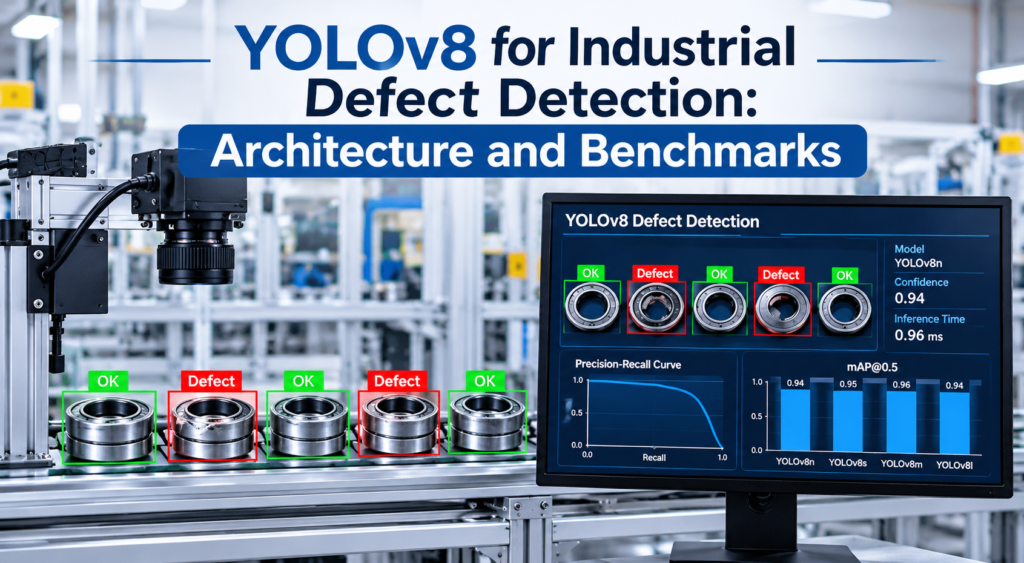
Figure 1 — YOLO-based defect detection on a production line: structured outputs (class, box, confidence) rendered over the live frame.
Vision Language Models: connecting vision with language
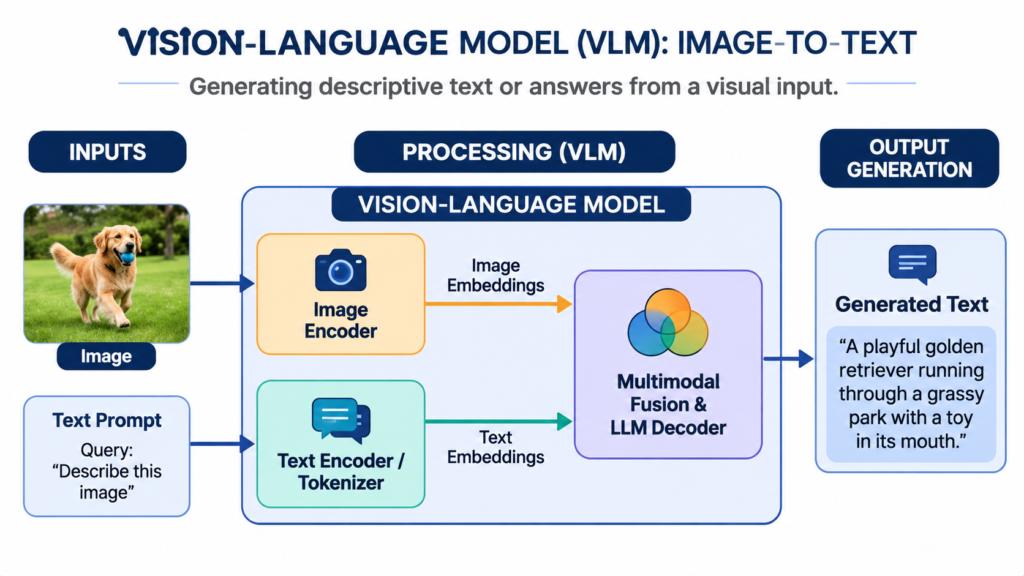
A VLM pairs visual understanding with language processing. Instead of emitting only predefined labels, it accepts an image plus a free-text prompt, analyzes the visual content, and generates a natural-language response. Example prompts:
- "Describe the visible condition of this weld. Are there any noticeable irregularities?"
- Possible VLM response: "The weld surface appears uneven, with a visible irregularity near the right side."
Representative VLMs include Qwen2.5-VL, LLaVA, InternVL, PaliGemma, and closed models like GPT-4o. The key difference: a VLM follows flexible language instructions, while a detector performs the specific task it was trained for. One important caveat — a VLM's description is not automatically a verified engineering conclusion. Its observations must still be checked against inspection requirements.
3. The Experiment: Give the Same Image to YOLO and a VLM
Here's a simple but revealing experiment. Take one image of a metal component with a visible surface irregularity, and hand it to two different AI systems.
Experiment A — YOLO
A custom-trained YOLO model identifies the region it has learned to recognize. Its output:
Detected object: Surface defect
Confidence: 0.91
Location: bounding-box coordinates
Result: potential defect detected
The output is structured, measurable, and easy to process programmatically. What YOLO does not do is explain, in engineering terms, why the region is defective or what the irregularity looks like.
Experiment B — VLM
Provide the same image with the prompt: "Analyze this component and describe the visible surface abnormalities."
"The component appears to have a scratch-like mark near its upper section. The surrounding surface looks relatively uniform."
A human inspector reads that instantly. But there's a catch: the VLM might miss a small defect, misdescribe a normal variation, or assert something the pixels don't support — the well-known hallucination problem
What the experiment tells us
| YOLO | VLM |
|---|---|
| Detects predefined classes | Describes visual content |
| Returns bounding boxes | Returns natural language |
| Provides confidence scores | Generates textual responses |
| Built for fast detection | Built for contextual analysis |
| Needs task-specific training for most applications | Responds to new prompts using learned visual-language knowledge |
| Strong for structured outputs | Flexible for descriptive outputs |
Summary: YOLO answers what was detected, and where is it?, while a VLM answers what does the image appear to show, and how can we describe it? Neither model replaces the other
4. Why Traditional Detection Sometimes Isn't Enough
Imagine an inspection system trained on three defect classes: crack, scratch, missing component. It performs beautifully in testing. Then the manufacturing process changes — a new type of surface irregularity appears.
What happens? The YOLO model may misclassify the new defect, miss it entirely, or force it into a known category. Why? Because it learned patterns from its training data; it does not automatically understand every defect the real world can produce. This is the unknown-defect problem — the Achilles' heel of class-based detection.
Manufacturing environments are inherently unpredictable: new materials, shifting lighting, damaged components, and previously unseen defects all create situations absent from the training dataset. Practical countermeasures include:
Collecting new defect samples and retraining the detector
Using anomaly detection to flag unusual patterns (Section 7.1)
Applying a VLM to generate descriptions of unfamiliar images
Routing uncertain cases to human review
Continuously improving the dataset with verified inspection results
Reality check: VLMs make investigations of unfamiliar images more flexible, but they are not a guaranteed detector of unknown defects. No single model solves this problem — combined techniques do.
5. YOLO vs VLM for Industrial Inspection: An Engineer's Comparison
| Parameter | YOLO | VLM |
|---|---|---|
| Main capability | Object detection and related vision tasks | Visual and language understanding |
| Input | Images or video frames | Images + text prompts; some models support video |
| Output | Classes, bounding boxes, confidence scores | Text descriptions and question answers |
| Speed | Generally faster | Often slower |
| Localization | Structured boxes or masks | Not inherently precise |
| Training | Usually task-specific training | Zero-shot and instruction-based use possible |
| Flexibility | More specialized | More flexible through prompts |
| Edge deployment | Generally easier | Depends heavily on model size |
| Best application | Known defects and objects | Contextual image analysis |
| Main limitation | Limited to learned task and classes | Can hallucinate or miss visual details |
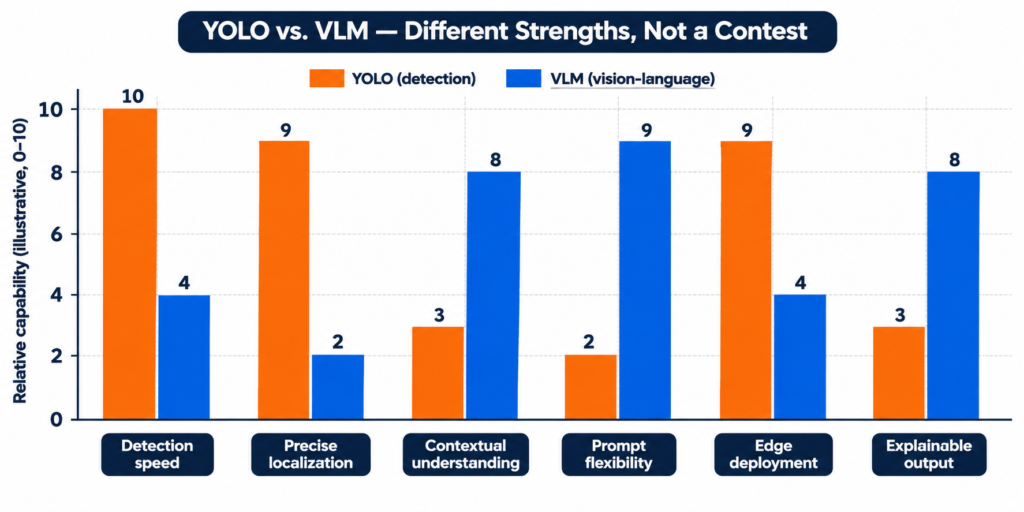
Figure 2 — Illustrative capability profile: YOLO and VLMs optimize for fundamentally different trade-offs (original chart).
5.1 Accuracy alone is not enough
A system that detects 95% of visible defects but needs several seconds per image is impractical on a fast conveyor belt. Equally, a blazing-fast model that misses critical defects is useless. Industrial inspection demands a balance across:
Detection accuracy, precision, and recall
False-positive and false-negative rates
Inference latency and throughput (frames per second)
GPU memory consumption
Reliability across changing production conditions
For detectors, standard metrics are mAP, precision, and recall. For VLMs, evaluation must additionally ask: is the description factually supported by the image, are important details missed, and are responses consistent across repeated runs?
5.2 Speed vs. contextual understanding
YOLO is engineered for efficient object detection, while Vision-Language Models (VLMs) handle the more computationally demanding tasks of visual understanding and language generation.
Smaller, quantized VLMs can run on edge hardware, but their resource requirements and response times must be measured rather than assumed. The choice ultimately depends on one key question: Does the application prioritize fast, structured detection or richer contextual analysis?
Quick Decision Guide
- Known defects, high production-line speed, and a tight budget: Choose YOLO, potentially combined with anomaly detection as a secondary layer.
- Explaining, reporting, or querying images in natural language: Choose a VLM.
- Both detection and contextual understanding: Use a hybrid pipeline that combines YOLO with a VLM. This approach is increasingly relevant to industrial AI deployments in 2026.
6. The Innovative Approach: What If YOLO and VLM Work Together?
Instead of asking which model is better, ask a better question: what if each model performs only the task it's best at? The answer is a hybrid AI inspection architecture.
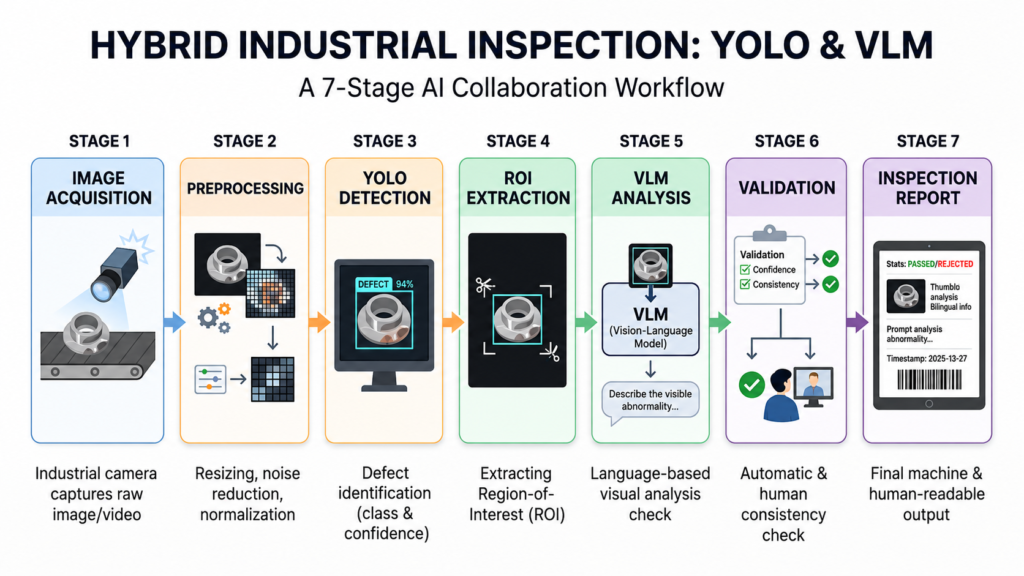
Stage 1 — Image acquisition
An industrial camera captures images or video of products moving along the line.
Stage 2 — Preprocessing
OpenCV prepares the image: resizing, normalization, noise reduction, region extraction.
Stage 3 — YOLO detection
A trained YOLO model identifies potential defects and returns class, bounding box, and confidence.
Stage 4 — Region-of-interest extraction
The detected region is cropped from the original frame. Sending only the ROI (plus context when needed) to the VLM keeps prompts focused and costs down.
Stage 5 — VLM analysis
The crop is passed to a VLM with a disciplined prompt, for example: "Describe the visible abnormality in this region. Identify its appearance and location. Do not assume a defect type if the visual evidence is insufficient."
Stage 6 — Validation layer
The system should never blindly accept model output. It checks whether the class is allowed, the confidence exceeds threshold, the VLM description is consistent with the detected region, and whether human review is warranted. For critical decisions, a validated rule or a human inspector makes the final call.
Stage 7 — Inspection report
The system stores product ID, captured image, detection results, confidence, VLM description, inspection status, and timestamp — output that is both machine-readable and human-readable.
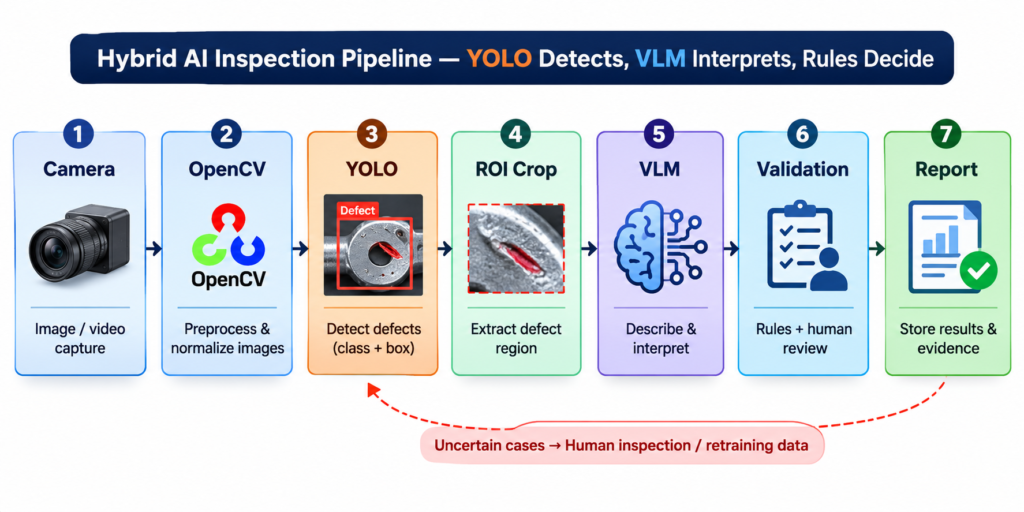
Figure 3 — Hybrid inspection pipeline: fast detection on every frame, deep interpretation only where it matters, human authority on uncertain cases.
Design insight: Invoking the VLM only on flagged regions turns an expensive per-frame model into an affordable per-event model — the single most effective cost optimization in this architecture
7. The Future: Multimodal Industrial AI
The next generation of inspection systems combines several forms of intelligence in one loop:
- Capture the product image automatically
- Detect defects with a trained CV model
- Flag unusual patterns via anomaly detection
- Describe suspicious regions with a VLM
- Compare results against product specifications
- Store inspection history and generate engineering reports
- Send alerts when further inspection is needed
And it can go further by fusing vision with other industrial signals — temperature readings, vibration measurements, machine operating conditions, production history. Combining these data sources provides context no image alone can deliver: the foundation of multimodal industrial AI, enabling predictive maintenance, process monitoring, quality analysis, and better-informed manufacturing decisions. These capabilities demand proper integration, data quality, validation, and reliable decision rules — the unglamorous work that makes AI trustworthy.
8. Final Thoughts: Detection Is the Beginning, Not the End
Computer vision gave machines the ability to analyze images; YOLO made that analysis fast enough for the factory floor.
Vision Language Models add a new dimension — connecting visual information with natural language. But the goal of industrial AI is not to adopt the newest or largest model; it's to solve the actual engineering problem.
Detecting known defects at high speed? $\rightarrow$ A properly trained, optimized YOLO model.
Spotting unusual patterns? $\rightarrow$ Anomaly detection.
Describing observations or answering image questions? $\rightarrow$ A VLM.
Need all of the above? $\rightarrow$ A hybrid architecture.
The real advancement in industrial AI will not come from replacing every existing model with a VLM. It will come from combining specialized models intelligently, validating their outputs, and building systems that are not only capable of seeing — but useful in making reliable inspection decisions
Frequently Asked Questions
Yes. AI India Innovations develops custom Generative AI and Large Language Model (LLM) solutions based on specific business use cases. Solutions can be customized using domain-specific data, knowledge bases, prompts, APIs, and integrations to create AI applications that align with an organization's workflows and requirements
About the Company
Company Name: AI India Innovations
Connect With Us
Interested in implementing AI-powered visual inspection solutions for your manufacturing process?
Email: connect@aiindia.ai