
Choosing the Best Voice Activity Detection in 2026: Cobra vs Silero vs WebRTC VAD
Introduction
Best Voice Activity Detection in 2026 depends less on picking the most popular tool and more on understanding what your voice application actually needs. Whether you are building a voice AI agent, call centre bot, transcription application, smart speaker or another speech-based product, Voice Activity Detection (VAD) is one of the first components your audio passes through.
In simple terms, WebRTC VAD is the fastest and simplest option, but can struggle in noisy environments. Silero VAD is a strong free and open-source choice for most developers, while Cobra VAD from Picovoice focuses on high accuracy, low latency and on-device processing. This guide compares all three in practical terms so you can make the right choice for your project.
At AI India Innovations, we see a similar need across AI implementations: the right model or technology is only useful when it fits the actual business workflow. Just as our OCR solutions are designed to turn documents into usable business data rather than simply "read" documents, choosing a VAD should also be about what happens after speech is detected.
What Is Voice Activity Detection (VAD)?
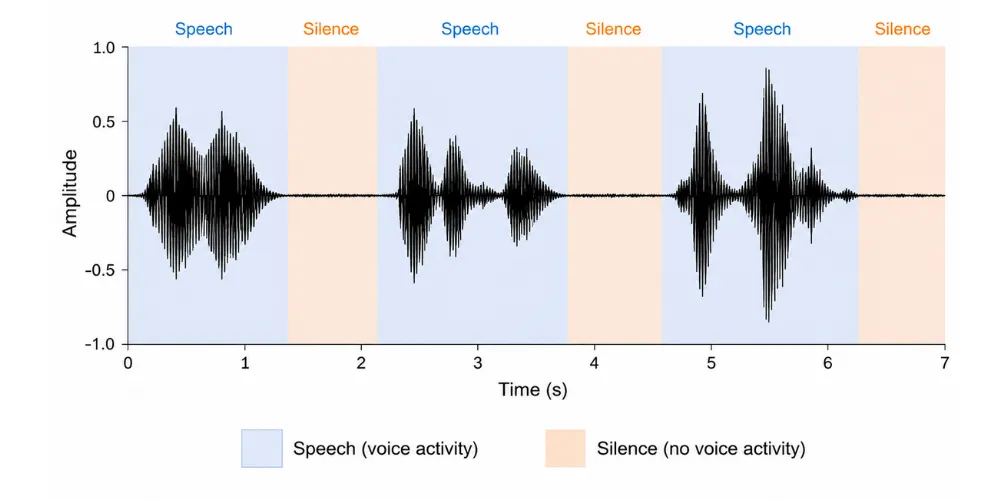
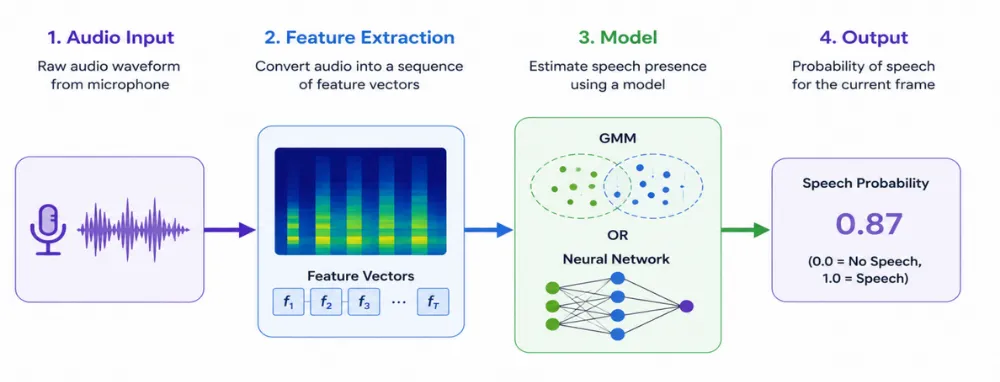
Voice Activity Detection is a small piece of software that listens to a stream of audio and decides, moment by moment, whether a person is speaking or not. It looks at short pieces of audio, called frames and labels each one as "speech" or "no speech".
VAD sits right at the start of almost every voice application. It runs before speech-to-text, before a voice agent decides to reply and before a call recording system decides to save a piece of audio. Because of this, VAD is also called speech detection or speech activity detection.
Without VAD, your system would process every single second of audio - including silence, background hum or music - through expensive steps like transcription or AI model calls. This wastes computing power, adds delay and increases your cloud bill. VAD simply tells the rest of the system: "start paying attention now" or "this part is just noise, skip it."
Why VAD Matters in Voice AI Today
Voice AI is now used everywhere - customer support bots, meeting note-takers, voice assistants and automated phone systems. All of these depend on a VAD engine underneath to know exactly when someone is talking.
– Voice agents need VAD to know when a caller has finished speaking, so the AI can reply without an awkward pause or cutting the person off.
– Speech-to-text and AI model costs depend on how much audio you send. A good VAD removes silence and noise before sending audio further, which lowers cost.
-- Devices with small chips, like smart speakers or wearables, need a VAD that is light and fast enough to run without a powerful processor.
– Real environments are noisy - call centres, streets, offices. A cheap VAD often fails here, while a well-trained VAD keeps working correctly.
Meet the Three VAD Engines
WebRTC VAD
WebRTC VAD is the voice activity detector that comes with Google's open-source WebRTC project - the same technology used for video calling inside web browsers. It uses an older method called a Gaussian Mixture Model (GMM), which looks at the energy level of the audio across a few frequency bands to guess if it is speech. It has been used for more than ten years, is very lightweight and is free to use under the BSD licence.
Silero VAD
Silero VAD is a newer, open-source VAD that uses a small deep learning model instead of the older signal-processing method. It was trained on a large amount of speech data covering many languages and noise conditions. The model file is very small, under 2 MB and it runs through PyTorch or ONNX Runtime. Silero VAD is released under the MIT licence, so it is completely free, even for commercial products.
Cobra VAD (Picovoice)
Cobra VAD is a commercial VAD engine made by a company called Picovoice. Unlike Silero, Cobra does not use PyTorch or ONNX at all - Picovoice built its own small and fast engine from scratch, made specifically to run on phones, browsers and small devices. Cobra runs completely on the device itself, meaning no audio needs to be sent anywhere else to check for speech. Picovoice offers official, ready-made SDKs for Python, C, .NET, Node.js, Android, iOS and the web.
Cobra vs Silero vs WebRTC VAD - Comparison Table
| Feature | WebRTC VAD | Silero VAD | Cobra VAD |
|---|---|---|---|
How it works |
Signal processing (GMM) |
Deep learning model |
Custom-built deep learning model |
Accuracy in noise |
Lowest of the three |
Good |
Highest, based on Picovoice’s own tests |
What it returns |
Yes / No (speech or not) |
Timestamps and a probability score |
A probability score from 0 to 1 |
Model size |
No model, pure algorithm |
Under 2 MB |
Small, made for edge devices |
Licence |
BSD (free, open source) |
MIT (free, open source) |
Commercial licence |
Cost |
Free |
Free |
Free to try, paid for production use |
Need any framework? |
No |
Yes – PyTorch or ONNX Runtime |
No, its own custom engine |
Official SDKs |
C/C++, some community versions |
Python, plus community versions |
Python, C, .NET, Node.js, mobile, web |
Pros and Cons of Each VAD
| VAD Engine | Pro(s) | Con(s) |
|---|---|---|
WebRTC VAD |
— Tiny footprint with minimal setup required. — Completely free and open source. — Very fast and efficient on low-power or older hardware. — Low CPU and memory usage, making it suitable for real-time. |
– Lower accuracy in noisy environments. – Uses a traditional rule-based algorithm instead of deep learning. – Less effective for complex or overlapping speech. |
Silero VAD |
– Completely free and open source. – Deep learning-based model with high accuracy. – Performs well across different languages and noises. – Suitable for real-time and offline speech processing. |
– Requires PyTorch or ONNX Runtime for inference. – Higher computational and memory requirements. – Slightly increased inference latency due to the neural network. |
Cobra VAD |
– Highest accuracy among the three according to Picovoice. – Optimized for edge devices with low latency. – Robust performance in noisy environments. – Commercial product with documentation and support. |
– Paid product beyond the free usage tier. – Closed-source, limiting customization and transparency. – Requires a Picovoice AccessKey and internet access for initials. |
Accuracy - Which VAD Detects Speech Best?
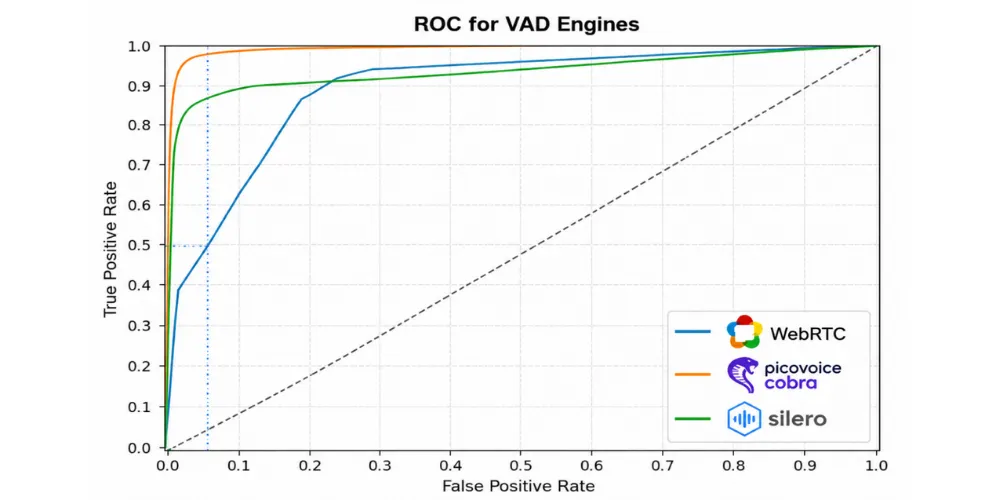
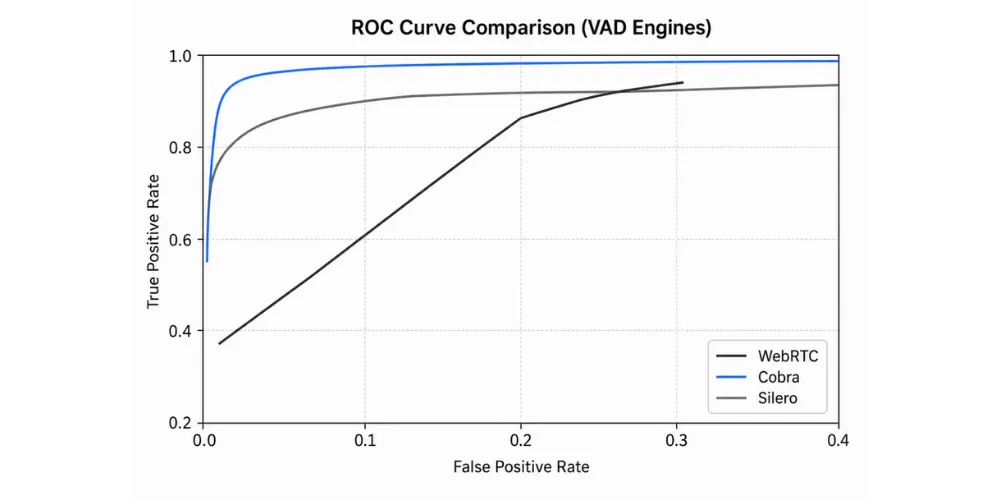
To test accuracy fairly, engineers usually mix clean speech with real background noise - traffic, kitchen sounds, office chatter - and check how often the VAD gets it right. This is measured using something called a ROC curve, which compares how much real speech is correctly caught against how much noise is wrongly marked as speech.
Picovoice, the company behind Cobra, has published an open-source benchmark that tests all three engines using this method. According to their own published results, Cobra reaches close to 99 percent accuracy at a low false-alarm rate, while Silero reaches around 88 percent under the same noisy conditions. WebRTC VAD, being the oldest and simplest method, tends to struggle the most once background noise is not steady, such as traffic or people talking in the background.
Speed and Performance
Being accurate is not enough - a VAD also needs to run fast enough for real-time use, sometimes on very small devices. Engineers measure this using the Real-Time Factor (RTF), which tells you how much computer time it takes to process one second of audio. A smaller RTF means faster processing.
– Silero VAD processes a 30-millisecond piece of audio in about 1 millisecond on a normal computer, using just one CPU thread.
– Cobra VAD, according to Picovoice's own tests, is around 2.5 times faster than Silero when comparing their Python versions.
– WebRTC VAD is the lightest of all three because it has no neural network at all - this is why it is still used in older phone and calling systems.
In practice, all three run comfortably in real time on a normal computer or phone. Speed is rarely the deciding factor - accuracy in noisy conditions usually matters more, unless you are working with a very small, low-power chip.
CPU, Latency and Memory Usage
Here is a quick side-by-side view of how light each engine is on system resources:
| Engine | CPU Usage | Latency | Memory |
|---|---|---|---|
WebRTC VAD |
Lowest |
Very Low |
Very Low |
Silero VAD |
Moderate |
Low |
Low |
Cobra VAD |
Low |
Very Low |
Very Low |
These are general, real-world patterns rather than fixed numbers - actual CPU, latency and memory use will vary a little depending on your hardware and settings.
How to Install and Use Each VAD (Simple Code Examples)
Below is beginner-friendly code for each VAD engine. These examples show only the basic setup - a real product also needs extra logic to group frames into full speech segments, but this is enough to get each engine running and detecting speech.
WebRTC VAD - Code Example
WebRTC VAD only works with 16-bit mono audio, at 8000, 16000, 32000 or 48000 Hz and each audio frame must be exactly 10, 20 or 30 milliseconds long.
# Step 1: Install the library

pip install webrtcvad


# Step 2: Basic usage

import webrtcvad


vad = webrtcvad.Vad()

vad.set_mode(3)

# 0 = least strict, 3 = most strict about filtering non-speech


sample_rate = 16000

frame_duration_ms = 30

frame = b'\x00\x00' * int(sample_rate * frame_duration_ms / 1000)


is_speech = vad.is_speech(frame, sample_rate)

print('Contains speech:', is_speech)
Silero VAD - Code Example
Silero VAD can work on a full audio file and return the exact timestamps where speech happens.
# Step 1: Install the library

pip install silero-vad


# Step 2: Basic usage on a WAV file

from silero_vad import load_silero_vad, read_audio, get_speech_timestamps


model = load_silero_vad()

wav = read_audio('my_audio.wav')


speech_timestamps = get_speech_timestamps(

    wav,

    model,

    return_seconds=True

)

print(speech_timestamps)
Cobra VAD - Code Example
Before using Cobra, sign up for free on the Picovoice Console website and copy your AccessKey - you need to pass this key in when you create the Cobra object.
# Step 1: Install the library

pip install pvcobra


# Step 2: Basic usage

import pvcobra


cobra = pvcobra.create(access_key='YOUR_ACCESS_KEY')


def get_next_audio_frame():

    # read audio samples from your microphone or audio stream

    pass


while True:

    frame = get_next_audio_frame()

    voice_probability = cobra.process(frame)

    if voice_probability > 0.5:

        print('Speech detected')
How Each VAD Works Internally
Inside WebRTC VAD
WebRTC VAD breaks incoming audio into short frames and measures the energy levels across a few frequency ranges. A pre-built statistical model (the Gaussian Mixture Model) then checks how closely this energy pattern matches typical speech versus typical noise. There is no learning happening while it runs and no neural network involved. This makes it extremely fast and small, but it also means it has a fixed idea of what noise looks like - so it struggles with sounds it was never designed to recognise, like changing traffic noise or overlapping voices.
Inside Silero VAD
Silero VAD replaces the older statistical model with a small, trained neural network. It was trained on a very large and varied set of recordings covering many languages and background conditions. Because it learned from real, messy audio examples instead of following fixed rules, it generalises much better to noise types it has never directly seen before, compared to WebRTC VAD.
Inside Cobra VAD
Cobra also uses a neural network, but Picovoice built the entire system themselves - the training data, the model and the runtime that runs the model - instead of relying on PyTorch, TensorFlow or ONNX Runtime. This means there is no extra framework overhead sitting on top of the model. This is part of why Picovoice can claim both a smaller footprint and higher accuracy at the same time. Because it runs fully on the device, no audio ever needs to leave the device just to check for speech, which is one reason healthcare and finance companies find it appealing.
Licence and Cost
| Engine | CPU Usage | Latency |
|---|---|---|
WebRTC VAD |
BSD (open source) |
Completely free, personal or commercial use |
Silero VAD |
MIT (open source) |
Completely free, no keys, no telemetry |
Cobra VAD |
Commercial licence |
Free tier to try it, paid plans for production use |
If you have no budget and just need something that works well enough, Silero VAD is the easiest choice - it is free, has no restrictions and needs no account or key. If accuracy in real, noisy conditions is critical to your product and you can pay for it, Cobra is worth trying against Silero on your own data before deciding.
Platforms and Programming Languages Supported
– WebRTC VAD: written in C/C++, with community-made versions for Python and several other languages. It has been around for a long time, so it is very widely supported.
– Silero VAD: officially supports Python through PyPI and torch.hub, plus a large community that has built extra versions in Rust, C# for iOS and macOS, Flutter for mobile apps and TypeScript for the browser.
– Cobra VAD: has official, company-maintained SDKs for Python, C, .NET, Node.js, Android, iOS and the web through WebAssembly. It also runs on small boards like Raspberry Pi, NVIDIA Jetson Nano and BeagleBone.
Where Companies Use VAD
Call Centres and Phone Bots
VAD tells a voice bot exactly when a caller has stopped talking, so the bot can reply right away instead of waiting an extra second or interrupting the caller.
Voice Assistants and Agents
Voice assistants need VAD to allow "barge-in" - letting a user interrupt the assistant while it is still speaking - and to avoid talking over the user during a conversation.
Meeting Transcription Tools
VAD removes long stretches of silence from meeting recordings before sending the audio to a transcription or summarising system, which saves both time and processing cost.
Healthcare and Finance
Since Cobra runs fully on-device, it appeals to industries handling sensitive information, such as medical dictation tools or banking voice systems, where audio should not need to leave the device just for basic speech detection.
Smart Speakers and Small Devices
Lightweight VADs help devices like smart speakers or wearables filter audio locally before waking up a more expensive, battery-heavy process such as cloud-based transcription.
Which VAD Should You Choose?
| If you are Building… | Best Choice | Why |
|---|---|---|
A quick personal project or prototype |
WebRTC VAD |
No setup needed, tiny, works fine on clean audio |
A product with no budget for paid tools |
Silero VAD |
Free, open source, good accuracy, active community |
A voice agent for noisy places like call centres |
Cobra VAD |
Best accuracy in noise, based on published tests |
A healthcare or finance product |
Cobra VAD |
Fully on-device, good for privacy needs |
A small IoT or embedded device |
WebRTC VAD or Cobra |
Both are light; Cobra adds accuracy at a similar size |
Key Takeaways
– VAD decides when audio should be treated as speech or as silence and noise - it is the first step in almost every voice application.
– WebRTC VAD is the lightest and simplest, completely free, but weaker in noisy conditions.
– Silero VAD is the best free, open-source choice for most developers - small, accurate and MIT licensed.
– Cobra VAD is the most accurate option based on Picovoice's own published tests, runs fully on-device, but needs a paid licence beyond the free tier.
– Choose based on your budget, how noisy your environment is and what devices you are running on - not just one accuracy number.
– Always test any VAD on your own real audio before fully relying on it in production.
Conclusion
There is no single best Voice Activity Detection in 2026 for every application. WebRTC VAD still makes sense when you need something extremely lightweight and free. Silero VAD is a strong choice when you want open-source flexibility without paying for a commercial engine. Cobra VAD becomes more attractive when noisy environments, low latency, on-device processing and speech detection accuracy are critical to the product.
The bigger lesson is that VAD should not be selected in isolation. It needs to fit into the complete voice AI pipeline - from audio capture and speech detection to speech-to-text, AI processing, response generation and deployment. The same principle applies to other AI systems too. For example, our OCR solutions at AI India Innovations are designed around the complete business workflow, helping companies move from raw documents to usable information rather than treating OCR as just an isolated text-extraction task.
If you are planning a voice AI agent, call centre automation, speech application or a custom AI solution and are unsure which VAD or AI architecture fits your requirements, AI India Innovations in Pune can help you evaluate, integrate and customize the right solution for your use case. We work with businesses across India on voice AI, AI agents, OCR and other custom AI applications, with the technology selected around the actual business requirement rather than a one-size-fits-all approach.
