Amazon Bed-Rock:
Building Enterprise AI Agents, Copilots & Intelligent Automation
Introduction
Enterprise interest in generative AI has moved past experimentation. Organizations now want AI that is connected to real business data, tools and workflows — not just a chat window. This guide covers what Amazon Bedrock is, the add-on services and enterprise AI patterns it enables, practical use cases across sales, support, procurement, finance, HR and manufacturing and the security, governance and ROI considerations that determine whether a pilot becomes a production system.
From Generative AI to AI That Works
Artificial intelligence is moving beyond chatbots. A chatbot can answer a question; an enterprise AI system must understand business context, retrieve trusted information, interact with applications, follow business rules, recommend actions and, where appropriate, execute a workflow.
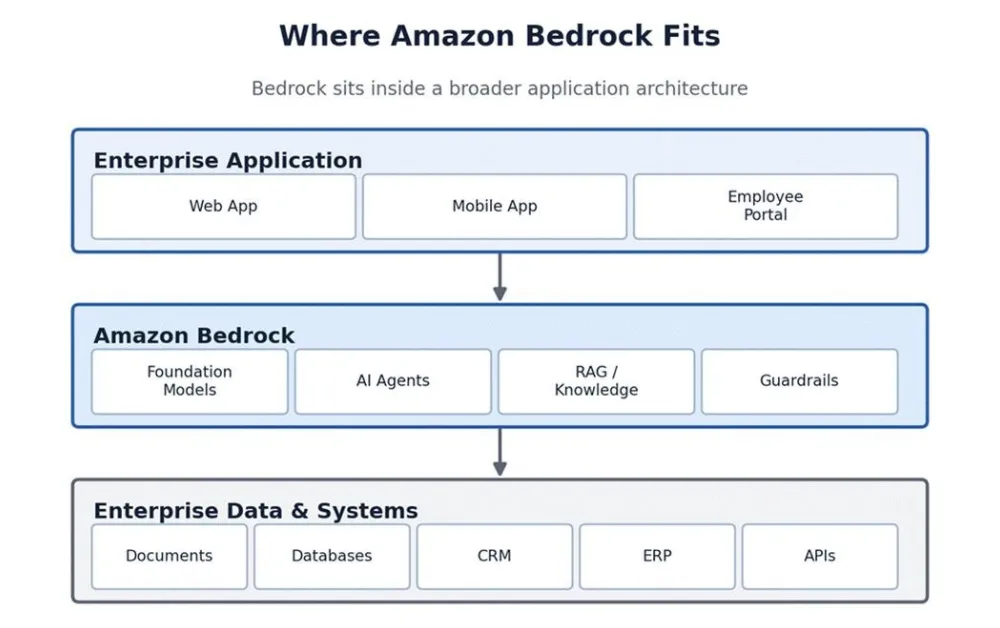
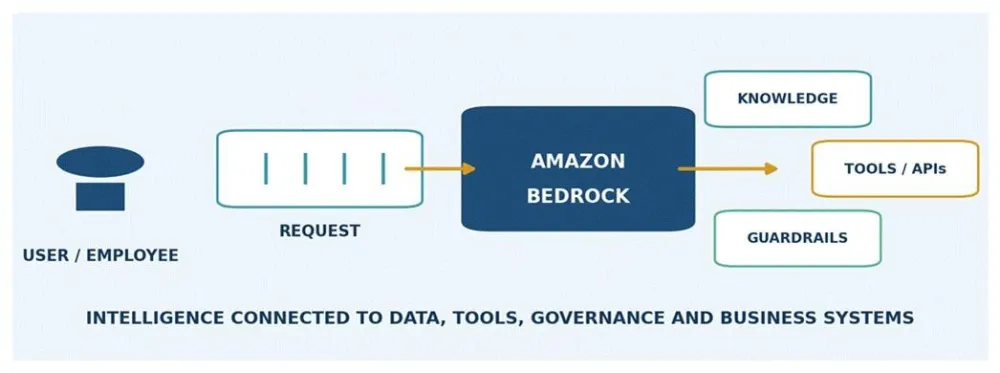
Traditional software follows a relatively fixed path from user interface to application, database and result. Modern enterprise AI adds a reasoning layer, enterprise knowledge, tools and APIs, business logic and human approval before a business action is completed.
What Is Amazon Bedrock?
Amazon Bedrock is AWS's managed platform for building generative AI applications using foundation models from multiple providers. It provides model access through AWS services and APIs so application teams can select models for their requirements without operating foundation-model infrastructure themselves.
For a business leader, the simplest view is: Amazon Bedrock provides the AI foundation; the enterprise application provides the business context, data, tools, rules and workflow.
What Does Bedrock Provide?
– Foundation-model inference
– Model selection and evaluation
– RAG and Knowledge Bases
– AI-agent capabilities
– Guardrails
– Model customization
– Application APIs
– Generative AI workflows
– Integration with surrounding AWS services
Bedrock is not a complete enterprise application. A production solution still requires business process, data, application logic, integrations, security, governance and user experience.
Amazon Bedrock Add-On Services
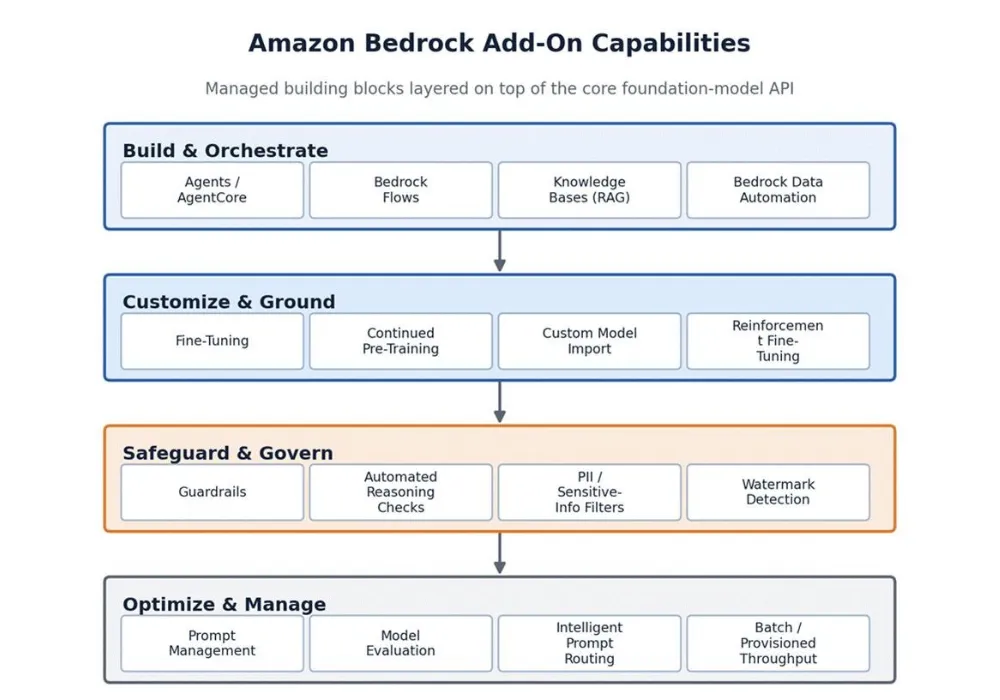
Beyond raw model inference, Bedrock provides managed capabilities for building and orchestrating AI systems, grounding models in enterprise data, safeguarding outputs and optimizing cost and performance.
Amazon Bedrock Add-On Services — In Simple Terms
Amazon Bedrock provides more than foundation-model access. Build and Orchestrate capabilities help teams create agents, workflows and retrieval-based applications. Customize and Ground capabilities can adapt models for specific domains and business requirements. Safeguard and Govern capabilities help control sensitive information, policy risks and unsafe outputs. Optimize and Manage capabilities focus on prompt management, model evaluation, routing, throughput, cost and operational scale.
Why Enterprises Need More Than Chatbots
Enterprise processes are rarely just conversations. A useful AI system may need to understand an enquiry, extract requirements, identify a customer, check CRM history, retrieve product information, check inventory, determine pricing, create or update an opportunity, prepare a response and request approval when terms exceed business limits.
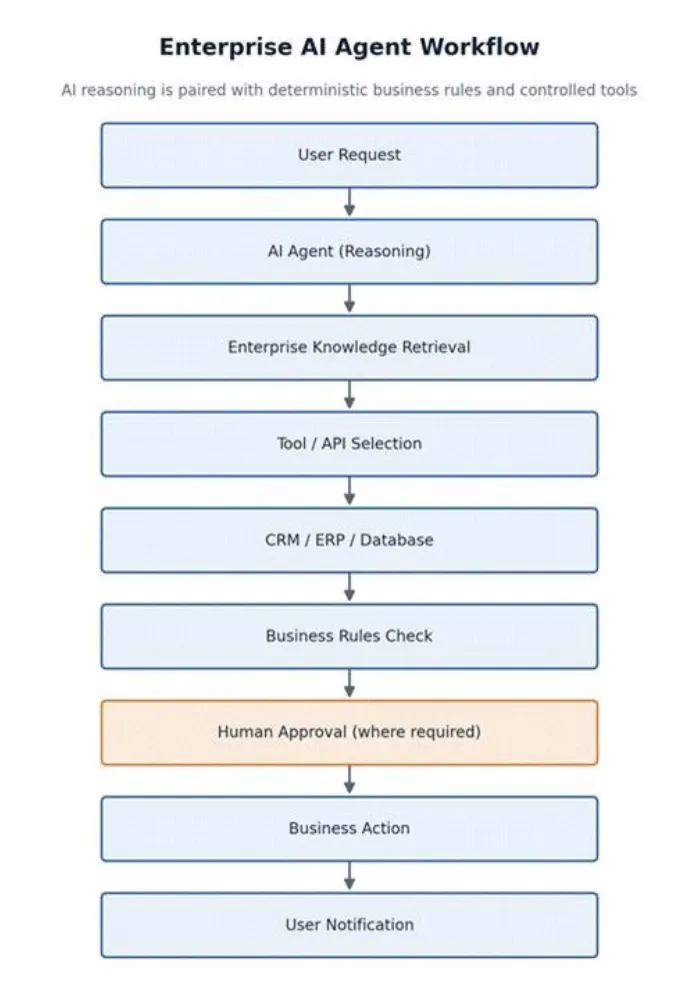
A chatbot can draft a response. An AI agent integrated with enterprise systems can participate in the entire workflow while keeping systems of record and deterministic controls authoritative.
Key Enterprise AI Terms — In Simple Terms
A large language model understands and generates language, while a foundation model provides broad core intelligence for many tasks. RAG retrieves relevant external or enterprise knowledge and supplies it to the model as context. An AI agent uses reasoning and tools to complete or coordinate multi-step work. A copilot assists a person with information and productivity tasks. Workflow automation connects defined systems and steps to execute repeatable business processes.
How Amazon Bedrock Fits Into Enterprise AI
A practical architecture can be understood as a series of layers: user/application → AI application layer → Amazon Bedrock → foundation model → knowledge and tools → business logic → enterprise systems → business action.
AI Reasoning and Enterprise Controls — In Simple Terms
An enterprise AI agent can understand a request, retrieve relevant information, select approved tools and prepare a recommended action. The CRM remains the authoritative source for customer records, while pricing and policy continue to follow business rules. Operational systems remain responsible for facts such as inventory and status. Human approval can be added when an action is exceptional, sensitive or high impact. This approach combines flexible AI reasoning with deterministic enterprise controls.
AI Agents
An AI agent goes beyond producing text. The source architecture describes enterprise agents as systems that can understand requests, reason over information, access enterprise systems, call APIs, retrieve documents, perform calculations, execute workflows, update applications, request human approval and escalate exceptions.
Enterprise AI Copilots
An AI copilot is designed primarily to assist a person rather than operate independently. Instead of manually searching several systems, an employee can use a natural-language interface to retrieve approved information, summarize it and explain the result.
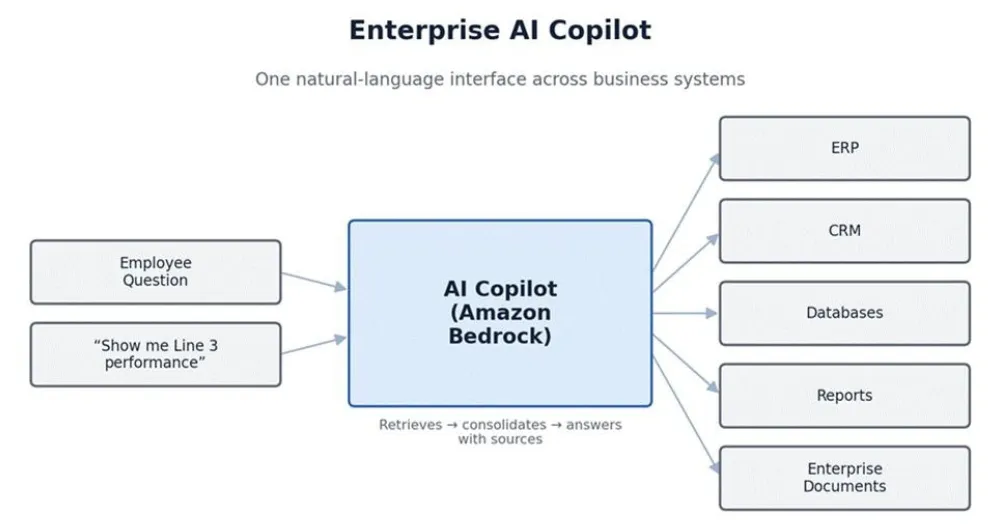
AI Copilot vs. AI Agent — In Simple Terms
An AI copilot mainly works alongside an employee and helps retrieve, summarize and explain approved business information. An AI agent generally has greater autonomy and can coordinate tools and workflow steps. Copilots usually keep the person directly involved in the task, while agents can operate through approval-based workflows. Tool usage is useful for both, but it is more central to an agent. The right choice depends on whether the business needs assistance or multi-step task execution.
Typical copilots include manufacturing, HR, finance, sales, procurement, engineering, customer support and knowledge-management assistants.
RAG and Enterprise Knowledge
Enterprise knowledge is rarely stored in one place. It can exist across SOPs, product manuals, technical documentation, policies, contracts, training material, engineering documents, reports and PDFs.
What Is RAG?
Retrieval-Augmented Generation retrieves relevant information and supplies it as context rather than expecting the foundation model to know private company information. Bedrock Knowledge Bases provide managed capabilities for building RAG applications and retrieving information from configured data sources.
Production RAG still requires document permissions, data freshness and versioning, retrieval-quality evaluation, source citations and failure handling.
Enterprise AI Use Cases
An AI Sales Agent processes customer enquiries by understanding requirements, retrieving customer and product information, checking CRM records and preparing responses. It can support opportunity scoring and CRM updates. Pricing, discounts, contracts and unusual commitments remain under business rules and human approval. Bedrock can connect the workflow with CRM, product, pricing, inventory, email and calendar systems.
1. AI Sales Agent
An AI Customer Support Agent handles repetitive questions about products orders, warranties and common technical issues. It can retrieve approved knowledge, check order information, draft responses and create support tickets. Troubleshooting should rely on verified documentation rather than generated guesses. Complex or uncertain cases can be escalated to human specialists.
2. AI Customer Support Agent
An AI Procurement Agent organizes purchase requests, supplier information, quotations and purchasing documents. It can understand specifications, compare quotations and summarize price and delivery information. The agent can prepare recommendations rather than independently selecting suppliers. High-value purchases, new suppliers and policy exceptions can require approval. Bedrock can connect with ERP, inventory, supplier and procurement systems.
3. AI Procurement Agent
An AI Finance Agent supports invoice and financial-document processing. It can extract fields, validate information, compare invoices with purchase orders and goods-received records and identify exceptions. This goes beyond OCR by adding context, business rules and cross-system validation. Exceptions can be routed to finance staff before ERP processing, reducing manual checking while preserving financial controls.
4. AI Finance Agent
An AI HR Agent answers routine employee questions using approved policies and authorized HR information. It can support leave, reimbursement, onboarding, candidate communication, interview scheduling, resume extraction and ATS updates. Access to employee information should be role-controlled. Sensitive employment decisions should remain under human supervision. The goal is to reduce repetitive HR work without making the AI the final decision-maker.
5. AI HR Agent
An AI Manufacturing Agent brings operational information together for faster investigation of production issues. It can retrieve production volume, downtime, maintenance events, shift reports, quality information and machine documentation. A manager can ask why production decreased and receive an evidence-based analysis. The output should remain a recommendation unless the evidence confirms the root cause. Bedrock can connect with ERP, IoT, production, maintenance and document systems.
6. AI Manufacturing Agent
An AI Maintenance Agent helps technicians interpret equipment alerts and maintenance history. It can combine sensor anomalies with historical records, manuals, previous failures and service information. The system can summarize likely causes and prepare a recommended next step or maintenance ticket. For safety-critical machinery, recommendations must remain subject to engineering controls and human authorization. The agent supports technicians rather than directly performing unsafe actions.
Multi-Agent AI Systems
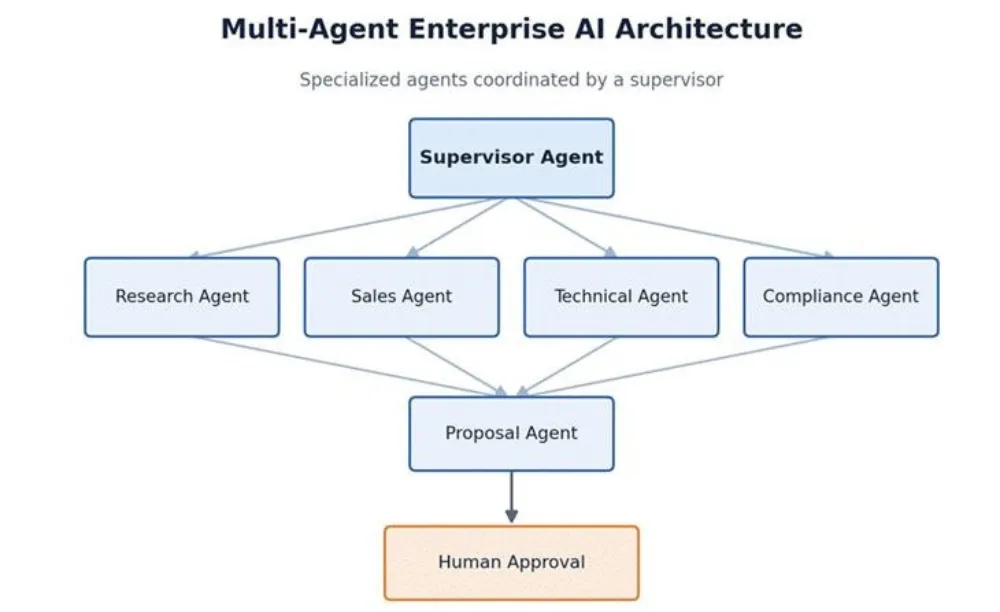
Complex workflows do not always need one general-purpose agent. A multi-agent architecture can assign specialized responsibilities to agents under a supervisor or workflow layer, with a human reviewer at the end where required.
The source architecture positions workflow automation between AI reasoning and enterprise applications. n8n, APIs and webhooks can connect Bedrock-based intelligence to CRM, ERP, HRMS, databases, ticketing systems and other business applications.
Enterprise Integration Layers — In Simple Terms
The AI layer interprets requests, summarizes information, reasons over context and recommends actions. The knowledge layer retrieves approved enterprise information, while the tool and API layer exposes controlled functions. Business rules enforce deterministic policies and thresholds before actions are taken. CRM, ERP, databases and other enterprise systems remain the systems of record. The workflow layer coordinates sequencing, retries, notifications and approvals. Together, these layers extend existing software instead of replacing it.
The integration pattern is designed to extend existing enterprise software rather than replace it.
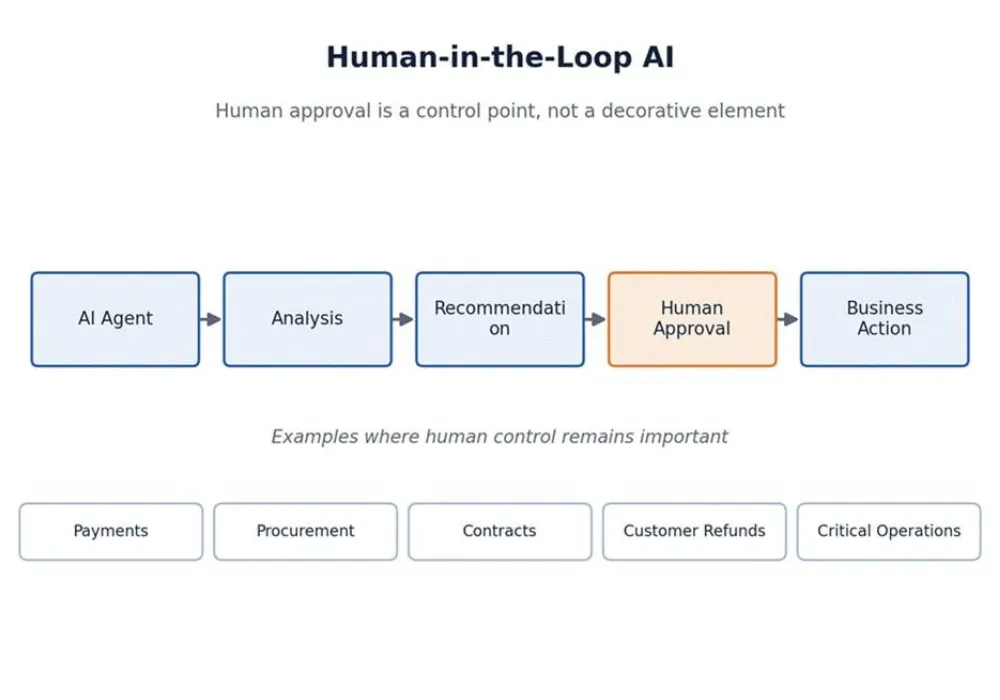
Security, Governance & Human-in-the-Loop AI
Enterprise AI must be designed around identity, least privilege, authentication, authorization, data protection, guardrails, prompt-injection defenses, tool permissions, auditability and observability.
Core controls
– Role-based access and least-privilege permissions
– Encryption and data-protection controls
– Guardrails and sensitive-information filtering
– Controlled tool access and prompt-injection defenses
– Audit logging and observability
– Human approval for high-impact or uncertain actions
Measuring ROI & Moving From Pilot to Production
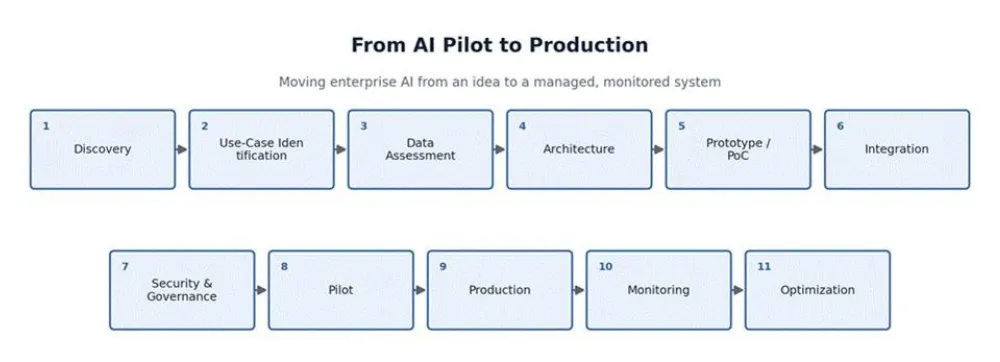
A focused pilot should target one well-defined workflow and establish measurable outcomes before production commitment.
From Pilot to Production — In Simple Terms
A successful enterprise AI project should begin with discovery of the existing workflow, bottlenecks and owners. The organization then selects a focused use case with measurable business value and assesses the required data and integrations. Architecture and prototyping can combine Bedrock, RAG, agents, tools and workflow automation. Security, governance, privacy, guardrails and approval controls should be established before production. After launch, teams should continuously monitor quality, latency, cost and business outcomes and optimize the workflow.
Conclusion
Amazon Bedrock provides enterprises with a practical foundation for building secure, scalable and intelligent AI applications. By combining foundation models with RAG, AI agents, enterprise data, APIs, workflows and governance controls organizations can move beyond simple chatbots toward AI systems that support real business processes.
The key to successful enterprise AI is not only model capability but also trusted data, controlled tool access, security, human oversight and measurable business outcomes. With the right architecture and governance, Amazon Bedrock can help organizations improve productivity, automate repetitive work, enhance decision-making and deliver more personalized experiences while keeping enterprise systems and policies at the center.
Build Your Enterprise AI Agent
AI India Innovations focuses on enterprise AI agents, copilots, RAG, document intelligence, workflow automation and integrations that connect generative AI to real business processes.
The opportunity is not simply to add a chatbot. It is to build intelligent systems that can understand, retrieve, reason, assist, automate and escalate — with the controls required.