Why Should We Use NVIDIA Omniverse and Isaac Sim for Advanced Robotics Simulation?
Introduction
Robotics and industrial automation are transforming warehouses, manufacturing facilities, and logistics operations. However, deploying robots without proper planning can result in high investment costs, inefficient workflows, traffic congestion, and resource wastage.
NVIDIA Omniverse and NVIDIA Isaac Sim provide a simulation-first approach that allows organizations to create virtual environments, test robotic operations, and optimize automation strategies before investing in physical robots.
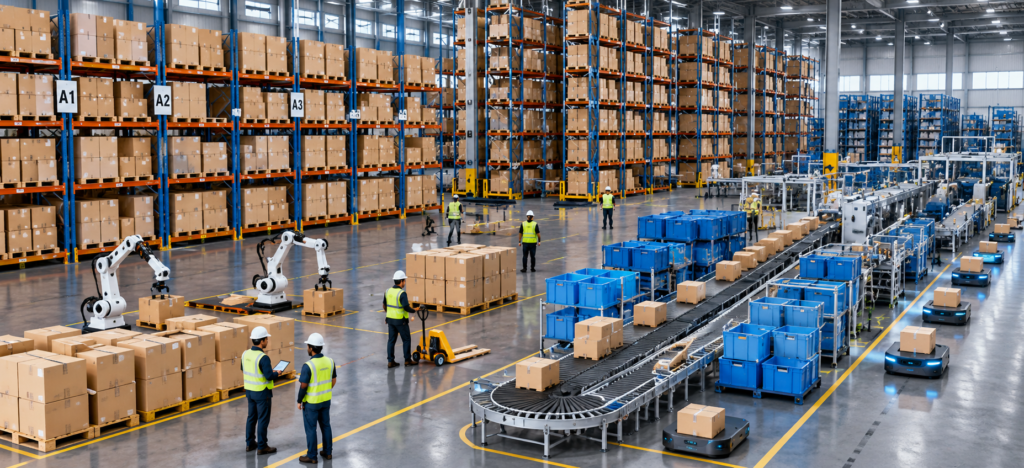
1. Understanding NVIDIA Omniverse and Isaac Sim
NVIDIA Omniverse
NVIDIA Omniverse is a platform for developing physically based 3D applications and industrial digital twins. Built around OpenUSD, it enables teams to create, connect, and collaborate on complex virtual environments such as factories and warehouses.

NVIDIA Isaac Sim
NVIDIA Isaac Sim is a robotics simulation application built on Omniverse technologies. It provides physics-based simulation, virtual sensors, robot models, and ROS 2 integration for developing and testing robotic systems.
2. Why Simulate Before Buying Robots?
One of the biggest advantages of simulation is the ability to plan resources before making physical investments.
For example, before purchasing an Autonomous Mobile Robot (AMR) fleet for a warehouse, engineers can create a digital twin of the facility and simulate different fleet sizes, such as 5, 10, or 15 robots.
Engineers can evaluate:
- How many robots are required for the workload.
- Which routes provide efficient material transportation.
- Where charging stations should be placed.
- Whether robots will experience traffic congestion or collisions.
- How warehouse storage and available space can be optimized.
This approach helps organizations identify operational problems and make better procurement decisions before physical deployment.
3. Physics-Based Simulation and AI Development
Isaac Sim supports realistic physical interactions between robots and objects using properties such as gravity, friction, and collisions.
It also provides capabilities for:
- Synthetic Data Generation: Generate virtual training data for AI models.
- Virtual Sensors: Simulate cameras, LiDAR, and depth sensors.
- AI Perception: Test object detection and robotic perception.
- ROS 2 Integration: Connect simulation environments with robotics software.
These capabilities allow developers to test robotic behavior and perception systems in a controlled virtual environment before real-world deployment.
4. Practical Application: Warehouse Automation
Consider a warehouse planning to deploy AMRs for material transportation. Using Omniverse and Isaac Sim, engineers can create a digital twin of the warehouse and simulate the complete workflow.
The simulation can compare the initial warehouse layout with optimized alternatives by adjusting:
- Robot routes and movement paths.
- Storage locations.
- Charging station placement.
- Collision avoidance strategies.
The following Key Performance Indicators (KPIs) can be evaluated:
KPI | Purpose |
Robot Utilization | Measure robot usage |
Travel Distance | Optimize movement |
Task Completion Time | Evaluate efficiency |
Waiting Time | Identify delays |
Overall Throughput | Measure productivity |
This helps identify bottlenecks and improve the automation strategy before purchasing and installing physical robots.
5. Benefits and Required Know-How
Key Benefits
- Better resource planning and utilization.
- Reduced avoidable physical testing and redesign.
- Improved robot navigation and workflow evaluation.
- Safer testing of complex scenarios.
Efficient, accurate simulation of real-world interactions between physical objects, powered by the PhysX physics engine included in the Omniverse stack.
- Support for AI development through synthetic data.
Required Know-How
- Requires accurate 3D assets and robot configurations.
- High-performance GPU hardware may be necessary.
- Technical expertise is required.
- Real-world testing is still essential to validate simulation results.
Conclusion
NVIDIA Omniverse and Isaac Sim are valuable technologies for the future of intelligent robotics and industrial automation. They allow organizations to build virtual environments, test robotic operations, optimize resources, and identify potential problems before physical deployment.
Instead of buying robots first and solving problems later, organizations can simulate, analyze, and optimize their automation strategy before investing.
This simulation-first approach supports smarter planning, efficient operations, and more reliable robotic systems.
References
- NVIDIA Omniverse Documentation – https://docs.omniverse.nvidia.com/
- NVIDIA Isaac Sim Documentation – https://docs.isaacsim.omniverse.nvidia.com/
- OpenUSD Documentation – https://openusd.org/release/
- NVIDIA Robotics – https://developer.nvidia.com/robotics
Frequently Asked Questions
The primary benefit is enabling a simulation-first approach to test robotic workflows, optimize AMR fleet sizes, and eliminate bottlenecks in a virtual digital twin to prevent high capital wastage. At AI India Innovations, our team leverages Omniverse and Isaac Sim to build custom virtual models, guiding enterprises seamlessly from initial simulation to real-world deployment.
Isaac Sim utilizes high-fidelity PhysX physics engines and virtual sensors like LiDAR and cameras to test robot navigation, collision avoidance, and payload distribution across varying fleet sizes. AI India Innovations utilizes these advanced simulation capabilities to thoroughly evaluate your AMR parameters and determine optimal travel paths for maximum efficiency.
Yes, the platform features Synthetic Data Generation (SDG) capabilities to produce large volumes of virtual training data with precise ground truth labeling for AI vision systems. AI India Innovations implements customized SDG pipelines using Isaac Sim to help developers safely train, test, and validate perception models in controlled virtual environments.
Yes, it offers native ROS 2 support that allows developers to connect simulation software directly with existing navigation stacks and control code prior to hardware deployment. AI India Innovations integrates these native ROS 2 workflows into our Isaac Sim deployments to rigorously test real-world behavior before pushing code to physical hardware.
Running these tools demands high-performance NVIDIA RTX GPU hardware, accurate 3D CAD/OpenUSD asset models, and advanced technical simulation expertise. AI India Innovations provides the specialized technical infrastructure and deep simulation expertise required to manage these complex deployments from end to end.