NVIDIA OMNIVERSE AND ISAAC SIM
Transforming Robotics Through Realistic Simulation
Explore physics-based simulation, digital twins, AI-powered perception, and robotic pick-and-place automation with NVIDIA Omniverse and Isaac Sim.
Introduction
Robotics and artificial intelligence are reshaping industries such as manufacturing, logistics, healthcare, and warehousing. Robots are increasingly expected to perform complex tasks with accuracy and consistency. Yet developing and testing these systems directly on physical hardware can be costly, time-consuming, and difficult to scale. Simulation provides a practical way to design, test, and refine robotic systems in a controlled virtual environment before deployment.
NVIDIA Omniverse and NVIDIA Isaac Sim support this approach by combining 3D collaboration, physics-based simulation, sensor modeling, and robotics development. Together, they help engineers evaluate robot behavior and industrial workflows in realistic virtual worlds.
Understanding NVIDIA Omniverse
NVIDIA Omniverse is a platform for building and operating 3D workflows and physically based virtual environments. It is built around Universal Scene Description (OpenUSD), an open framework for describing, composing, and exchanging complex 3D scenes. OpenUSD makes it possible to organize assets and scene data while connecting workflows across compatible applications.
For industrial simulation, an Omniverse scene can represent a warehouse, factory floor, production line, machine, or other physical space. Teams can bring together geometry, materials, lighting, and scene data to create a digital representation of an environment.
- OpenUSD integration — Structures and composes 3D assets and scene descriptions.
- RTX real-time rendering — Supports realistic lighting, reflections, shadows, and materials.
- Physics and digital twins — Helps represent physical interactions and virtual counterparts of real systems.
- Extensible workflows — Allows developers to connect tools and build custom simulation pipelines.
NVIDIA Isaac Sim: A Robotics Simulation Environment
NVIDIA Isaac Sim is a robotics simulation application built on Omniverse. It provides an environment for developing, testing, and validating robotic applications. Developers can configure virtual robots, articulations, grippers, sensors, and surrounding objects, then evaluate how the system behaves under different conditions without relying on physical hardware for every experiment.
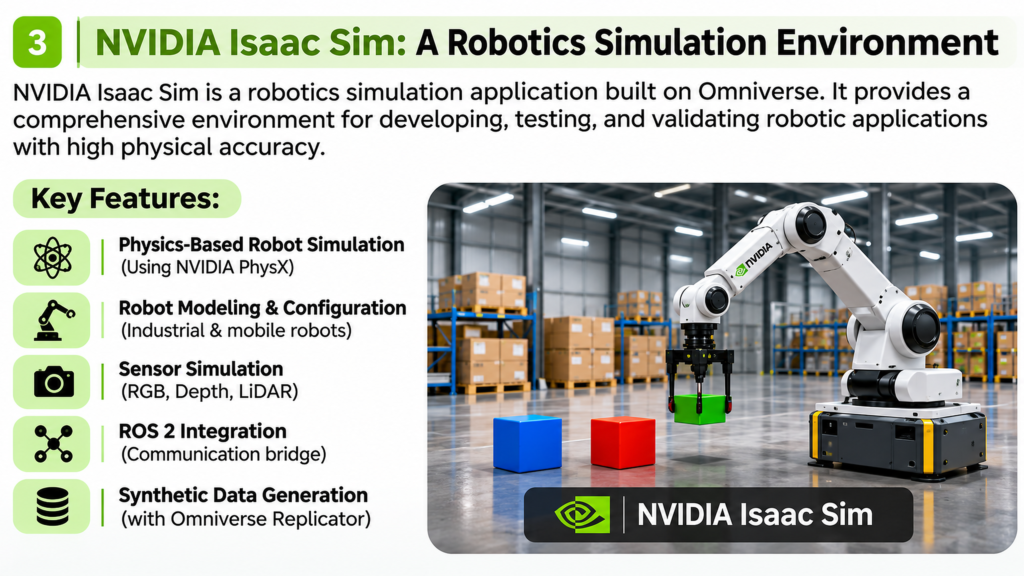
A simulated robotic arm interacting with objects in a virtual environment.
Isaac Sim supports physics-based interactions through NVIDIA PhysX, including rigid-body dynamics, collisions, gravity, friction, and contact behavior. It also supports simulated sensors such as RGB and depth cameras and LiDAR, ROS 2 communication workflows, and synthetic-data generation using Omniverse Replicator. These capabilities are useful for testing perception, manipulation, and robotics software in repeatable scenarios.
Applying Omniverse and Isaac Sim to Warehouse Automation
A practical application is warehouse pick-and-place automation. Imagine a warehouse containing storage racks, objects of different shapes and sizes, and a robotic arm that transfers items from one shelf to another. In Isaac Sim, this environment can be assembled virtually so the robot can be tested against varied object positions, orientations, and physical properties.
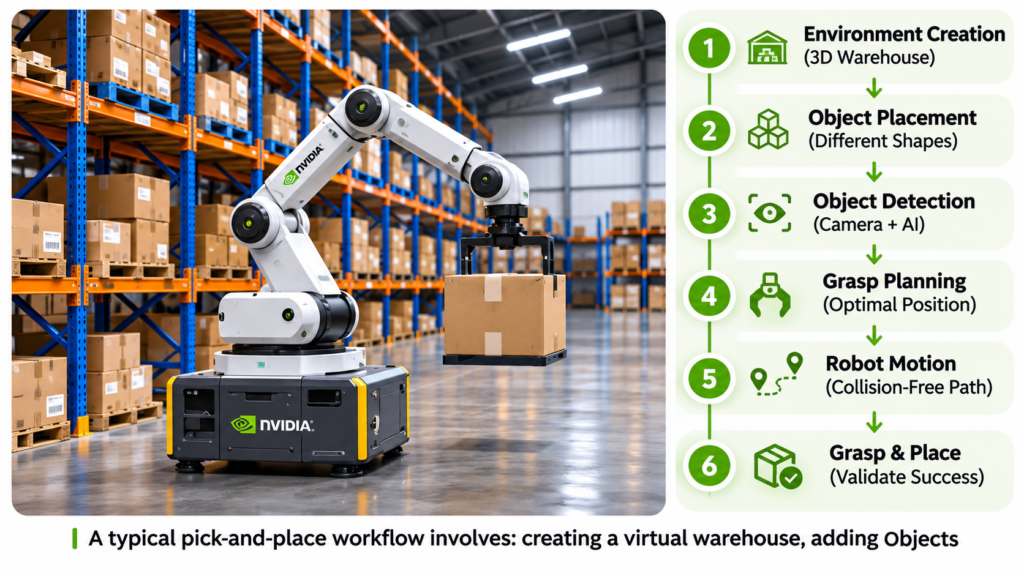
Example warehouse pick-and-place simulation concept.
A Typical Pick-and-Place Workflow
- Environment creation — Build the warehouse, racks, shelves, robot, and obstacles using 3D assets.
- Object placement — Introduce objects with different dimensions, shapes, masses, and orientations.
- Object detection — Use simulated camera data and computer-vision models to estimate object locations.
- Grasp planning — Select a suitable grasp pose based on object geometry, accessibility, and gripper design.
- Motion planning — Generate a trajectory that moves the robot while avoiding collisions.
- Grasp and placement — Close the gripper, lift the object, move it to the target, and release it.
- Validation — Check whether the object was picked and placed successfully; retry or re-plan when needed.
Why Simulation Matters Before Real-World Deployment
- Reduced development cost — Reduces dependence on physical prototypes and repeated hardware trials.
- Faster experimentation — Makes it easier to compare robot configurations, grasp strategies, and trajectories.
- Improved safety — Allows potentially risky scenarios and collision cases to be explored in a controlled setting.
- Scalable testing — Supports many combinations of object shapes, positions, lighting, and environmental conditions.
- AI development — Synthetic datasets can support training and evaluation of perception models.
- Digital-twin insight — Virtual representations can help teams study and optimize industrial processes.
Important Engineering Considerations
A successful simulation must use appropriate physical properties, collision geometry, joint limits, gripper settings, and sensor configurations. Results in simulation do not guarantee identical behavior on a physical robot. Real systems introduce sensor noise, calibration errors, manufacturing tolerances, latency, and variations in friction or object properties. For this reason, simulation should be followed by careful validation and sim-to-real testing.
Conclusion
NVIDIA Omniverse and Isaac Sim provide a strong foundation for modern robotics development. Omniverse enables connected, physically based 3D environments, while Isaac Sim applies those capabilities to robot modeling, sensor simulation, manipulation, and AI workflows. In warehouse automation and other industrial applications, simulation gives engineering teams a repeatable way to experiment, validate, and improve robotic behavior before deployment.
The future of robotics is not only about building more capable machines. It is also about creating better virtual environments in which those machines can be designed, tested, and prepared for the complexities of the physical world.
Frequently Asked Questions (FAQs)
NVIDIA Omniverse is a platform for developing realistic 3D environments and digital twins, while NVIDIA Isaac Sim is a robotics simulation application built on Omniverse. Together, they enable developers to simulate robotic movements, test AI models, and validate automation workflows before real-world deployment. These technologies help reduce development costs, improve operational safety, and accelerate robotics innovation. AI India Innovations supports related industrial applications through AI-powered computer vision, intelligent automation, and embedded AI solutions that help businesses develop smarter and more efficient workflows.
NVIDIA Isaac Sim enables physics-based robot simulation, virtual testing, sensor modeling, and AI-driven robotic development. Its primary benefits include reduced hardware testing costs, faster experimentation, improved safety, and scalable validation of robotic systems. By testing different environmental conditions and robotic configurations virtually, businesses can identify potential issues before physical deployment. AI India Innovations complements these capabilities through custom AI solutions for industrial automation, computer vision, and intelligent process optimization.
NVIDIA Isaac Sim allows engineers to simulate warehouse environments, robotic arms, object detection, grasp planning, and collision-free motion. This helps evaluate robotic pick-and-place operations under different object positions, sizes, and environmental conditions before implementing them in physical warehouses. AI India Innovations develops computer vision and intelligent automation solutions that support object recognition, visual monitoring, and automated industrial workflows, helping businesses improve operational accuracy and warehouse efficiency.
NVIDIA Omniverse supports digital twins by enabling realistic virtual representations of factories, machinery, and industrial processes. These environments allow engineering teams to study production workflows, test automation strategies, identify potential bottlenecks, and evaluate operational improvements without disrupting physical systems. AI India Innovations supports smart manufacturing through AI-powered visual inspection, industrial monitoring, and intelligent automation solutions designed to improve productivity, quality control, and operational efficiency.
Yes. NVIDIA Isaac Sim supports synthetic data generation through Omniverse Replicator, allowing developers to create simulated datasets with different objects, lighting conditions, camera angles, and environments. These datasets can support the training and evaluation of AI-powered perception models while reducing dependence on manually collected data. AI India Innovations develops custom computer vision solutions for object detection, image recognition, and industrial inspection, where appropriately validated synthetic data can complement real-world datasets.
AI India Innovations helps businesses develop intelligent automation solutions through custom computer vision, embedded AI, object detection, industrial monitoring, and AI-driven process optimization. These capabilities support smarter manufacturing, automated visual inspections, and more efficient industrial workflows. For businesses exploring robotics simulation using technologies such as NVIDIA Omniverse and Isaac Sim, AI India Innovations' AI development expertise can support complementary perception and automation requirements, while specific simulation integration capabilities should be confirmed during project consultation.