Top 10 OCR Models in 2026:
Best AI OCR Models Compared for Enterprise Document Processing
Introduction
Top 10 OCR Models in 2026 are transforming the way businesses digitize, understand and automate documents using Artificial Intelligence. Modern OCR (Optical Character Recognition) has evolved far beyond simply converting scanned documents into editable text. Today's AI-powered OCR models can interpret layouts, extract structured data from invoices, analyze handwritten documents, understand tables and even reason over complex business documents with remarkable accuracy.
In this guide, we compare the Top 10 OCR Models in 2026, explore their strengths, weaknesses, ideal use cases and explain how to choose the right OCR model for your organization. Whether you're building enterprise document automation, invoice processing, banking workflows, healthcare applications or AI agents, this comparison will help you make an informed decision. At AI India Innovations, we've also developed enterprise-ready OCR solutions that can be customized for industry-specific workflows, multilingual document processing and secure on-premise deployments.
What Is OCR?
OCR stands for Optical Character Recognition. In simple terms, it is technology that looks at an image of a document and turns it into text a computer can use. You give it a scanned page, a photo of a receipt or a PDF and it hands back words, numbers and structure that a machine can actually work with.
For a long time, OCR was seen as a small, unglamorous part of computer vision. You fed it a scanned page, it gave you a wall of text and everyone downstream argued about how to fix the mistakes. That is no longer the whole story. OCR in 2026 behaves more like a reading system than a simple text extractor. It looks at a document the way a person does, taking in tables, forms, handwriting and layout together, instead of picking out letters one at a time.
This matters because so much of business still runs on documents. Invoices, contracts, medical records, loan forms and research papers arrive as scans or photos every single day and any AI system built on top of them is only as answers, no matter how capable that model otherwise is.
What actually changed is the underlying approach. Early engines detected individual characters. Deep learning systems detected whole words and lines with far more reliability. Newer transformer based systems learned to understand reading order and page structure, not just letters. Vision language models went further still, treating a document image as something to be understood, not just copied out. The models covered in this guide sit at the front of that shift and a few of them barely look like classic OCR tools at all. They are general purpose reasoning models that happen to be excellent at documents.
How OCR Has Evolved
It helps to see the whole journey in one place before looking at individual models. Each stage below solved a real limitation of the one before it.
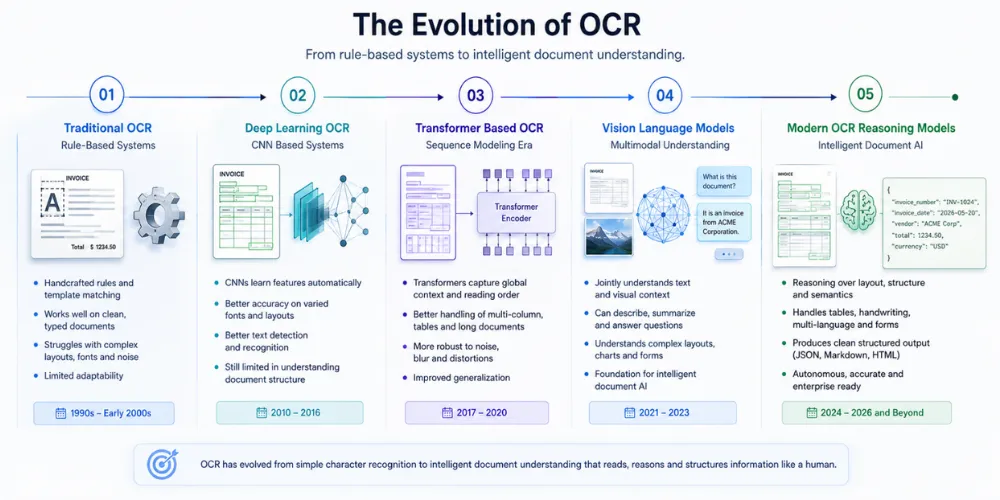
– Traditional OCR: Early engines such as classic Tesseract relied on hand tuned rules and template matching. They worked well on clean, typed, high contrast scans and struggled badly with anything else, including skewed pages, low resolution photos, mixed fonts or handwriting.
– Deep learning OCR: Convolutional networks took over the job of finding text on a page, while separate decoders handled reading it. Accuracy improved a great deal, but the system still treated a page as a loose bag of text lines, with no real sense of structure.
– Transformer based OCR: A shared way of representing both images and sequences let models start reasoning about reading order, tables and multiple columns, instead of only recognizing characters.
– Vision language models: Pairing a strong image reader with a language model backbone meant a document could be described, summarized or questioned directly, rather than only transcribed.
– Modern OCR reasoning models: The current generation adds a genuine reasoning layer on top. These models work out table structure from visual cues, resolve confusing layouts using context and return clean, structured output such as JSON, Markdown or HTML instead of loose text. This is the generation covered in this guide.
How Modern OCR Actually Works
Regardless of who builds it, almost every serious OCR or document reading system today follows some version of the same basic pipeline, from the moment a file goes in to the moment structured text comes out.
Step 1: Preprocessing
The raw image or PDF is cleaned up first. Rotated scans are straightened, poor lighting or low contrast is corrected and a multi page PDF is split into individual page images. Getting this step wrong causes every later stage to compound the error.
Step 2: Layout detection
Before any text is read, the model identifies the page's structural regions, such as paragraphs, headers, tables, figures and footnotes. This is the step that most separates modern systems from classic OCR, because it lets the model reason about what a block of text actually is, not just where it sits on the page.
Step 3: Text detection
The model then finds the precise regions containing letters or words inside each layout block already identified in the previous step.
Step 4: Text recognition
Those regions are converted into actual character sequences. In transformer and vision language systems, detection and recognition are often fused into a single pass rather than run as two separate models.
Step 5: Language understanding
This is where reasoning models pull ahead of older pipelines. This stage resolves ambiguity using context, for example deciding whether a smudged character is a zero or the letter O, based on the word around it or whether a row of numbers is a table or just a stray list. It is also where multilingual and specialised vocabulary get handled correctly.
Step 6: Structured output
Finally, everything is packaged into a machine readable format, such as JSON with bounding boxes and confidence scores, Markdown that keeps headings and tables intact or HTML for direct display. This is the interface that retrieval systems, agents and other applications actually consume.
The Different Types of OCR Models
Before ranking specific models, it helps to be precise about the categories, because companies use the word OCR loosely and the category a model falls into has real consequences for accuracy, cost and how it can be deployed.
– Traditional OCR engines: Rule based or classical machine learning systems such as Tesseract. Fast, free and still fine for clean, typed, single column text, but they struggle badly with handwriting, complex tables and scripts outside English.
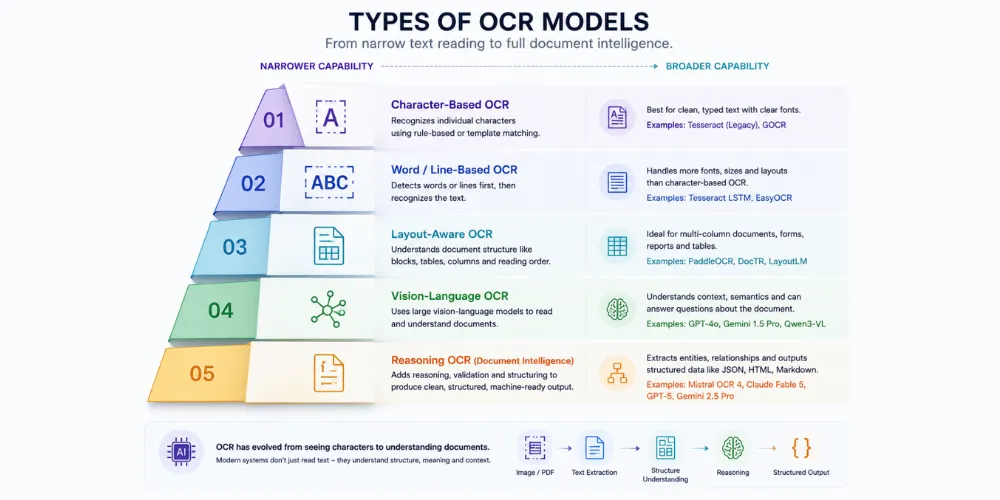
– Deep learning OCR: Systems built on convolutional and recurrent networks for detection and recognition. More resistant to noise and unusual fonts than classical engines, but their sense of layout is still limited. They read text, not structure.
– Transformer based OCR: Systems that unify detection and recognition in one architecture and begin to model reading order and document structure directly, instead of stitching separate stages together.
– OCR vision language models: General purpose or OCR focused models that treat a document image as something to reason about. These models can answer questions about a document, summarize it and extract structured fields in a single pass, not just transcribe it.
– Document AI models: End to end systems purpose built for business documents such as invoices, forms, IDs and contracts. They combine layout understanding, field extraction and structured output into one product, often with support contracts, confidence scores and compliance features included.
Top 10 OCR Models in 2026
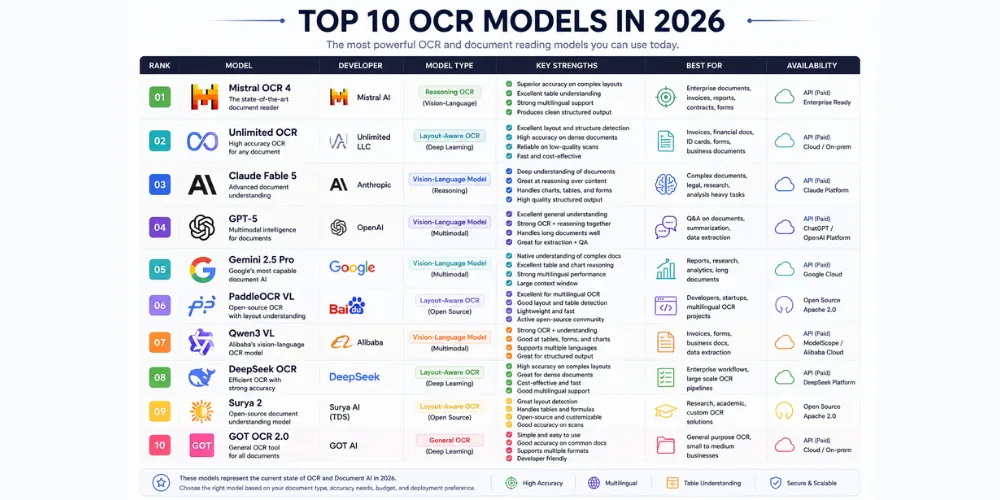
This chapter is the core of the guide. It goes through today's ten most useful OCR and document reading models, one by one, in ranked order. For every model, the focus is on what it actually is, its real strengths, its weaknesses and where it fits best in a real project.
Mistral OCR 4 (Mistral AI)
What it is: Mistral AI built this model in 2026 as the newest version of its widely used document reader, following on from Mistral OCR 3. It reads a page and works out what kind of block each part is, a heading, a paragraph or a table and returns that structure along with the text. Companies can run it entirely on their own servers or call it through a hosted service.
Strengths:
– Reads more than 170 languages, one of the broadest ranges on this list
– Understands the structure of a page, so it separates headings, tables and body text correctly instead of returning one long block of text
– Can be installed and run entirely inside a company's own systems, which matters for banks, insurers and government agencies that cannot send documents to an outside server
– Returns confidence scores alongside its answers, so teams know which extractions to trust and which to double check
Weaknesses:
– Priced per page, so very high volume jobs need careful budgeting
– Handwriting recognition is only moderate and cloud services from larger labs still read messy handwriting more reliably
Best for: Regulated industries such as banking, insurance and government, where documents must stay on the company's own servers and a support contract matters.
Unlimited OCR (Baidu)
What it is: Baidu released this model in 2026 as a free, openly licensed reading model with around 3 billion parameters, small enough to run on a single workstation graphics card. It sits alongside Baidu's lighter PaddleOCR line as the stronger, research grade option.
Strengths:
– Free to use and free to modify, released under the MIT license
– Runs on a single consumer or workstation GPU, so teams do not need a large server budget
– Very capable for its size on printed and mixed page layouts
– Backed by an active open community that keeps improving it
Weaknesses:
– No managed service or official support contract is offered
– Handwriting recognition is weak, which is common across most open OCR models today
Best for: Research teams and startups digitizing large document collections on a fixed hardware budget and anyone who wants full control over the model.
Claude Fable 5 (Anthropic)
What it is: This is Anthropic's frontier model from its Mythos generation, released in 2026. Rather than acting as a narrow reading tool, it applies broad reasoning directly to documents, which lets it work through confusing layouts and mixed handwriting the way a careful person would.
Strengths:
– Reads both typed and handwritten text to a very high standard
– Understands documents rather than simply copying them out, so it can follow instructions such as extract only the line items marked as returned
– Handles irregular tables, including nested and merged cells, better than most specialist tools
– Can be asked in plain language to return JSON, Markdown or a custom format
Weaknesses:
– Costs more per page than dedicated document tools when the job is simple, high volume extraction with no ambiguity involved
– Only available through Anthropic's API, with no option to run it on your own servers
Best for: Complex or messy documents where judgment matters as much as recognition, such as legal review, research papers and automated workflows that need reasoning, not just transcription.
GPT 5 (OpenAI)
What it is: OpenAI's flagship model, released in 2025, applies its general reasoning ability to reading documents and images rather than relying on a purpose-built OCR engine underneath.
Strengths:
– Strong general reasoning carries over well to reading typed documents and charts
– Wide, mature tooling and a large ecosystem of existing integrations
– Good performance on tasks that mix document reading with something else, such as reading a chart and then explaining it
– A natural fit for teams already using OpenAI for other parts of their product
Weaknesses:
– As a general purpose model rather than an OCR specialist, its per page cost and raw accuracy can trail dedicated document tools on narrow, high volume jobs
– Table extraction is good but not always as precise as specialist systems on very complex tables
Best for: Teams already built around OpenAI's platform who want document reading folded into an existing product without adding another vendor.
Gemini 2.5 Pro (Google DeepMind)
What it is: Released in 2025, this is Google's long context, natively multimodal model, trained on text, images and video together. Its very large context window lets it read an entire long document in a single pass.
Strengths:
– Can hold an extremely long document in memory at once, useful for full contracts or lengthy filings
– Reads both scanned pages and native digital PDFs with strong accuracy
– Fits naturally into products already built on Google's cloud tools
– Handles video and audio alongside documents when a task needs more than one type of input
Weaknesses:
– Cost and response time both rise as documents get longer
– Not always the cheapest choice for short, simple pages where a lighter model would do just as well
Best for: Very long documents such as full contracts, regulatory filings or multi chapter reports, where keeping the whole file in context improves accuracy.
PaddleOCR VL (Baidu)
What it is: Baidu's lighter, faster reading model, built for teams that need to process huge numbers of pages quickly rather than a single document with maximum reasoning. It is released as open source under the Apache 2.0 license.
Strengths:
– Very fast, built for high volume processing
– Strong table extraction despite its smaller size
– Reads more than 100 languages
– Free and open source, so there is no per page licensing cost
Weaknesses:
– Handwriting recognition is weak
– Less capable than frontier reasoning models on unusual or confusing page layouts
Best for: High volume pipelines feeding a search index or a retrieval system, where speed and cost per page matter more than handling rare or messy formats.
Qwen3 VL (Alibaba)
What it is: Alibaba's vision capable model from its Qwen3 line, built to pair general reasoning with strong OCR performance and released as open weight so anyone can download and run it.
Strengths:
– Combines solid general reasoning with strong reading accuracy in one model
– Good performance on both typed and handwritten pages
– Open weight, so it can be self managed and customized
– Broad language coverage
Weaknesses:
– Not quite as strong on the hardest, most ambiguous documents as the top frontier reasoning models
– Running it well at scale still needs real GPU capacity, since it is a large model
Best for: Teams that want general purpose reasoning and reliable OCR from the same open model, especially where running it themselves is preferred.
DeepSeek OCR (DeepSeek)
What it is: A cost focused reading model released as open weight, built to deliver solid accuracy on everyday documents without the price tag of a frontier general purpose model.
Strengths:
– Fast and affordable to run at scale
– Reads roughly 100 languages
– Good accuracy on standard, well organized layouts
– Open weight, so it can be hosted inside a company's own systems
Weaknesses:
– Accuracy drops on unusual or heavily damaged pages compared with frontier models
– Handwriting support is only moderate
Best for: Cost sensitive projects reading standard layouts at volume, where a frontier model would be more capable than the job actually needs.
Surya 2 (Open source community)
What it is: A lightweight, open source reading model built for teams that need broad language coverage without a heavy hardware footprint.
Strengths:
– Very broad language support, wider than most models on this list
– Fast and light enough to run on modest hardware
– Fully open source
– Simple to deploy for smaller projects
Weaknesses:
– Handwriting recognition is weak
– Table extraction is only moderate compared with the strongest specialist tools
Best for: Lightweight, multilingual OCR projects where hardware is limited and the documents are mostly typed text rather than complex tables.
GOT OCR 2.0 (Open source community)
What it is: An open source model built with a focus on scientific and technical documents, including mathematical notation and charts, rather than everyday business paperwork.
Strengths:
– Strong at converting mathematical formulas into usable formats such as LaTeX
– Good at reading and interpreting charts
– Solid table extraction
– Free and open source
Weaknesses:
– Multilingual support is only moderate compared with models built for global coverage
– Less suited to everyday business documents like invoices, where other models on this list are a better fit
Best for: Research papers and technical documents where formulas, charts and precise tables matter more than everyday business paperwork.
Choosing the Right Model for Your Use Case
Matching a model to the job in front of you matters more than chasing the top score on a leaderboard. Here are some practical pairings worth starting from.
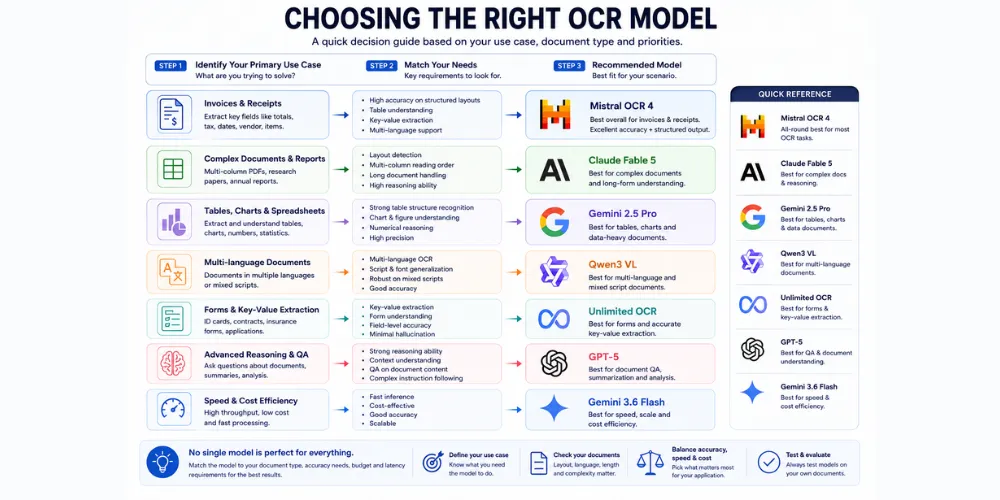
– Invoice extraction: Mistral OCR 4 or PaddleOCR VL, since both handle structured fields and tables well at a reasonable cost
– Medical documents: Claude Fable 5 or Gemini 2.5 Pro, since messy handwriting and high stakes context both call for stronger general reasoning
– Legal documents: Gemini 2.5 Pro for very long contracts or Claude Fable 5 when interpretation and nuance matter as much as extraction
– Banking: Mistral OCR 4, since self managed deployment and compliance features are usually non negotiable in this sector
– Enterprise search: PaddleOCR VL or Qwen3 VL for cost efficient reading at scale
– Research papers: GOT OCR 2.0 for formula and chart heavy papers or Qwen3 VL when broader reasoning is also needed
– Receipts: PaddleOCR VL or DeepSeek OCR, given the high volume, standard layouts and low cost per page
– ID cards: Mistral OCR 4 or Gemini 2.5 Pro, both of which handle small, structured, high stakes fields reliably
– Forms: Mistral OCR 4 for enterprise forms or Surya 2 for lightweight, multilingual form digitizing
– Large scale OCR: PaddleOCR VL or Surya 2, since both are built for throughput on modest hardware
– AI agents: Claude Fable 5 or Qwen3 VL, since agent style workflows benefit from reasoning about what to extract, not just how
– Retrieval pipelines: PaddleOCR VL for efficient ingestion or DeepSeek OCR as a strong lower cost alternative
Where OCR Is Headed
The line between OCR and full document understanding is disappearing. The next wave of systems will not be judged on character level accuracy alone, since that problem is largely solved for printed text, but on how well they reason about a document's meaning and act on it.
OCR and vision language models are converging into a single category. Purpose-built OCR models are gaining general reasoning ability, while general vision language models are getting better at document specific tasks and the line between the two will keep blurring.
Document AI is also expanding beyond simple extraction into ongoing monitoring, flagging anomalies in extracted invoices, cross checking extracted fields against other systems and routing exceptions to a person automatically.
Agentic OCR is probably the most significant near term shift. Instead of following a fixed extraction template, an agent can decide what to extract based on the task at hand, re-read a document if the first pass looks wrong and chain extraction together with actions like updating a database or drafting a reply.
Multimodal reasoning and full document understanding also mean fewer fragile, multi stage pipelines. A single model call is increasingly replacing what used to require separate detection, recognition and cleanup steps stitched together by hand.
The overall direction is clear. OCR is moving from a tool that simply reads what is on a page toward a system that reads, understands, checks and acts on a document with very little human written rule in between. Getting the reading layer right, as covered in this guide, is the foundation everything else in that stack depends on.
Conclusion
OCR technology is no longer just about recognizing text—it has become the foundation of intelligent document understanding. As businesses increasingly automate invoices, contracts, identity documents, healthcare records, financial statements and compliance workflows, selecting the right OCR model becomes a strategic decision that directly impacts efficiency, accuracy and operational costs.
At AI India Innovations, we help organizations move beyond off-the-shelf OCR by developing customized AI-powered OCR and Document AI solutions tailored to specific business requirements. Whether you need multilingual document processing, invoice automation, ID verification, handwritten text recognition, table extraction or fully on-premise OCR deployments, our team builds scalable enterprise solutions that integrate seamlessly with your existing systems. If you're looking to modernize document workflows with AI, our OCR solutions are designed to deliver high accuracy, security and long-term business value.