Unified Vision Models:
Why "One Model for Everything" Might Be the Next Big Shift in Computer Vision
Introduction
Unified Vision Models could fundamentally change the way Artificial Intelligence understands images and videos. For years, computer vision has relied on a collection of specialized AI models - one for object detection, another for segmentation, another for OCR, another for depth estimation and so on. While this approach has delivered impressive results, it has also made AI systems increasingly complex to build, maintain and scale.
A recent research direction proposes something different: instead of using many separate models, why not use one model capable of handling almost every vision task through natural language instructions? Researchers behind SenseNova-Vision believe this could be the next major leap in computer vision by treating vision tasks as a generation problem rather than a collection of isolated AI pipelines.
If this approach continues to mature, it could simplify enterprise AI systems and make computer vision far more flexible than it is today.
The Problem with Traditional Computer Vision
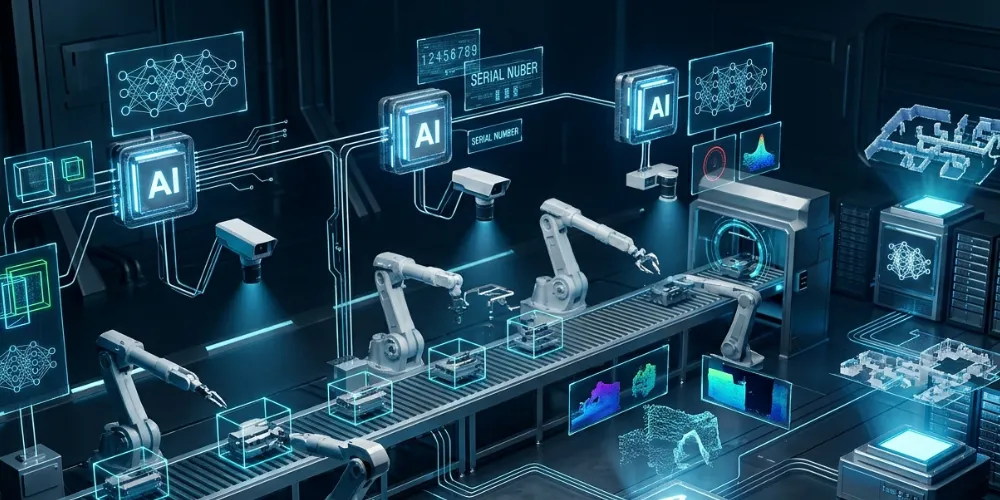
Today's AI vision systems are incredibly powerful - but they're also fragmented.
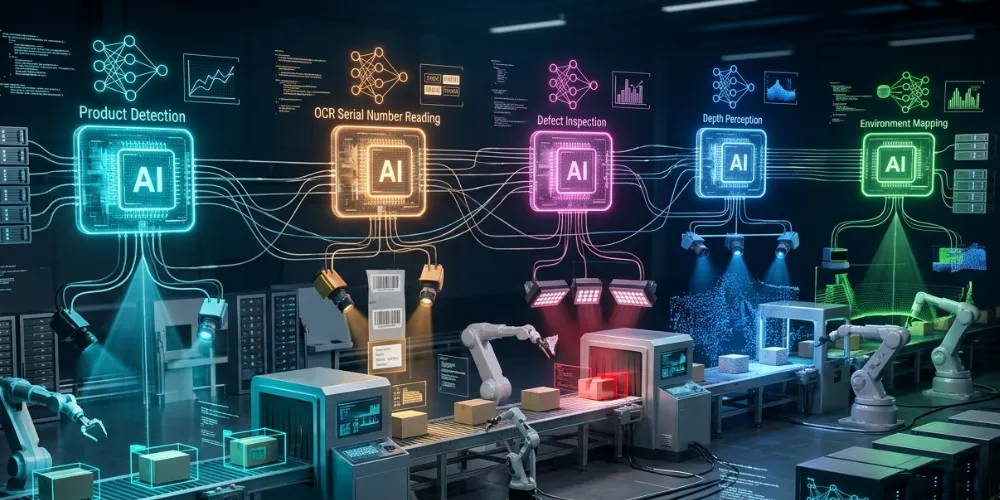
Imagine building a smart factory inspection system.
You may need:
- One AI model to detect products.
- Another way to read serial numbers (OCR).
- Another to identify defects.
- Another to estimate depth.
- Another way to understand the factory layout.
Each model has:
- Different training datasets
- Different architectures
- Different maintenance requirements
- Different deployment pipelines
As more capabilities are added, the AI system becomes increasingly difficult to manage.
This complexity isn't just a technical challenge - it also increases development time, infrastructure costs and long-term maintenance.
Why the Specialist Model Approach Has Limits
Traditional computer vision models excel at individual tasks, but combining them into one application introduces several challenges.
Some of the biggest limitations include:
- Training data doesn't transfer in tasks because every dataset has a different format.
- Adding a new capability often requires building and training an entirely new model.
- Individual models cannot naturally share reasoning or context with one another.
- Systems struggle to handle flexible, language-driven instructions without retraining.
For businesses building AI products, this means more engineering effort every time a new requirement appears.
What Are Unified Vision Models?
Unified Vision Models take a completely different approach.
Instead of assigning one model to each task, they use a single multimodal AI model capable of performing multiple vision tasks simply by changing the instruction.
Think of it like ChatGPT.
You don't open one model for translation, another for summarization and another for coding.
You ask one model different questions.
Unified Vision Models attempt to do something similar for images.
Rather than switching between separate AI models, users simply instruct the model to:
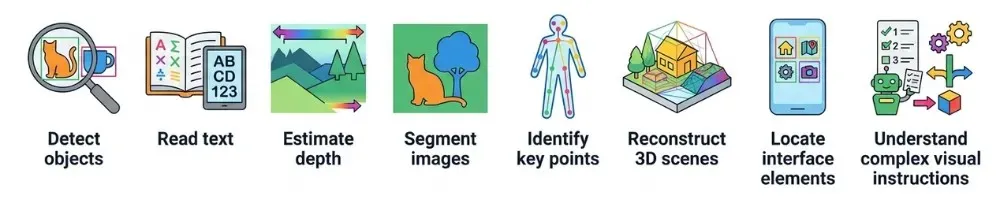
- all using the same underlying system.
What Can SenseNova-Vision Actually Do?
According to the research, SenseNova-Vision supports an impressive range of computer vision tasks through one unified architecture, including:
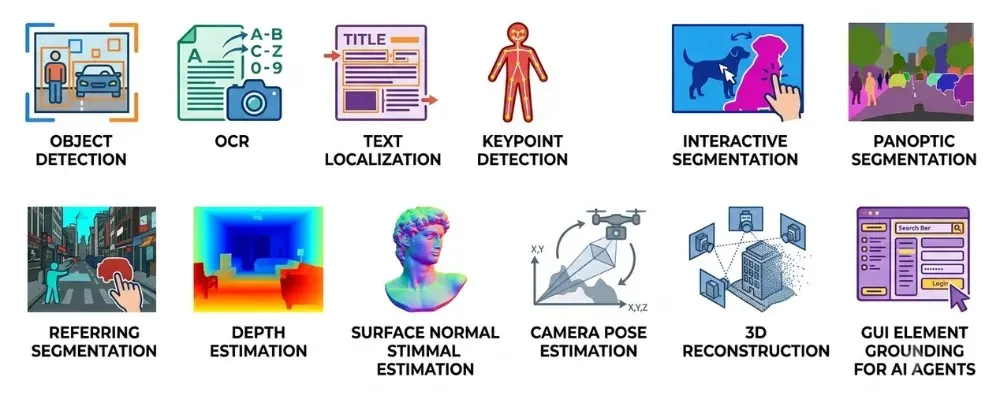
Perhaps even more interesting is its ability to understand language-based instructions such as:
"Segment the chair closest to the window."
or
"Detect only the green bottles."
without requiring a separate model or retraining.
Why This Matters for Businesses
Most enterprise AI applications don't require just one vision capability.
Consider an autonomous warehouse robot.
It might need to:
✔ Detect packages
✔ Read labels
✔ Measure distances
✔ Understand warehouse layouts
✔ Interact with touch screens
Today, this usually means combining multiple specialized AI models.
A unified vision model could simplify deployment by allowing one AI system to perform all these tasks together.
Potential benefits include:
✔ Lower engineering complexity
✔ Easier maintenance
✔ Faster development
✔ Better knowledge sharing between tasks
✔ More flexible AI applications
For businesses, that translates into reduced operational overhead and faster innovation.
How Unified Vision Models Work
One of the most interesting aspects of SenseNova-Vision is that it doesn't create a separate neural network for every task.
Instead, researchers fine-tuned an existing Unified Multimodal Model (Bagel) and taught it to interpret vision tasks through natural language instructions.
The architecture combines:
- A Vision Transformer (ViT) to understand images.
- A Variational Autoencoder (VAE) for image generation.
- A language model backbone that connects image understanding with text instructions.
Rather than task-specific "heads," one decoder produces different outputs depending on the request.
For example:
- Detection outputs structured text with object coordinates.
- Segmentation produces image masks.
- Depth estimation generates grayscale depth images.
- Complex tasks combine text and generated images together.
This unified design is what makes the model so versatile.
Does One Model Really Perform Well?
A natural concern is whether one model can compete with highly specialized systems.
According to the published benchmarks, SenseNova-Vision performs competitively across object detection, OCR, segmentation, depth estimation, keypoint detection and several other vision tasks.
While it doesn't outperform every specialist model in every benchmark, it consistently delivers strong performance across a wide variety of tasks using a single architecture - a notable achievement given the breadth of capabilities.
The Bigger Picture: Could Computer Vision Follow the Same Path as LLMs?
A few years ago, Natural Language Processing relied on separate systems for translation, summarization, question answering and text generation.
Then Large Language Models unified those tasks into one conversational interface.
The researchers argue that computer vision may now be heading in the same direction.
If that happens, future AI systems could become easier to train, simpler to integrate and more adaptable to new tasks through instructions rather than entirely new architectures.
For businesses building AI-powered products, this could dramatically reduce development complexity.
A Few Things to Keep in Mind
Like any emerging research, Unified Vision Models are promising - but they're not yet the industry standard.
Some important considerations include:
- Specialist models still outperform unified systems on certain benchmarks.
- Training unified models requires significant computational resources.
- SenseNova-Vision is currently a research project rather than a commercial product.
Even so, the underlying idea of treating computer vision as a unified generation problem represents an exciting direction for future AI development.
Why This Matters for AI India Innovations
As AI technologies evolve, businesses need partners who understand not only today's solutions but also tomorrow's innovations.
At AI India Innovations, we continuously track emerging AI research - from Generative AI and Large Language Models to Agentic AI, Computer Vision, Speech AI and multimodal systems - to help organizations adopt technologies that create real business value.
Whether you're building intelligent inspection systems, AI-powered automation, visual quality control, OCR solutions or custom computer vision applications, we design enterprise AI solutions tailored to your business objectives.
Conclusion
Unified Vision Models represent more than another improvement in computer vision - they signal a shift in how AI systems may be built in the future. Instead of stitching together multiple specialized models, organizations could eventually rely on one intelligent system capable of understanding images, generating visual outputs and following natural language instructions across a wide range of tasks. While the technology is still evolving, its potential to simplify AI development and unlock more adaptable applications makes it one of the most exciting trends to watch.
At AI India Innovations, we help businesses stay ahead of these advancements by turning cutting-edge AI research into practical solutions. From computer vision and AI agents to automation, multimodal AI and enterprise AI consulting, our team works closely with organizations to build intelligent systems that solve real-world business challenges. If you're exploring the future of AI, we're here to help you build it.