
Introduction
ai in voice is the spoken loop of speech recognition, language understanding or orchestration, and speech output. For production use, the practical task is simple: make each turn clear, measurable, and easy to control, then add fallbacks before you expand the scope.
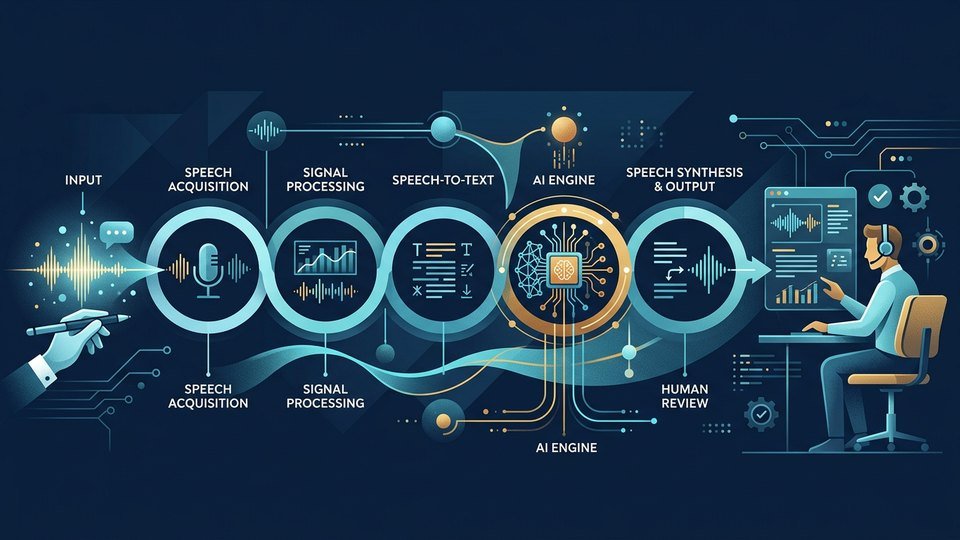
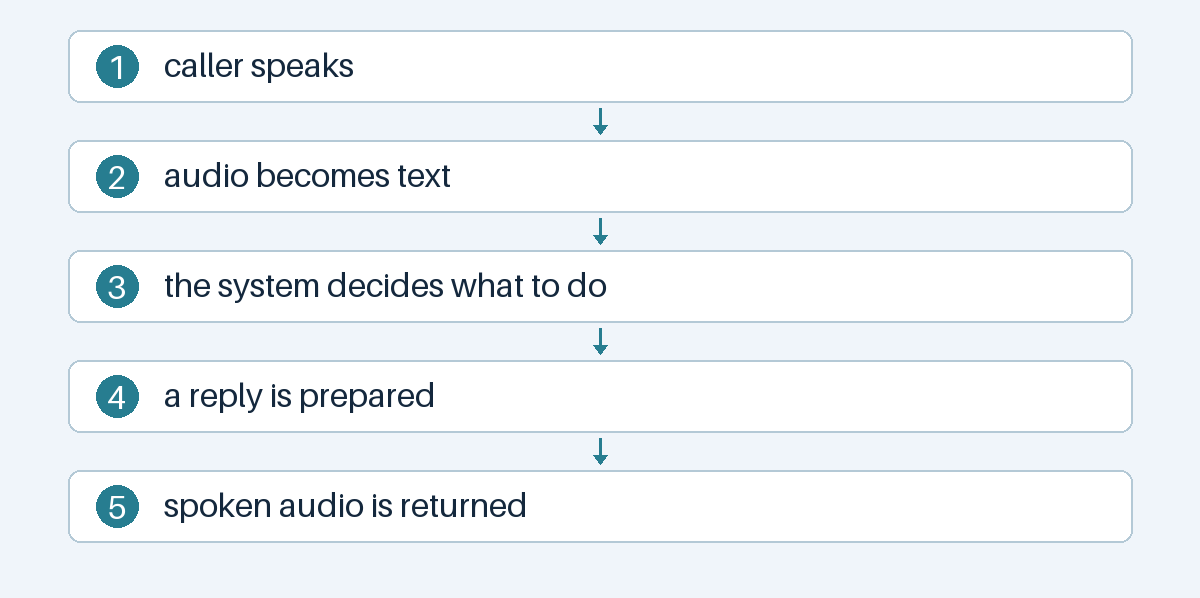
A simple way to think about ai in voice is as one repeated turn. Audio comes in. Speech recognition turns it into text. An orchestration layer decides what should happen next. Speech output returns the reply. In real-time systems, some steps may overlap to reduce waiting time. Telnyx describes this as the full audio path from caller to reply, and IBM places AI voice in uses such as virtual assistants and IVR systems.[^telnyx][^ibm]
That basic loop is well supported by the supplied evidence. Many other details depend on your stack, your channel, and your rules. So this guide stays practical. It focuses on what to map, what to measure, and what to test before you call a design production-ready.
Sources: How does AI voice work? ASR, LLM and TTS explained, What is AI voice?.
Why ai in voice needs careful production design
The hard part of ai in voice is not the label on one model. It is the full call path. A caller only hears the result: a pause, an interruption, a useful answer, or a dead end.
The supplied evidence supports a narrow but useful core:
- AI voice covers the loop from speech recognition to spoken reply.[^telnyx]
- A turn can include speech recognition, language understanding, orchestration, and text-to-speech.[^telnyx2]
- Real-time systems may overlap some steps.[^telnyx3]
- AI voice is used in contexts such as virtual assistants, IVR, and customer service.[^ibm][^connex]
Everything beyond that should be treated as design work, not as a guaranteed product outcome. That means you should measure your own system instead of relying on broad claims.
ai in voice and the latency budget
A practical starting metric for ai in voice is the time from the caller’s last word to the first audio in reply. This is easy to explain and easy to compare across tests.
Then break that single measure into smaller parts:
This does not assume any vendor result. It gives you a repeatable test method.
Accuracy checks on real calls
The evidence mentions customer service and IVR use cases, but it does not prove performance on your calls. For that reason, test conditions should match your own traffic.
Useful slices include:
- accent or dialect groups relevant to your callers
- quiet versus noisy audio
- different telephony paths or codecs used in your environment
- mixed-language or code-switched speech if your calls include it
- domain terms that matter to your business
If one slice fails often, the average result can hide it. Review by segment, not only in aggregate.
Control and fallback planning
The sources support the broad loop of ASR, language understanding, orchestration, and TTS. They do not prove that any given system will handle every live scenario well. So add control points in your own design.
For example, define in advance:
- when the system can answer directly
- when it should ask a clarifying question
- when it should retry or re-prompt
- when it should hand off to a human or another channel
That kind of rule set is practical advice, not a claim that all enterprise systems already work this way.
Engineering approach for ai in voice
A good ai in voice design starts with a small scope and a visible turn flow. Keep the loop simple first. Add retrieval, tools, or more open replies only after the base path is measured.
Start with the turn, not the feature list
Map one turn in plain language:
This basic map matches the evidence and keeps the design grounded.[^telnyx][^telnyx2]
From there, decide which parts are fixed and which parts are flexible.
Deterministic steps versus open replies
A comparison table helps here.
Use the least open design that still solves the task. That reduces review time and makes failures easier to diagnose.
Orchestration as the control layer
The evidence names orchestration as part of the loop.[^telnyx2][^telnyx3] In practice, that means one layer should decide what happens next after each turn.
A simple orchestration design can track:
- the latest transcript
- the current task step
- whether more input is needed
- whether a lookup or external action is allowed
- whether the call should transfer
You do not need to describe this as a universal industry rule. Treat it as a practical way to keep behavior consistent.
Retrieval and tool use
If your ai in voice flow uses retrieval or external tools, document each dependency before rollout.
At minimum, record:
- what data source is being queried
- what can trigger that query
- how long you will wait for a response
- what the caller hears if it times out
This replaces unsupported claims with an operational checklist.
How ai in voice works end to end
ai in voice works as a conversational loop. The caller speaks, the system processes that speech, and the system returns spoken output. The exact stack can vary, but the same high-level stages appear in the supplied sources.[^telnyx][^telnyx2]
ai in voice signal flow
1. Call ingress
Accept the call or audio session and start the media stream. Confirm the format you expect to receive. Log basic session events so you can review failures later.
2. Speech recognition
Convert incoming speech to text. If your stack supports streaming or interim text, test whether earlier text helps your turn timing. Telnyx notes that real-time systems may overlap stages, which is why this test matters.[^telnyx3]
3. Orchestration
Pass text into the decision layer. The job here is to determine the next action. That may be a direct reply, a clarifying question, a retrieval step, or a transfer.
4. Retrieval or external action
If a turn needs outside data, call the source you selected for that task. Set a timeout and write the fallback copy in advance.
5. Speech output
Turn the reply into audio and return it to the caller. Test how the system behaves if the caller starts talking before playback finishes.
Workflow details
- Map
- Measure
- Test
- Limit
- Pilot
What to measure at each stage
Sources: How does AI voice work? ASR, LLM and TTS explained, AI Voice Technology: The Complete Guide for Customer Service Leaders.
Architecture choices for ai in voice
There is no single best ai in voice pattern for every use case. The right choice depends on how broad the caller requests are, how much variation you expect, and how much review you need before acting.
Channel choice
IBM places AI voice in areas such as IVR and virtual assistants.[^ibm] If your project can run on more than one audio channel, compare them with the same script and test set.
Do not assume one channel will always behave better. Measure:
- transcript quality
- time to first reply audio
- caller interruptions
- transfer rate
- task completion by scenario
Hosting choice
The supplied evidence does not prove that one hosting model is always faster or safer. So compare options against your own needs.
Use a scorecard. Include latency, logs, access control, debugging depth, and rollback steps.
Limits of ai in voice
ai in voice is useful, but it has clear limits.
First, speech input is only as good as the audio path and recognition result. If the transcript is weak, later steps may also be weak. Second, broad generative replies can drift away from the source material unless you restrict them. Third, external systems can delay the turn even when speech recognition is working well.
These are not vendor-specific claims. They are practical limits you should plan around.
Use simple guardrails:
- set retry rules for unclear input
- ask clarifying questions before acting on weak transcripts
- set timeouts for lookups and tool calls
- keep fallback copy ready for slow or failed external steps
- route to a human when the task leaves the tested scope
A safe design does not force automation where it is a poor fit.
Practical rollout plan for ai in voice
A staged rollout is the easiest way to learn what your ai in voice system can really do.
Start with one workflow. Keep the target narrow. Good first candidates are tasks with repeatable prompts and clear success criteria.
Build the rollout in five passes:
- define the start and end state for the task
- map every turn and branch
- instrument timing and outcomes
- test with recorded or simulated scenarios
- pilot with a limited audience
For review, keep a short scorecard:
Metrics like containment rate, handle time, and cost per contact can be useful if they match your operation. The key point is to define them clearly and collect them the same way across tests.
Conclusion
ai in voice is easiest to evaluate when you keep the design concrete. Map the turn. Measure the pause from last word to first reply audio. Test the same task across real call conditions. Add retrieval, tools, and broader replies only after the base loop is stable.
That approach will give architects and operators a clearer basis for comparing stacks, channels, and rollout choices than broad marketing claims.
Discuss your project with AI India Innovations.
Sources: How does AI voice work? ASR, LLM and TTS explained, What is AI voice?.
Workflow at a glance
- caller speaks
- audio becomes text
- the system decides what to do
- a reply is prepared
- spoken audio is returned
Frequently Asked Questions
What components are required for ai in voice?
A basic ai in voice setup needs speech recognition, a decision layer that interprets or routes the text, and speech output. The Telnyx source describes this as the conversational loop from speech recognition to text-to-speech, with orchestration in the middle.[^telnyx][^telnyx2]
How should teams measure ai in voice latency?
Start with one measure: the time from the caller’s last word to the first audio in reply. Then split it into speech recognition delay, orchestration time, any retrieval or tool time, and speech output start time. This helps you find the slow part instead of guessing.
When should ai in voice use fixed flows instead of broader generation?
Use fixed flows when the task is narrow, heavily scripted, or easy to express as a small set of choices. Use broader generation only where variation is useful and the reply can still be checked against approved content or a clear fallback path.
[^telnyx]: How does AI voice work? The audio path from caller to reply
[^telnyx2]: Telnyx shows the turn stages as audio capture, speech recognition, language understanding, orchestration, and text-to-speech in the supplied evidence.
[^telnyx3]: Telnyx states that real-time systems can overlap some steps in the loop in the supplied evidence.
[^ibm]: What is AI voice?
[^connex]: AI Voice Technology: The Complete Guide for Customer Service Leaders